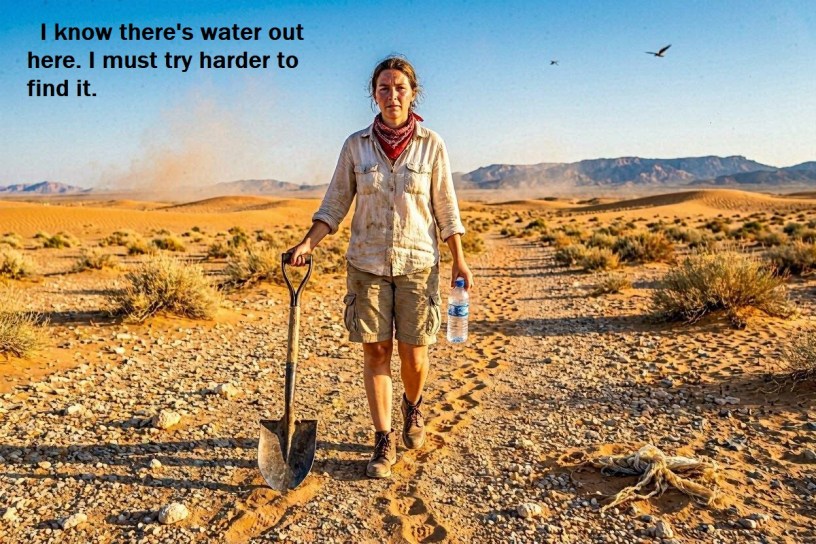
In all sincerity, I get why people embrace belief systems centred on elusive deities and spirits they can mould into whatever meets their emotional needs at that moment. I’ve been there – hence this post, originally written in a hurry and edited later, to explore more avenues.
Let’s start, counterintuitively, with the following conclusions:
- The universe, or a deity, or a spirit does not intervene despite heartfelt prayers and invocations;
- There is no such thing as divine justice;
- Forgiveness, good faith and love have no impact on material reality;
- Hope and resilience can be detrimental;
- Projecting certain qualities (such as empathy or morals) onto others, despite evidence to the contrary, can be very dangerous.
Why do so many people believe that thoughts and feelings can directly affect material reality?
For some, it’s as simple as their religious and cultural background; appealing to the supernatural is a reflex. Others are much too comfortable and end up believing they can manifest their future, without realising that if manifestation worked, there would be no suffering.
Equally, many people are drawn to this framework in a moment of crisis – prolonged uncertainty (the need for certainty and a clear direction), intense emotions (such as grief, fear, distress), the need for justice, the need for their suffering to have meaning, identity instability (the need to find oneself), loneliness (the need for community), the lack of psychological literacy (when spiritual phenomena are thought to explain uncanny behaviour) and last but not least, powerlessness (the need to feel protected and influence things that are out of their control).
Life is governed by learned behavioural patterns, battling shortcomings, hopes, fears, unconscious impulses, unfulfilled needs and crises. The world is confusing and often scary. Malignancy feels less disempowering if we believe there’s a universal system in place to impose justice and restore the balance, either in this life or an afterlife we want to think exists.
Finding refuge in unfalsifiable narratives (deities, aliens, supernatural forces) may be temporarily comforting. It may provide meaning by attributing the cause of human suffering (nature, hazard, oneself or other humans) to a divine plan, painting suffering as part of a broader narrative, serving a purpose.
It may also alienate someone from concrete solutions.
When people allow belief or speculation to overtake reality, it can even impair their survival instinct (Jonestown is one example), or their reason and empathy, causing them to harm themselves or others, waiting to be proven correct in some cataclysmic divine intervention. Hence the famous story:
A man is trapped on the roof of his house during a flood.
A neighbour in a rowboat comes by — he refuses, saying “God will save me.”
A rescue team in a motorboat arrives — he refuses again.
A helicopter lowers a rope — he still refuses.
He drowns, reaches heaven, and asks God why he didn’t help.
God says: “I sent you a rowboat, a motorboat, and a helicopter.”
The thought that the universe is sentient and cares about the welfare of every single human being should be outright implausible: nothing makes 200 people simultaneously killed by a volcanic eruption, earthquake, flood, tsunami individually prone to that fate, apart from their location at that time. A country can’t pray away famine. There are many things that are simply out of an individual’s control, and regardless of the intensity of their thoughts and wishes, cannot change.
The test of such beliefs should be simple: if a principle applies or may apply to someone in my situation, then it should apply universally, particularly to people in more stringent situations, whose thoughts and feelings must be even more intense. If the universe or a deity notices my pain and intervenes, it would obviously intervene to save and help others who are absolutely desperate. And yet it doesn’t.
The focus of this post is on the illusion/ delusion of being able to influence or decode human behaviour using religiously inspired frameworks.
Manifestation and its immediate problems when it comes to human interaction
The concept, stupid as it is, may be attractive to those who wish to manifest nebulous issues such as success, a specific career, marriage and a family as a concept etc. As soon as we get into specifics, involving named individuals, things fall apart immediately.
Let’s say you’re involved in litigation with someone, both parties believing the law to be on their side. Let’s exclude criminal cases and victimisation, to avoid the moral issue of good and evil. Both parties strongly believe they are correct and seek to manifest an imminent victory. However, the result will depend on multiple factors (who interpreted the law correctly and whether those involved in the legal system are honest and competent). Both parties cannot manifest a win in this situation, even if they lack any malice.
Close relationships are even more of a conundrum: a partner seeks to manifest a lifelong future, while the other seeks a new sexual partner every weekend, or a threesome involving the partner who longs for marriage and stability. These visions are incompatible. One might say you can’t impose your will on someone else, but in this case, you shouldn’t be able to influence your boss or parole officer either.
Karma (the current popular meaning, not the original religious one); divine justice
If a shitty person ends up in trouble after having wronged you, it’s not because they wronged you specifically (unless you took action and it yielded results), but precisely because they are a shitty person, prone to wrongdoing. They may have messed with the wrong person or group. If you didn’t take action, someone else did – otherwise they would’ve gotten away with their behaviour.
Perhaps there was an accident or other occurrence likely to stem from their behaviour, but which hadn’t happened previously. Or perhaps it was hazard.

God or some other force didn’t punish them for harming you. Although the harm may have been intense, there are people who commit a disproportionate amount and die peacefully of natural causes, without having been held accountable. Jimmy Saville, Henry Kissinger and many other monsters. Whatever any human or institution might do to Netanyahu one day, it would not atone for millions displaced and hundreds of thousands of innocent people killed. When crimes reach a certain level, justice becomes impossible. One may reach for the afterlife justice for comfort – but let’s face it, this character “burning in hell for eternity” would still not redress anything and would not make survivors’ lives any better.
Knowing that psychopaths who commit atrocities do go unpunished and live out their lives in safety and comfort, one cannot expect every garden variety scoundrel to be punished by a higher power.
The emotional need to reject reality and logic
This is a common need after a traumatic event, at times caused by the fear of accepting what is, instead seeking an alternative explanation or solution. At times it’s so pressing that it pushes people into an erratic state, from which delusions can emerge.
One example would be relying on mediums to “communicate” with the dead, to assuage grief. There is no way to verify any of the following:
- That there is life after death and consciousness continues;
- That even if it does, the ability to communicate with said consciousness exists;
- That even if it exists, the person in front of you has it;
- That what the person transmits is not a product of their own mind, even if they sincerely believe they are gifted;
- That the person isn’t knowingly scamming you (through cold or hot reading).
Unless the medium is caught scamming, or confesses to it, no other facts can be established regarding the entire process, apart from the fact that you’re paying someone who makes extraordinary claims. The rest is based on belief and wishful thinking.
The event I’m about to describe has been mortifying for more than 15 years, and although so much time has elapsed, the emotional turmoil remains vivid. My aim is to provide an example of how easy it is, when overwhelmed and with the right background (religious or spiritual), for the mind to prefer unverifiable hypotheses to reason.
Long story short: the man I was raising a family with convinced me that he was dying of a heart condition, which he claimed to be certain of, despite refusing to see a doctor. The health concern was not unfounded, as he had been having pains for years, which he claimed at the time were becoming constant. It turned out later that he wanted me and our child out of the way, to pursue another relationship. Evidently, I begged him to go to the hospital. When he again refused and continued to smoke heavily and drink, since “doctors couldn’t help him anyway”, I reached out to his family. This was instrumental, as he claimed I had made up a crisis out of distress over the break up. They believed I had lost my mind. The poor man had no choice but to get rid of me. Curiously, nobody minded that his child was moving abroad permanently with a crazy person (because they didn’t actually care). But I digress.
In the two weeks between his decision and our departure, my mind was spinning, trying to find an explanation. Why would he self-destruct and reject any help? Why would he deny it to his family? If he was really resigned to dying in his mid 30s, it must’ve been be a supernatural occurrence. Some type of interference; a curse, or witchcraft. Growing up, I had heard many stories of suspected spells or curses, leading people to ill health or insanity. Fear drove me over the edge; I desperately wanted to help him and no one was listening. It didn’t help that we had been living in isolation, in the middle of nowhere, for a couple of years.
An online friend, who had tragically lost her husband to an illness, had a system she had learned from somewhere. There would be signs of this spiritual interference and everything in my environment needed interpreting, especially words or symbols on random items. She believed it and I believed it as well, as it “made sense” at the time. For instance, the man wore a hat with the word “spiral” on it (the brand, I assume). I took it to be significant, given his supposed self-destruction. In reality, he wasn’t spiralling at all; he was calm and calculating – and of course, it had nothing to do with the hat. Such is the power of meaning-making; innocuous objects became threats or codes. I moved abroad in a state of bewilderment, with his family smiling compassionately, one person telling me to “get my head sorted”. For the following months I would regularly panic, thinking he had died alone in that house. At times I would revert to looking for clues in my environment, from wall scratches that resembled letters to shampoo bottle labels. There had to be answers somewhere regarding the discombobulating event I had experienced.
As soon as he admitted having had another relationship, apologised and reunited with us (very much alive), my hypervigilance and meaning-making disappeared instantly. I would instead rationalise his claim as a health deterioration combined with the stress of making a difficult decision. There was no dread, despair or helplessness anymore, hence the need for otherworldly interpretations wasn’t there. It’s not that I had fully converted to a new way of seeing the world; I had used it temporarily, as a crutch, trying to make sense of things.
It was many years later that I accepted having been put through a gratuitous and sadistic lie. He had, in the meantime, self-diagnosed as a psychopath. When I reminded him of this period one day, he giggled “What an arsehole, eh?”, as if there was any humour to be found. While it was happening, although every data point indicated it, the thought of him lying about something so serious was unbearable, as it had many implications:
- Perhaps the whole relationship had been an illusion;
- I had shared intimacy of all types with a cold and cruel person;
- He didn’t care about his child;
- I was stupid and unable to see through his character despite living with him;
- He had sought to portray me as insane on purpose, to delegitimise anything else I might tell his family (his first wife had disclosed abuse);
- While knowing I was desperate to get him to seek medical help, to others, he had portrayed me as dangerous, as if I might harm him (I later found this particularly cruel).
My point with this story is that facts should always come first. No matter how you feel about them and what you might discover when trying to get to the truth. It’s much easier said than done when attachment is involved, but it would save so much trouble on this planet.
For instance, people become attached to the façade of a political figure, who they come to almost worship as a saviour (such as Trump) or to a so-called spiritual leader (in 99.9% of cases, a scam artist). If their emotional attachment reaches a certain point, and they embrace the person’s worldview as the truth, facts are outright rejected (the person’s demonstrable behaviour and history). People cling to any explanation that doesn’t involve letting go of the fantasy. This is how QAnon members persist in their belief that Trump was replaced by a clone or spiritually corrupted by the Covid vaccine: they refuse to accept that the version of Trump they imagined had never existed.
Compensating for ignorance with spiritual explanations
In a few posts, I elaborated on the use of demons as a means to dehumanise political opponents and other undesirables by the far-right. In my personal life, there was an opposite example – that of mistaking a psychological phenomenon for possession, given how it manifested.
A couple of years after the events described above, the same man (who by then I had two children with) continued to be extremely abusive. He had moved on to encouraging me to commit suicide, at times describing how he’d like to watch. The abuse escalated to physical, although rare and mild compared to later events. At times he would be in a rage, yet more often than not, he had a smirking, laughing, sadistic predisposition. He would be normal one minute, then, with no warning, transform into a completely different person. It always involved alcohol, which the behaviour would be blamed on the next day.
I was completely ignorant at the time (it took Lundy Bancroft’s book to see that he wasn’t a unique individual with unique quirks and traits, but was employing run of the mill abusive tactics). Delving into personality disorders took me even longer. I had never heard of NPD, let alone switching between self-states, as Prof. Sam Vaknin describes.
This person believed he was a psychopath (substantiated by a long criminal record for violence, prior to meeting me) yet displayed every narcissistic pattern under the sun: the idealisation-devaluation-discard-hoovering cycle, repeated for 16 years on a frequent basis, whether we lived together or interacted at all (progression from one phase to another usually originated from his mind, without a particular trigger). He would announce my new role, according to his phase in the cycle, when we were barely speaking. I became an outside observer of this pattern, that I had no influence over, even thought it involved me directly (his internal object of me, anyway).
The discard was a mise-en-scene: he would loudly proclaim he was leaving, on a regular basis, at times weekly (again with no particular trigger apart from a conflict he had created abruptly) and change his mind in the morning, without any intervention from me, when sobering up. At times he would pack his bags and ask me to put his things back into place the next day, highly amused. On it went, all those years. I was used to it. Then the envy, the paranoia, the contempt towards most people, the portrayal of himself as special even in his defects, the wildly successful business ventures that never got past the registration stage – I can go on all day.
He seems to have suffered from an unfortunate combination of psychopathy and NPD, namely a malignant narcissist, sadism (which he manifested often) being a good indicator. I noticed he would take things very far – threats of violence (even murder), manhandling etc. – and when he saw he had provoked a state of genuine fear, he would start laughing and wanted a hug.
At the time, given how he would switch from one state to another, for instance from amiable to sadistic and threatening and back to amiable again, like a light, it was like dealing with two different people (or entities). Possession crossed my mind a few times. I didn’t focus on it though, remembering the last experience.
The point of this anecdote is obvious – psychology provides long-studied explanations for seemingly aberrant, disturbing human behaviour. However eerie, there needn’t be something supernatural involved. However, if one is uneducated in this regard, they can default to interpretations they have learned in the past, through a religious upbringing. This can be very detrimental.
I’ve seen many channels linking NPD with demonic possession or an active desire to cause harm to victims of narcissistic abuse. The reality is much simpler – the harm is a mere product of the proximity to someone who has this disorder. It’s not planned or targeted; it’s random. It does feel personal, of course, depending on the nature of the relationship – except it isn’t. Realising that was liberating.
The duty to hold the family together
In many cases, this is passed down through culture and a strict religious upbringing, mandating that a woman should suffer a man’s behaviour and interpret his misbehaviour as a test of faith or spiritual interference. Commitment to the family unit is of the essence, even if the man is unfaithful.
My case was slightly different – it involved using religion to justify fulfilling a psychological need; that of keeping the family I had started together, seeing turbulent events as obstacles to be overcome, and forgiveness as a virtue. This need arose from not living with my family for most of my childhood, which gave rise to fantasies of future unity and endurance, as well as unconditional love. When realising the relationship was barely survivable (mentally and emotionally), I used religion as a crutch, although I had never had a strict religious background. At one point I believed my own bullshit to the extent that I supported anti-feminist views, as they served the purpose of helping me convince myself that what I was experiencing was not abuse. It was just “life”.
Generally, women whose interpretation of their relationship or marriage is always filtered through religion see staying as a duty, unless things become so extreme separation or outside intervention cannot be avoided.
I don’t blame women who cheat while being abused or treated like furniture (though they run the risk of being duped by another abusive “saviour”), although I never did, as adultery is against my principles. It was inequitable in a sense, since the person I was with had both cheated and regularly discussed women he would like to approach, when I thought I was not in a position to leave. Even planning on doing so would have felt like betraying my own principles.
Something to consider regarding an abuser’s family
Abusers poison the well before their partners or spouses are ready to disclose any mistreatment. Particularly if they have narcissistic traits. This is called a pre-emptive smear campaign.
If losing the trust or respect of the abuser’s family is a concern (perhaps you are otherwise isolated, or you genuinely value those people), and the thought of breaking away brings the inevitability of smears – what you fear has already happened and you have nothing further to lose. They may be nice to your face; chances are that at the first opportunity, they may turn on you and regurgitate years of smears and hatred, at times disguised as “concern” by the abuser to portray you as unstable.
You have nothing to fear, that hasn’t already happened, and nothing to lose.
Like many, I was of the opinion that causing a tear in our big beautiful family (Trump-related sarcasm intended) would lead to colder relationships between my children and their father’s side of the family, who pretended to be very fond of them for many years. My children were mere cute little features of their father’s current lifestyle, adding to his positive image at the time. They were not individuals with their own rights and feelings. Hence as soon as a painful truth came out, they were swiftly shunned for speaking to the police and giving evidence in court. The family went on to ignore the verdict and cover everything up.Their father’s image was the priority – as soon as they were not useful (quite the opposite) in that regard, they were chucked out, much like putting out the bin early in the morning.
I wish I had insisted years ago regarding his self-confessed dying hoax, which had pushed me into a state of psychosis, trying to find any explanation, other than the fact that he was lying – but I never dared. I never wanted to rock the boat. I knew at the back of my mind they still believed I was potentially crazy or unstable, ever since. Truth be told, they wouldn’t have cared, as anything he did without personally affecting them was water off a duck’s back; they were used to him being in unusual situations and harming people.
For me, the shame was overwhelming.
Giselle Pelicot said something iconic: shame belongs with the perpetrator, not with the victim. This applies across the board, but is often overlooked. People who use deception and malice to abuse and cover their tracks should be the only ones held responsible and shame should not keep the people they abused from speaking out.
It’s easier said than done, but do bite the bullet if it’s safe enough, instead of maintaining a façade for other people’s mental comfort. It’s not worth it.
The fearmongering against social workers
This is present across the board in religious communities and right wing or far-right environments. They parrot the following:
- The state wants to destroy the family unit;
- The state wants to take away parental rights in order to brainwash children;
- The state wants to de-convert children from religious beliefs, to make them atheistic;
- The state uses social workers to punish people for expressing their beliefs or views etc.
It is utter, unadulterated bullshit. I’ve got enough experience to say that, given that the aftermath of what happened to my family affected people in different ways and they required support.
I will never invalidate the experiences of those who have dealt with power-hungry bad apples; they exist; they exist in every profession. My experience with social workers is one of gratitude and lifelong appreciation; I will never forget anyone who was involved; for them it’s a job and they have seen thousands of cases, but for people undergoing difficult situations, these interactions will always be special. Families facing a crisis may find themselves isolated, and were it not for the safety net and advice provided by professionals, exiting those situations would prove far more difficult.
Abusers are known for creating fear around social work involvement. Mine was no different. “Without me, you’ll end up on the street and the state will take your kids”. It’s a very common experience. Fear and prejudice inculcated by religious groups, or by propaganda, create an impenetrable wall, aiding their strategy. It’s a poisonous combination that leads to fear of seeking help, inaction and remaining trapped.
Social workers do not intend to separate families; it’s absolutely a last resort. For one thing, it involves the local authority paying foster carers. This is only done in emergencies. If you happen to read this and you are in a difficult situation, please don’t fall for this lie.
When they say they’re there to help, they mean it.
Is forgiveness a virtue?
Forgiveness is a choice, ideally made from a place of safety; it helps someone make peace with past events and no longer be retraumatised by them. It serves a function. I’m still working on it, in terms of people I will likely never interact with again. It’s healthy if you just want to stop ruminating.
However, if someone remains in a toxic or dangerous environment, forgiveness ensures the continuation of the toxicity and danger. It doesn’t make them morally superior; it makes them temporarily blind to the reality they are experiencing. It’s a plaster on a gaping wound, as the harm will return. It is also (at times knowingly) permission to breathe, taking a break from stress and tension, while knowing peace won’t last forever (or even very long). Consciously living in a toxic environment for prolonged periods of time, believing you can’t get out, is extremely difficult.
Religion teaches people that endless patience and forgiveness are saintly qualities, disregarding the exposure to repeated suffering or painting it as building someone’s character. However, this is only portrayed as such in close relationships. If a scammer stole from you once, would you allow them to do it again? If a stranger kept leaving death threats in your voicemail, would you forgive each time and eventually engage peacefully with them? It’s a quagmire.
Choosing a quick fix may lead someone to avoid or delay seeking help. In contrast, one can forgive and at the same time decide it’s unsafe to be around someone, or for that someone to have control or influence over them, taking all necessary measures, including legal, to ensure safety. These things are not mutually exclusive. Simple minds interpret them that way.
Forgiveness alters your state of mind, not the reality of the other person. They may remain equally or more dangerous than before, while you, in a peaceful state of mind, underestimate the danger. Many women would still be alive today if they hadn’t agreed to go on that last trip, to that last meeting, to keep living with the person for a while etc.
This is all very complicated
I fully acknowledge the benefits religion can bring, and strong values such as valuing the truth, protecting the vulnerable, helping people in need, empathising, forgiving when possible, remaining loyal against one’s personal interest (when that is indeed the moral thing to do) etc.
Some couples may have the same religion, be faithful and loving for the entire duration of their relationships or marriages. Faith helps people in desperate situations to not give up, and no one can fault people for not examining it while under extreme pressure. It can absolutely be a beautiful thing, or a necessary crutch when facing injustice, in order to avoid despondency. It would be arrogant to judge people from a comfortable place.
I’m not downplaying the good aspects – just pointing some things out. My heart goes out to anyone who is dealing with dilemmas mentioned in this post. Please remember the following:
- It’s OK to tell the truth; telling the truth is never wrong (apart from extreme circumstances, like shielding people during a pogrom, or protecting others from oppression generally).
- You matter just as much as the person you may be trying to protect. You have equal rights.
- You matter (this is not an editing error). You do matter.
- There is help available. No organisation listed as intending to help you ever intends harm. And they do help you. One small step (an email, a phone call) can change your life for the better. To contact Women’s Aid : Home – Women’s Aid.

