While Netflix has a reputation for treating true crime poorly (half-fictionalised series using real cases for instance), this documentary needed to be made. If anything, the reactions to it prove that it’s a much needed discussion. There is so much ignorance regarding the pressure and distress undergone by vulnerable witnesses, through lengthy and complicated legal proceedings which may take years. People are very quick to judge thought processes, emotions, decisions, trauma and cognitive dissonance.
It’s an important conversation.
The title remains inadequate, as it suggests that upon finding out about the homicide, the witness was still considering marrying the killer, which was not the case.
One thing is certain: the internet now has another woman to chew, which it absolutely loves. This post seeks to chew it right back – or rather, to expand on why certain attitudes are so misguided.
What happened
Chronologically, the sequence of events begins with the disappearance of cancer survivor Tony Parsons, who on the 29th of September of 2017 was cycling for charity, from Fort William to his home. At night, he stopped at the Bridge of Orchy bar briefly, deciding to resume cycling to get to his destination. He proceeded on the A82, in rainy weather and with poor visibility, and was never seen or heard from alive again. After he was reported missing, extensive searches were conducted, yet no trace of him was found. His family remained in a state of uncertainty for the following three years.
In 2020, Dr. Carloline Muirhead, a young forensic pathologist from Glasgow, matched on Tinder with a Bridge of Orchy local, Alexander McKellar, known as Sandy. He was a farmer in his late 20s and had a twin brother named Robert; they lived on the Auch Estate and hunted regularly. Sandy was known for being particularly rowdy after a few drinks. Caroline drove to the estate and quickly formed a romance with Sandy, as she recovered from a long term relationship which had ended. Only months later, he proposed and announced their engagement online.
Shortly after, McKellar revealed a dark secret: a lethal car accident three years prior, when he, while driving intoxicated, had struck a cyclist when blinded by another car’s headlights. His brother was in the car with him. Upon realising he had hit a person, he had stopped the car and had found the severely injured cyclist, who was still alive. Panicking at the thought of severe consequences, he and his brother had moved the injured man off the road (so he couldn’t be spotted and helped by another driver, presumably) and had driven home, only to return later. They had taken the now deceased man home with them, wrapped him in a tarp and left him outside overnight. The next day, they had buried him in a kill pit (where animal carcases were discarded). Years had passed and no one had found out. This immediately pushed her into a state of confusion.
Weeks later, McKellar brought up the body again, telling her there was going to be development work on the land, namely the body would likely be dug up; the remains needed to be moved. He talked about ways of disposal, including burning. This made Caroline realise that Sandy’s cover-up was not a past issue, but ongoing, and he was asking for her cooperation. This made her spiral, as it meant becoming involved in a serious crime. She contacted the police, but they required more evidence. She tricked McKellar into revealing the exact location of the body and pressed a Red Bull can into the ground, so the police would know where to dig. At that point, she was determined to be done with him and thought protection would be in place.
The brothers were arrested on the 30th of December of 2020. However, there wasn’t enough evidence at that moment to charge them, hence they were released. They had to leave their home, where an extensive search was conducted, and work began to locate and remove the body from the ground – however, this was a slow and very careful process which would take weeks. The brothers in the meantime were free and in a state of paranoia, not knowing who had led investigators to them. Realising she would not be protected, Caroline pretended to be on their side and allowed them to stay at her apartment, where she made several recordings of them confessing to the crime. Regular drinking and drug use led to her mental state deteriorating further.
At one point, the police entered her home to find the brothers there, reprimanding her for letting them stay, with the mention that she was their star witness. No consideration was given to the hypothesis that to keep herself safe while they were still at large, she had not broken off the relationship. While Robert moved out, Sandy remained there for some time. At a different point, the media were allowed to include the detail of the Red Bull can in their reporting. Sandy, still at large, realised Caroline had reported him and became enraged, shouting and swearing on the phone and driving to her apartment. Anything could’ve happened.
At a later point, Caroline lived with the brothers on the Auch Estate for a period of time, continuing to use drugs and overuse alcohol. She was in a very poor mental state, yet she continued to gather evidence at the same time.
In January of 2021, Tony Parson’s remains were found and sent for examination. As they were to be examined at the hospital Caroline worked at, she was removed from her position, becoming increasingly isolated and dependent on substances. She spent the following two years with deteriorating mental health, in the grips of addiction. Her mother communicated with the police, asking for permission for her to speak to a professional, but this was denied, as it apparently risked endangering the case (in reality, denying her help endangered the case far more, as she was isolated and unable to cope). No consideration to her as a human being was given throughout this process.
The day she was meant to give evidence, in 2023, she was overtaken by distress and consumed alcohol and drugs. In a state of psychosis, fearing her testimony would not be believed, she went to the estate and attempted to find Mr Parson’s bike, which according to Robert had been discarded under a waterfall. As she would later recount, she wanted something more than her word to be used. This of course resulted in a warrant for her arrest, for contempt of court (not showing up to testify). She was located and arrested. Sandy pleaded guilty to culpable homicide and attempting to pervert the course of justice, while Robert pleaded guilty to attempting to pervert the course of justice by helping him.
The prosecution had been relying on Caroline’s testimony to support the murder charge, but given the state she was in (which had been preventable) they accepted the pleas. This highlights the importance of communicating with the witness and ensuring the witness is mentally able to give evidence, as citing them under the threat of arrest is not always a guarantee of things going well. It was stated multiple times during the documentary that she was a doctor, hence highly intelligent, hence expected to act logically and in her best interest at all times. This completely discounted the emotional impact of what she was going through, very oddly – when victims are involved, the prosecution takes emotional impact and mental health very seriously. For witnesses, apparently not so much (there is hope that this case might tweak things slightly).
Three years on, Caroline is now free of addiction and has found a new partner, getting her life back from this horrible experience. She sees her treatment by the police and justice system at the time as very poor and unsupportive, leading her to spiral repeatedly and make dangerous choices. She is far from alone in thinking that.
It was, of course, not the intention of anyone involved for things to go this wrong – yet they did, and it can happen to anybody. Procedure alone is sometimes not enough for someone to make the right choices or even know what they are, in complicated situations they deal with one day at a time. These may be very clear to outsiders, who are emotionally detached – but it won’t always make a difference.
Somewhere in the vicinity
In cases of domestic abuse, unlike other countries, the UK does not allow the victim to ask for charges to be dropped. There are good reasons for this, and it likely has helped people get out of dangerous situations sooner than they otherwise might have. In the US, for instance, one can “drop the charges”, even if it’s clear that a violent offence was committed, exposing oneself to more violence immediately after. In the UK, bail conditions are imposed, which mandate separation and forbid direct communication. This has surely allowed many victims to breathe, away from constant emotional turmoil, and think clearly about the future.
Is UK law better in that sense? Yes, absolutely. Does it always work, in terms of severing emotional ties with an abuser, reflecting on the relationship and abandoning it for good? Well, no. On average, leaving takes 7 attempts, one or more of which may well involve the justice system.
Other factors may be involved. Children with the abuser, dependence of all kinds, isolation (lacking a support network), not knowing where to seek support in order to better process the relationship and make better decisions – these can add up to someone feeling like they cannot exit, or don’t wish to do so. Then there’s the layer added by the abuse itself – self doubt, self blame, the need to fix things.
In those cases, pressure to give evidence may place the victim, temporarily, in an adversarial dynamic with the system; the victim may become a reluctant witness, interpreting normal procedures (objectively beneficial to her) as coercion. Someone in a vulnerable state can incur further trauma from this, strengthening their bond with the abuser instead of diminishing it. Reporting again after a situation like this is its own can of worms.
Again, the system is designed with the right intentions, yet psychologically and emotionally, due to personal circumstances and attachment, someone might not be ready to understand that.
Vox populi with a side of low IQ
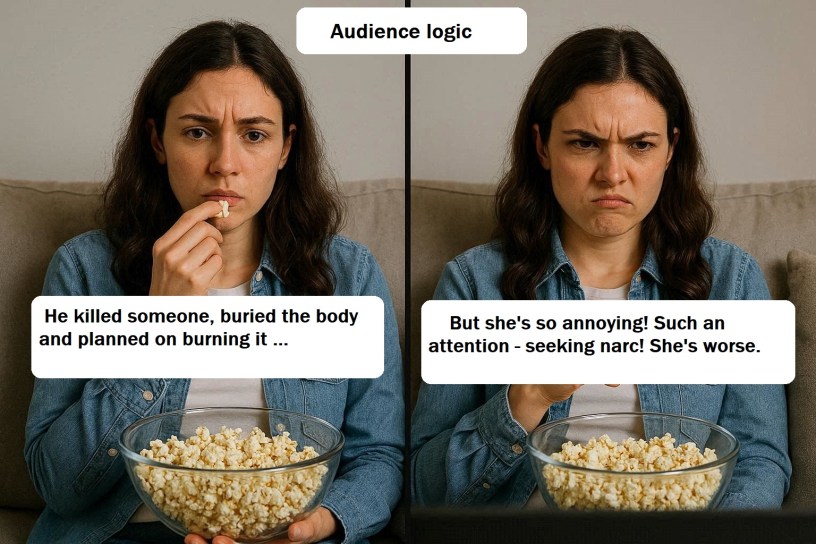
Reactions to the documentary were mixed. One would expect that to a certain point – however, the level of ignorance out there regarding the pressure put on vulnerable witnesses by lengthy court proceedings, as well as the romaticising or whitewashing of someone like Sandy, are astonishing. The sheer lack of empathy towards the victim and witness.
It appears that many treated this documentary the way they treat fiction, focusing on the male protagonist’s internal dynamics, which can only be speculated on based on his actions and confessions. And that is worrying.
When consuming fiction, the audience is trained to empathise more with the character being centred, regardless of the character’s actions. A murder victim can be a plot device, coldly mentioned on occasion as a side issue, and nothing more. The victim is not the protagonist, whose actions, backstory and real time behaviour occupy most of the screen time. The audience’s interpretation can be detached from reality (and from the way people would perceive events in their own lives).
Please marvel at the gems below.
None of the comments displayed here made any mention of Sandy’s intention to dig up the human remains and dispose of them in a manner leaving no trace, perhaps by burning them, turning Caroline into his accomplice. This would have been an entirely different (and very serious) crime. Somehow these people skip past it, turning the story into a romantic relationship involving Caroline’s betrayal.

Crime is a blanket term encompassing everything from pirating films and music to premeditated murder. Possession of illegal drugs is considered a crime. This commenter equates knowledge of someone having MDMA in the house to knowledge of a murder and buried body the family is actively looking for.
The “snitches get stitches, ha ha” attitude would not appear if this person’s loved one, heaven forbid, disappeared one day. She would want any possible information from any direction. She would want people to care. So would anybody.



Does Carlton have a basement? Just wondering.
This is by far not the only comment I’ve encountered describing the account of the accident and subsequent events as Sandy’s secret. As in it pertained to him; it was his, to hide or reveal as he thought appropriate, acting in his best interest, which is implicitly presented as moral and justified. In reality, it was the knowledge of a stranger’s fate and the location of a stranger’s body.
Carlton refers to possession and entitlement twice, both in relation to the secret and the female partner. Sandy was entitled to her silence. Caroline was supposed to belong to Sandy, just like the knowledge of the victim’s human remains.


The assumption that he loved her is bizarre. In fact, we are not told (and I’m not sure Caroline knows clearly) when Sandy found out there would be construction work on the land, hence he would need to dispose of the remains; was it before he started dating her? She speculates that her profession could be part of the reason he picked her in the first place. She was an expert on dead bodies. People love-bomb and propose marriage quickly for nefarious reasons; in fact it happens often.
Sandy did not “choose self-preservation” erratically. He chose to let a man die alone, then transported the body to his home, then chose a burial location, then went through with the burial. For months he watched frequent appeals for information on TV (even I remember them), remaining unmoved. He stayed silent for 3 years, then decided to finish the job so he would never be held responsible, and the family would never get answers. This is not a rash decision made in the heat of the moment. This is a series of calculated moves made over a few years.

Again, with the trust. His precious feelings. Any consideration for the victim’s family and their feelings? No; let’s prioritise the killer instead; he’s the main character.
Regarding any possibility of her keeping his secret – he had asked her to become an accomplice. Not only was remaining silent immoral; it put her in danger, as she now knew about the murder, the approximate location of the body and his plans. She had two choices: becoming an accomplice or turning him in.

He could have easily killed her if he suspected she would report him, without her having done so. She remained in danger of being disposed of in an unfortunate accident, until the brothers were arrested. When he discovered she had reported him, he was furious, but he remained with her as after all, she was a witness. There was the potential to convince her to lie or be inefficient, by messing with her head enough and pulling her into constant substance overuse.
I’ve seen the serial killer comparison repeatedly – perhaps because viewers consume series about them on Netflix. That is their bar now. Not a serial killer? Not Dahmer? He could be a decent person, regardless of his cold and grotesque actions. Regardless of his callousness towards human life. “He didn’t even blame her” suggests that perhaps he should have. Her actions were objectionable, not his.

Of course he was. He had a body to dispose of quickly and a forensic pathologist for a fiancée.
Blatant misogyny: his callous actions are softened by presumed emotional turmoil; her emotional turmoil is ridiculed and pathologised
Audiences (people in general) are trained to speculate into the backwoods on a man’s psychology and emotional landscape in order to explain his actions, should they be perceived as atrocious. A woman, in contrast, is scrutinised at all times for signs of being an unreliable narrator, a fabulist, an unstable person or a person driven by hidden motives to speak. Even when the facts speak for themselves. Perfection is expected from her, in terms of composure and conduct, in order for her to be believed.
People are actively (though perhaps subconsciously) looking for reasons to humanise the man and dehumanise the woman, regardless of context.
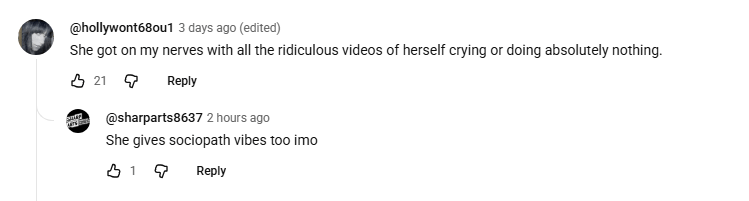


Sandy, while intoxicated, decided to pull the man he had hit with his car to the side of the road (so he couldn’t be spotted by other drivers) so he could die alone. Caroline, while intoxicated, filmed herself several times in an emotional state. Who was the criminal here? Who was the deranged and unsafe individual?
Not to mention they expect someone in the grips of addiction to make completely logical decisions. Someone whose life had been turned upside down (she even lost her job at the time) by a criminal case she simply had knowledge of. Years of her life were consumed by this case. Yet apparently “she wanted it” and “she got to be the star of her own show”.
Through the documentary, Caroline is raising crucial awareness about the immense stress and danger vulnerable witnesses have to deal with. So many will relate, having had distressing experiences (perhaps not as extreme) with the justice system. Would these same people commenting on their sofas, between a gulp of Pepsi and an arse scratch, claim Giselle Pelicot “wanted to be the star of her own show” by going public to raise awareness?

Caroline was recovering from a controlling relationship of 8 years. Yes, people in this situation are likely vulnerable. Yes, they might act out or be overactive on social media to gain self-confidence, hence the filming. Yes, they may jump into the wrong relationship. This is exactly when a predator strikes. When someone is already vulnerable.
“She was filming herself all the time; what a narcissist!”
If someone documents their experience (any experience) by journaling, no one finds it odd; it’s known as therapeutic, as well as helping people keep track of facts during stressful and confusing situations, especially if their mind is spiralling. If someone records their thoughts, feelings, moments etc. on camera, that is somehow seen as different, even if they keep those recordings to themselves for years.

“She helped them get away with murder”
Another camp seeking to condemn her takes issue with actions committed while in distress, most notably her decision to go looking for more physical evidence when she was supposed to be testifying in court. This was reframed by said camp as helping them.
They fail to understand the following:
- Had she not contacted the police, the body wouldn’t have been found at all;
- The evidence she gathered during the investigation was instrumental;
- She repeatedly asked for help and was denied, leaving her mental state to deteriorate;
- She was heavily addicted to substances and unable to think normally at the time.
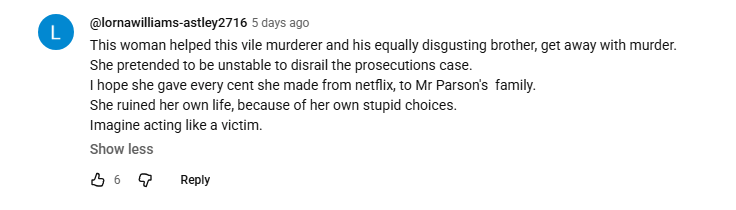
Lorna here likely never had to deal with the mindfuck of having to decide how to respond to a murderer released without charge, after having reported him. Caroline was on her own.
Even with all the documentation of Caroline having been unwell for so long, Lorna decides intentionality was present, as well as forethought – “she pretended to be unstable to derail the prosecution’s case”. Because, of course, women are devious and pretend to be suffering when they’re not. Mental breakdowns don’t exist. There was nothing stopping Caroline from continuing a relationship with McKellar after he was sent to prison, if she was so inclined. Some partners choose to do that. She didn’t. She sought help and got better.


It’s true that weeks passed between Sandy’s confession and Caroline reporting him. However, people feel free to act as if upon finding out (only by verbal admission) that someone has committed a crime, not to mention having no evidence to substantiate it, every single person would report it immediately. When she did report it, she was asked to find the location of the remains. Even after she did, they brothers were not immediately charged. People who see these situations as simple are ignorant.
Equally, again, had she distanced herself before reporting him, he could have harmed her to prevent her from talking, by staging an accident. The situation was incredibly messy. It’s one thing to discover someone has done something and another to be able to prove it – their verbal claim that they did, in the absence of concrete evidence, means little.
Intelligence is equated with 24/7 clarity on all aspects of life
People with degrees – yes, even doctors – continue to be human, affected by everything less educated folks are affected by: relationship issues, cognitive dissonance, confusion, fear etc. They are not machines. The public treats personal decisions made in a state of crisis with decisions made with a clear head.

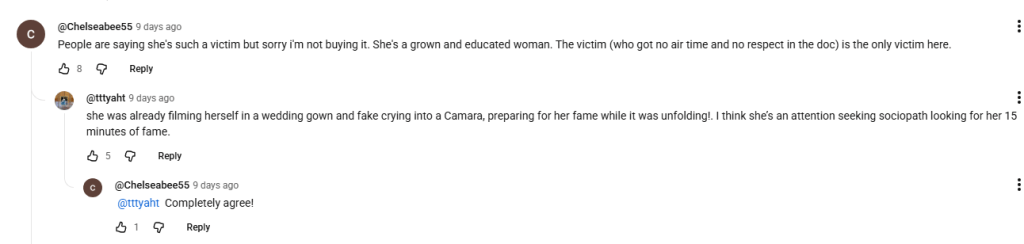
Curiously, some audience members think that because they watched a narration of a sequence of events in quick succession (a few hours) those events happened in quick succession. It took more than 3 years for this story to conclude. “Preparing for her fame”, they say. Caroline had no idea what was going to happen and things were taking a dramatic turn faster than a rollercoaster. Somehow it was all “planned”, because she’s a woman and women are devious.

As a side issue, given that many witch-burning participants have pointed out her focus on herself: the final cut of a documentary is only a fraction of what was recorded. No one knows what she spoke about and how long for. The interview was spliced and arranged according to other people’s choices.
Regarding doing it for herself – there are, I’m sure, many people who can relate. Perhaps their experience was less extreme – or perhaps it wasn’t. Who knows? This is a complicated issue and it needed broader awareness.

The commenter had the attention span to notice the arguments, yet failed to notice he was asking her to help him dispose of a body. The recordings occurred after she had reported him, by the way. I know it may come across as posting mindless drivel (and it is). But it proves a point. People see what they want to see. They omit crucial data or it doesn’t even register, since they only focus on the relationship aspect.

Today I watched a documentary centring two victims of rape while unconscious by their husbands. A comment mentioned the second victim’s account “seemed rehearsed” – I concluded the individual opined as such because she was calm and articulate. Perhaps the individual’s perception of women and these notions don’t meet.
Many evaluate female victims and witnesses based on how they personally think women should be and act. Any divergence from their preconceived stereotype gives untrustworthy. Therefore their account of events is untrustworthy as well.
In conclusion, men are judged on facts (even those are diluted, imbued with presumed emotions and minimised, however egregious); women are simply judged on “vibes”.
“Both the victim and the killer made a mistake”
Akin to McKellar, some opine that had Mr. Parsons not been there, McKellar’s life wouldn’t have been ruined by a prison sentence. Technically, that is true, if one removes all context and what followed.
Mr. Parsons’ mistake was cycling on a secluded road at night, with poor visibility.
Sandy McKellar’s mistake went as follows: driving drunk, hitting a cyclist, hiding the injured cyclist from view, leaving him to die, taking him to his home and placing him in a shed overnight, burying him in a pit used for animal carcasses the next day, watching his family’s appeals on TV for months, and finally, out of sheer necessity, trying to recruit someone to help him dispose of the remains again, ensuring the family would never find out what had happened.
In some people’s brains, these courses of action are comparable. They can be boiled down to this nebulous term, “mistake”, and somehow equated.
This is how we circle back to the main issue: their need to defend and even romanticise McKellar, the male archetype with a tragic fate, whom this incident “happened to”, omitting his three year series of choices (of which continued silence was one). The victim and witness are quite often subjected to harsher judgement.

