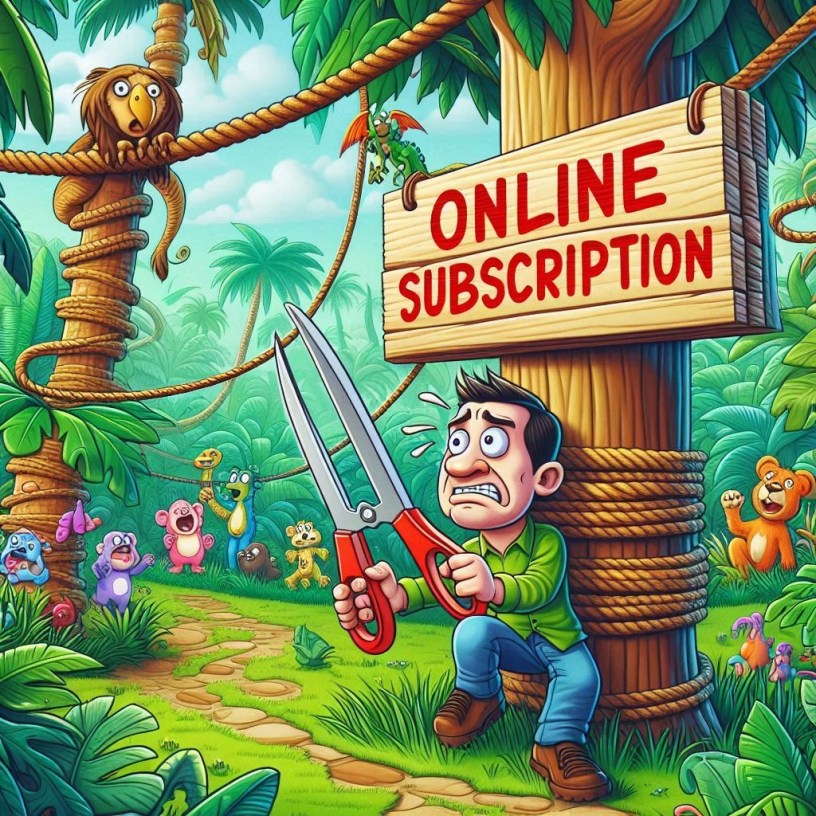
A 2024 report by the International Consumer Protection and Enforcement Network (ICPEN) lists a series of harmful practices used by subscription services, causing consumers to make decisions that are “often not in their best interest”. It concludes that this is a serious concern to be tackled internationally.
According to the report, 75.7% of subscription services use at least one dark pattern, and 66.8% use two or more. Only a measly 24% did not use any when examined.
The most common are as follows (you have surely come across all of them):
- Roach Motel
Easy to sign up, but deliberately hard to leave. - Nagging
Repeated prompts or interruptions pushing users toward subscription upgrades or continued use. - Obstruction
- Making cancellation or account deletion unnecessarily difficult (e.g., hidden buttons, multiple steps).
- Sneaking
Adding extra costs or features without clear disclosure (e.g., pre-ticked boxes, hidden fees). - Forced Continuity
Free trials that automatically convert into paid subscriptions without clear reminders or easy opt-out. - Misdirection
Designing interfaces that confuse users into making unintended choices (e.g., misleading button labels). - Confirmshaming
- Using guilt-inducing language to discourage cancellation (“Are you sure you want to miss out?”).
- Dead End Support
- Support that refuses to escalate or call — forcing users into public complaints
- Information Hiding
- Refusing to provide the customer with information such as how many accounts they have, their personal details retained, the status of their accounts etc.
BetterHelp’s subscription model is known to employ a variety of dark patterns, in addition to other deceptive practices, such as gaming review sites by flooding them with fake positive reviews, deceptive advertising by third parties (masked as unbiased testimonials from genuine users) and so forth. Here is a quick listing of the company’s use of dark patterns:
Dark Patterns in BetterHelp’s Model
- Obstruction
- Definition: Making tasks unnecessarily difficult.
- BetterHelp example: Cancellation is hidden under multiple menus, with confusing options like “pause” or “switch therapist” presented more prominently than “cancel.” Two steps are required, one by the user and one by staff, in order for an account to be supposedly terminated.
- Impact: Users waste time and often give up, staying subscribed longer.
- Nagging
- Definition: Repeated prompts that interrupt or pressure.
- BetterHelp example: Frequent reminders to “message your therapist” or “upgrade to live sessions,” even if the user prefers not to. Excessive promotional emails from the company and third parties on its behalf, including after cancellation.
- Impact: Creates pressure to engage or spend more, rather than respecting user choice.
- Sneaking
- Definition: Adding costs/features without clear disclosure.
- BetterHelp example: Free trials or promotional discounts that silently convert into full billing; unclear pricing differences between weekly vs. monthly plans. No invoices or warnings before a payment is taken.
- Impact: Users discover charges only after their card is billed.
4. Forced Continuity
- Definition: Free trials that auto‑renew without clear reminders.
- BetterHelp example: “First week free” offers that automatically roll into paid subscriptions unless cancelled in advance. Continued billing of inactive accounts, without contacting the user or stopping the payments.
- Impact: Users feel tricked into paying for services they didn’t intend to keep.
- Misdirection
- Definition: Interface design that confuses or misleads.
- BetterHelp example: During cancellation, “pause subscription” or “switch therapist” buttons are highlighted, while “cancel” is less visible.
- Impact: Users may click the wrong option, unintentionally staying subscribed.
- Confirmshaming
- Definition: Guilt‑inducing language discouraging exit.
- BetterHelp example: Prompts like “Are you sure you want to lose access to support?” or “Don’t miss out on progress with your therapist.”
- Impact: Emotional manipulation makes users feel guilty for canceling.
- Roach Motel
- Definition: Easy to enter, hard to leave.
- BetterHelp example: Sign‑up is quick and seamless; cancellation is obstructive, hidden, and psychologically manipulative.
- Impact: Maximizes retention and billing, even at the expense of user autonomy.
The (very stressful) problems users experience are not accidental; they are by design, namely the company disregards the effect of its practices on users’ lives. While this is always wrong, regardless of niche, it is far more unethical when targeting people suffering from psychological and emotional issues, particularly with the pretence of a more affordable service. BetterHelp targets the most vulnerable type of user in existence.
Further proof that these so-called accidents are by design consists of the company receiving the same complaints over many years and not fixing the root causes, instead choosing to give complainants the run-around, unless they escalate through third parties, to the point that they become impossible to ignore. Only then is their personal issue sorted out – no matter how serious it is to begin with (such as accidental reactivation and recurring payments that need to be stopped asap).
Accidental reactivation – how this happens
Many complaints describe users having cancelled the paid subscription and at times having requested the deletion of their account (implicitly, their information) from the platform. Months or even years later, former users discover monthly charges from BetterHelp, after not having interacted with the platform at all since cancellation. As per usual, this happens with no warning, no bill, no invoice. Silently.
Theoretically, especially after having the account “deleted”, this shouldn’t be possible – yet it is a common enough experience. Moreover, after a former user complains to the BBB for instance, their issue is resolved by “working internally” – an admission that data was in fact being retained and was able to be accessed by staff. With a bit of help from Copilot:
How “working internally” is possible after “deletion”
• Front‑end vs. back‑end data: when BetterHelp tells users their account is “deleted,” that usually means the front‑end profile and access credentials are removed.
• But the billing record (payment token, subscription ID) often remains in the back‑end system, tied to the payment processor (Stripe, PayPal, card networks).
• That’s why staff can “work internally” — they still have access to billing infrastructure even if the user’s profile is gone.
Soft deletion vs. hard deletion: many companies use “soft deletion,” where data is hidden from the user but retained for compliance, accounting, or fraud prevention. This allows them to reverse or adjust billing even after telling the customer their account is “deleted.”
Why charges restart after cancellation
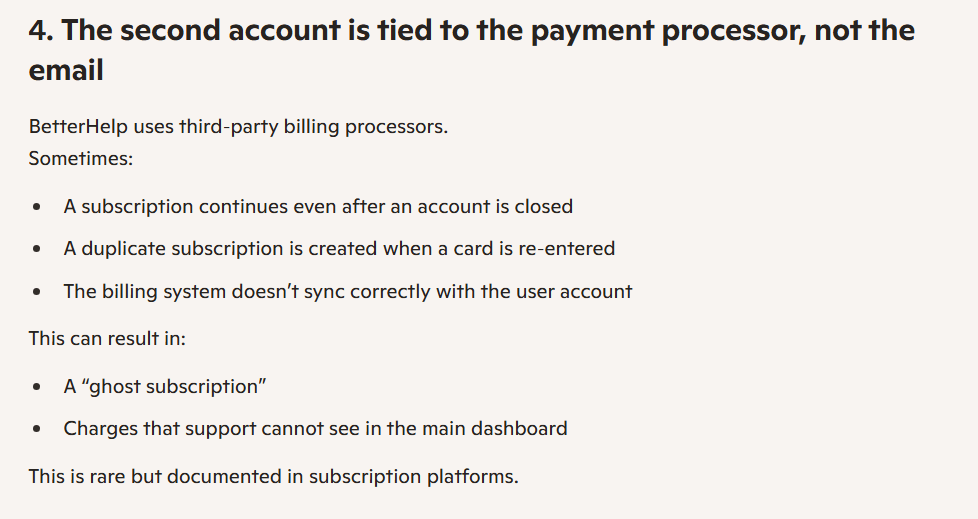
• Payment processor errors: Sometimes cancellation requests don’t fully propagate to the card network, leaving a “ghost subscription” that reactivates later.
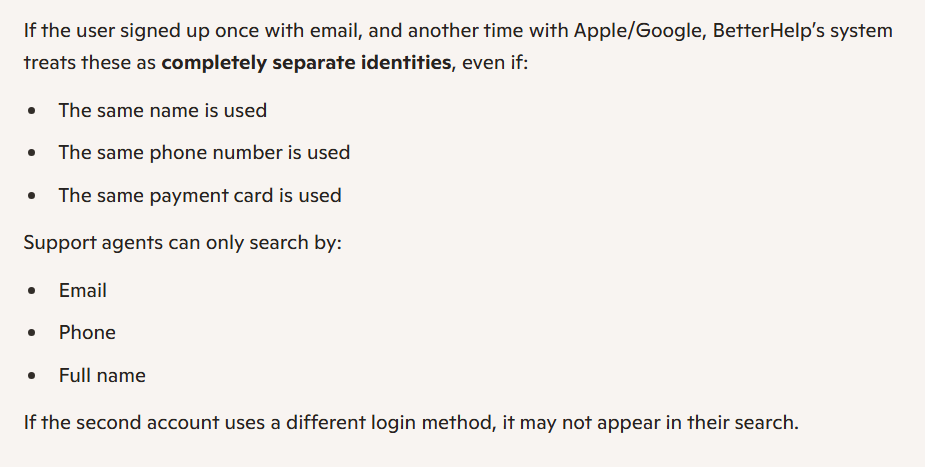
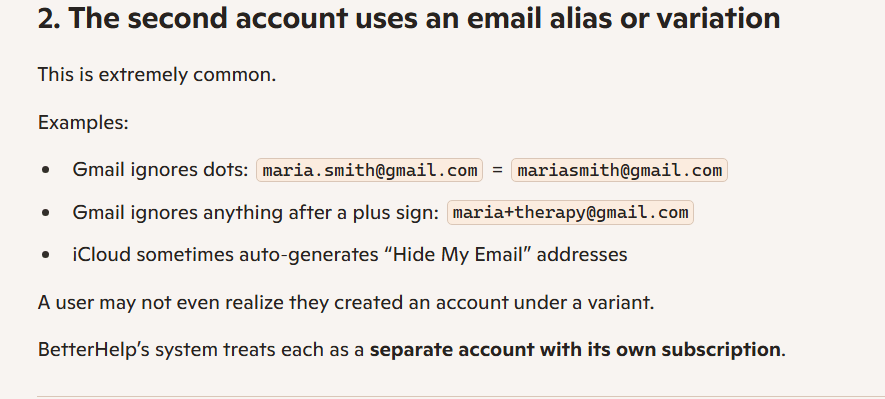
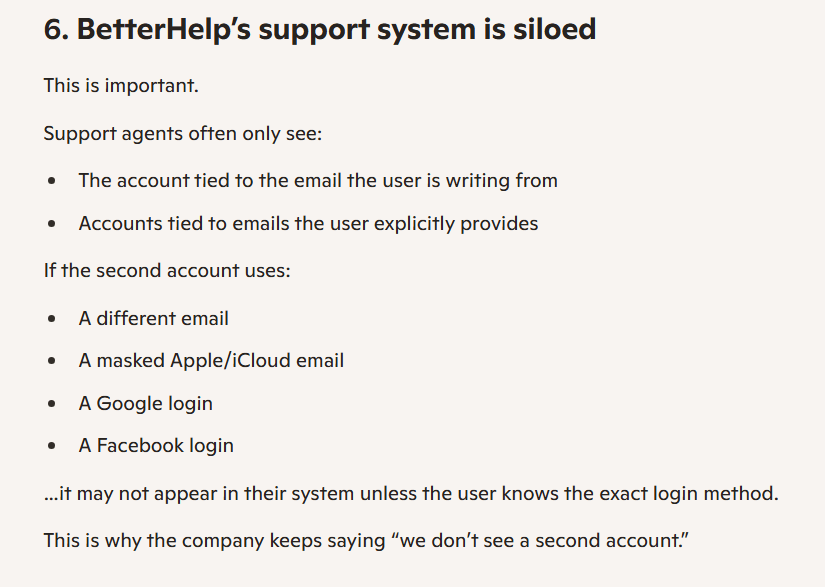
• Multiple accounts or tokens: If a user signed up with more than one email or payment method, one subscription may remain active even after another is cancelled.
• System design: Some complaints suggest BetterHelp’s system may re‑flag inactive accounts as billable if the payment token is still valid. This can look like a “reactivation” months later.
• Dark pattern possibility: In some industries, companies deliberately leave billing tokens active so charges can resume if the system “detects” prior activity. Even if not intentional, poor system design can cause this.
This is extremely convenient for BetterHelp, as while charges continue, they can assert that they can’t find the former user’s account. While those directly handling complaints may be genuinely unable to find details (as described below in the post) the system was designed with major flaws which allow the company to syphon money.
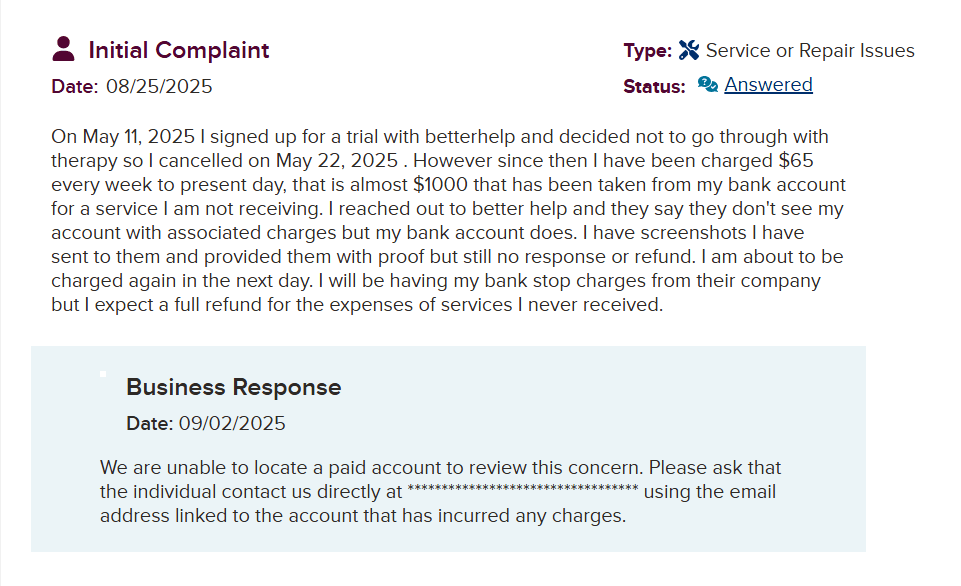
It’s otherworldly to present a company with evidence that it keeps taking your money, like bank statements, and the company refusing to look into it. Complaints have mentioned having to address it with the bank and at times cancelling the affected card altogether. This shouldn’t happen to anybody, ever.
Painstaking process to be refunded after accidental reactivation
The complaint below describes an incident of accidental reactivation confirmed by BetterHelp (it is now resolved). Although an employee had confirmed this to the client before the BBB complaint, they had only refunded one week of charges, refusing to refund the rest – while the charges were admittedly the company’s fault.
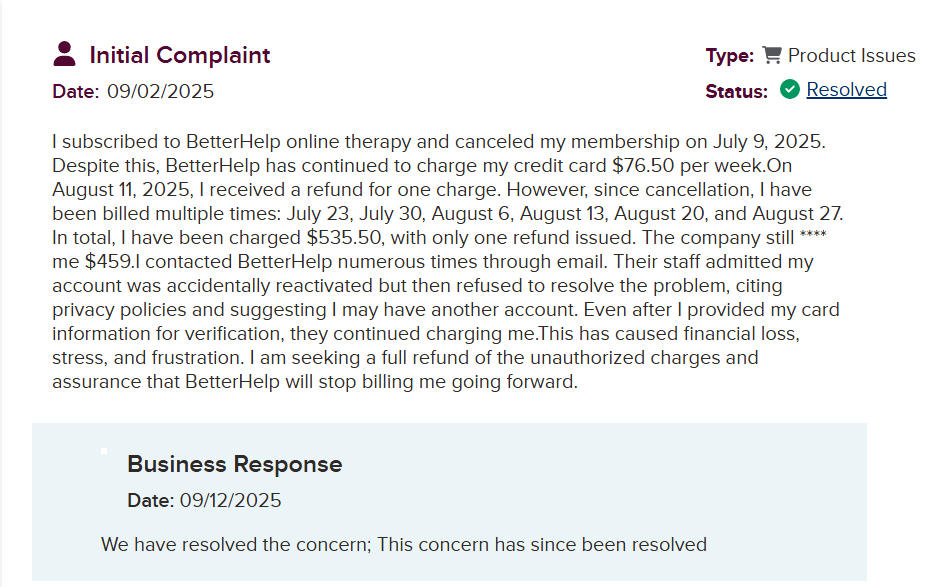
Lack of clear communication confuses clients
There will always be clients prone to misunderstanding how to manage their subscription. If confusion becomes obvious, in many companies, the employee/ contractor would normally point out how to proceed or where to find guidance at least. It’s not only the decent thing to do, and takes a minute; helping the client avoids future disputes as well.
BetterHelp does the opposite: communication is absent, fragmented or unclear, resulting in many clients not knowing the correct steps to end their subscription. Furthermore, they are by default dealing with vulnerable people, at times elderly, who may find navigating their processes difficult. In the complaint below, the client experienced the following:
- Expressing wanting to cancel to the therapist, the therapist noticing for over a month that the subscription was still active and messaging the client 3 times, without enquiring why this was happening, as it couldn’t have been on purpose.
- No invoices, notifications etc., leaving the client in the dark about the payments continuing.
- The payments continuing for months, into the foreseeable future, until the client noticed.
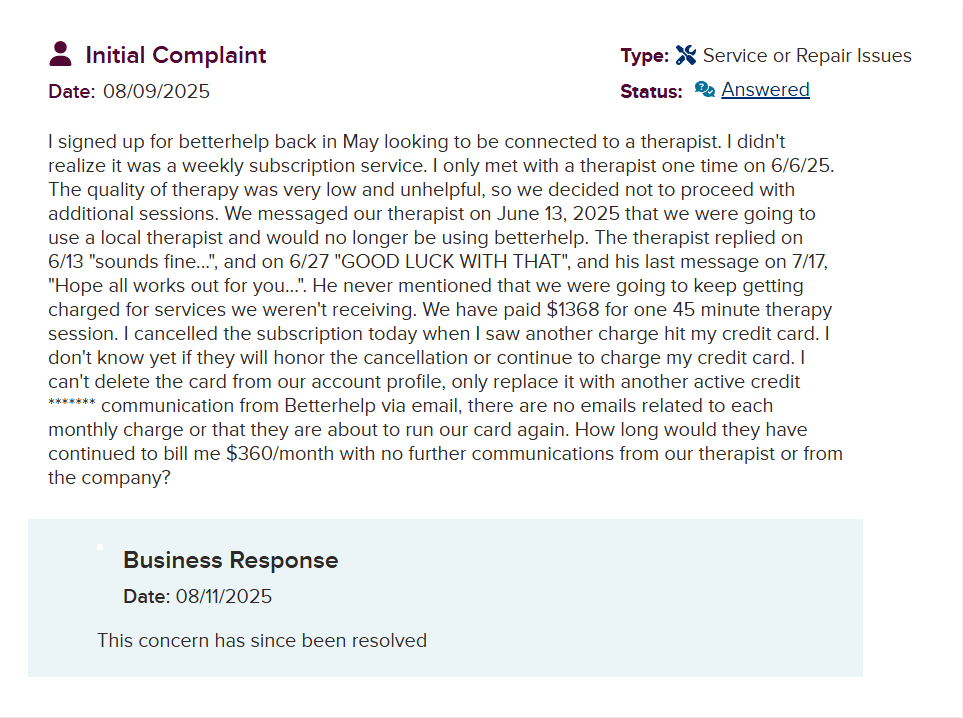
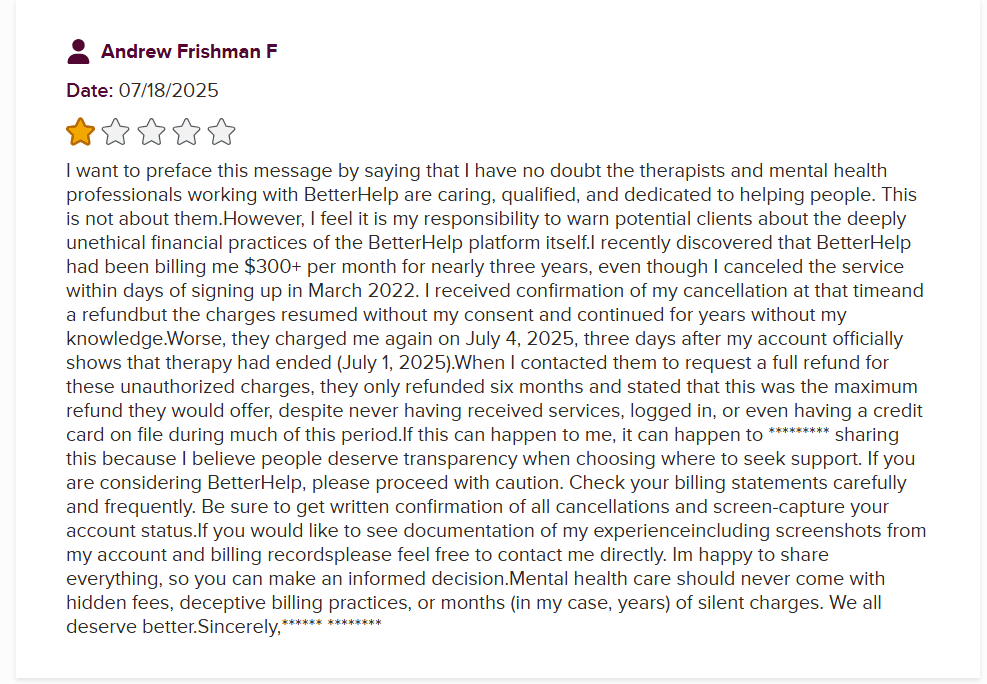
A similar situation is described below, this time for 40 weeks. A partial refund was offered, which is obviously how they get to keep at least part of the money they steal, without providing any service. Free money, zero effort. This happens all the time.
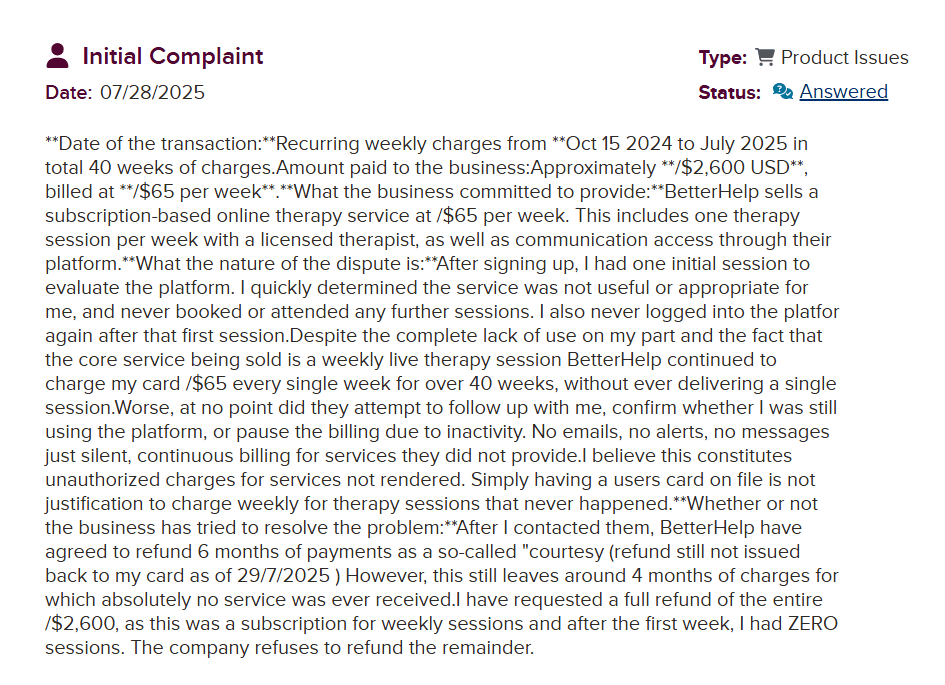
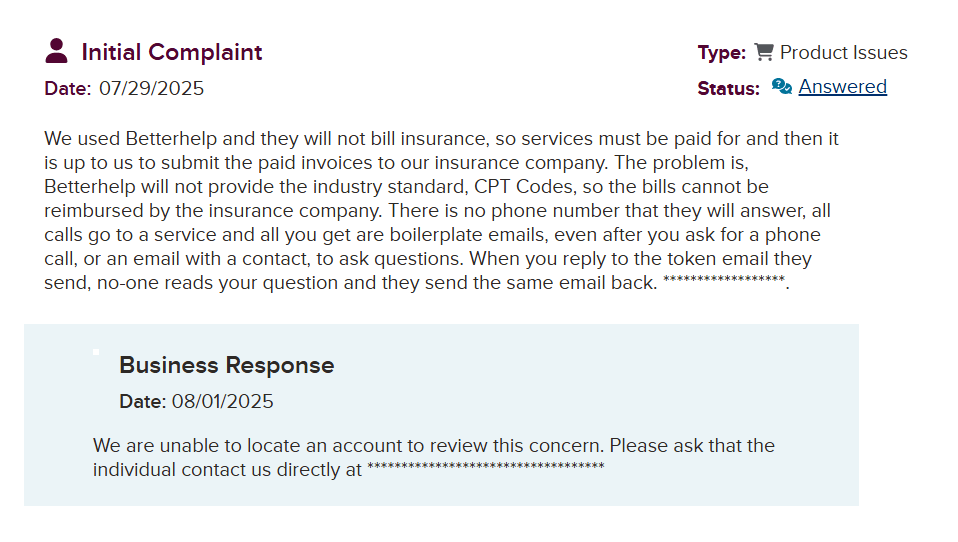
Communication is paramount in what is described as the provision of mental health services. Yet queries go unanswered and the company doesn’t care, after having received the client’s payment. Their interest stops there. Even the language used in addressing complaints is dismissive: “the individual”.
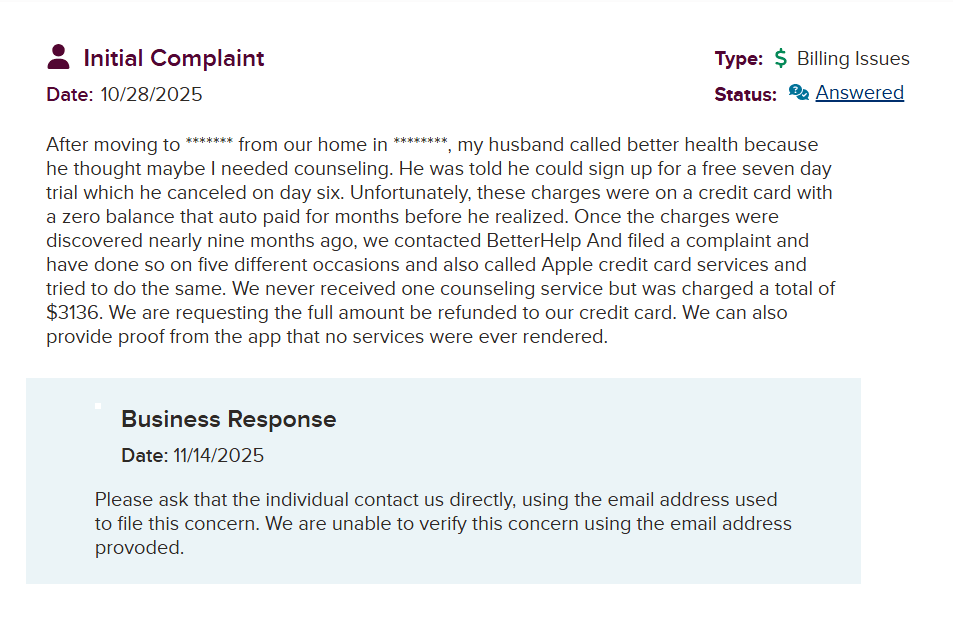
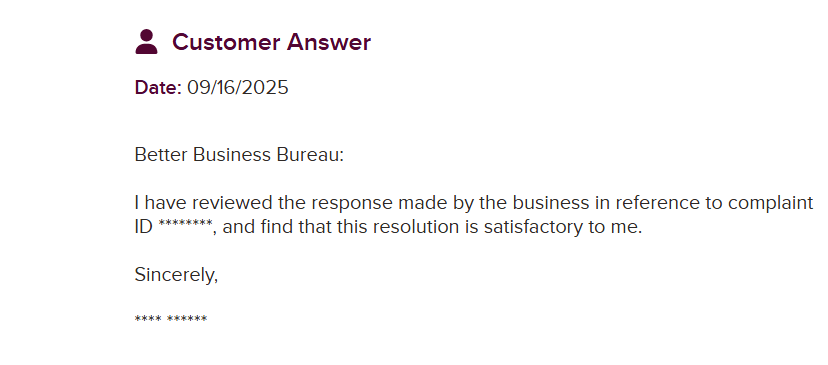
Free trial cancellation ignored, 3136 dollars charged to a credit card
As the tactic known as Sneaking shows, free trials tend to silently convert into paid subscriptions, in hopes that the client will forget to cancel before it’s too late. However, in the case below, the cancellation on day 6 was ignored altogether. This is far from an isolated case, as there have been piles of complaints regarding BetterHelp’s use of free trials or limited free services to deceive people into a subscription.
One example was BetterHelp offering a month of free services after the Astroworld tragedy, to those affected. The event was used in sociopathic fashion to hook unsuspecting people into future payments. They also attempted to monetise October 7th of 2023, by similarly offering free services for a limited time.
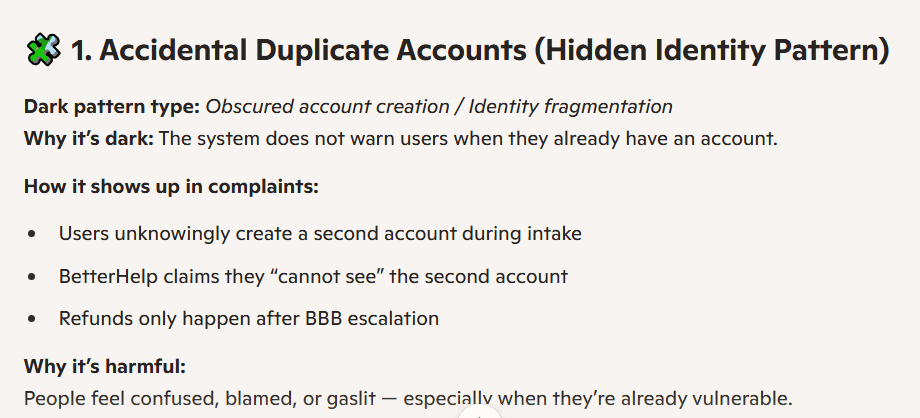
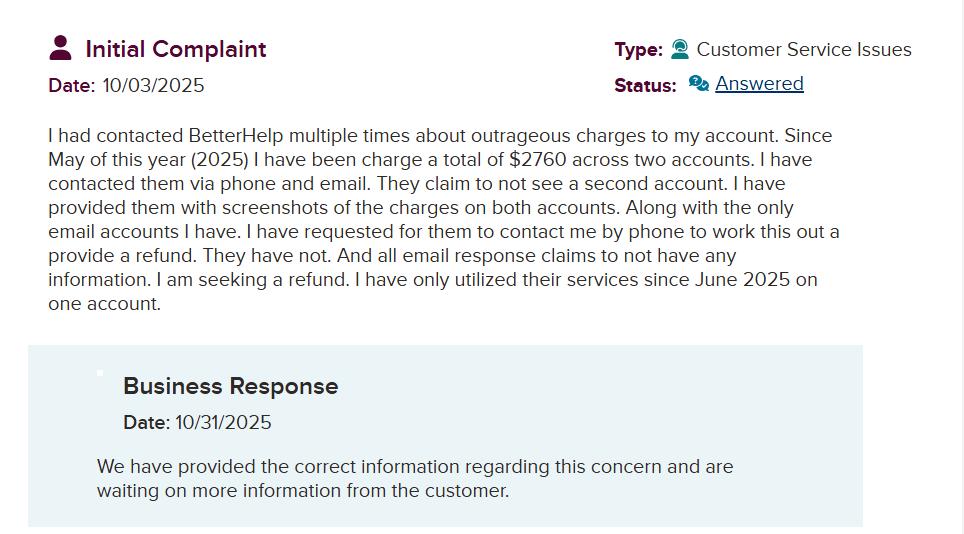
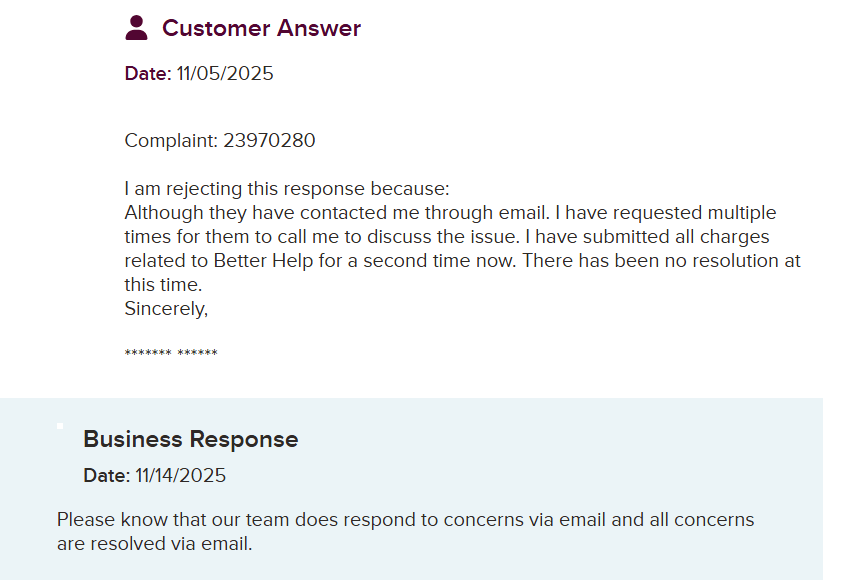
Multiple accounts resulting in serious billing errors
Nowhere on the company’s website can a prospective client or client find warnings about this frequent occurrence, as well as the one below (ghost subscriptions). These issues have been occurring since its inception and are not publicly known.
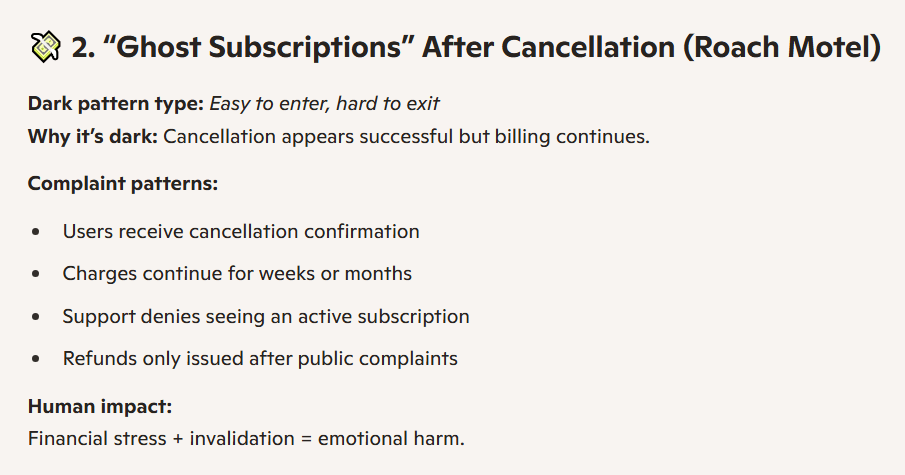
Ghosts subscriptions/ failed cancellation
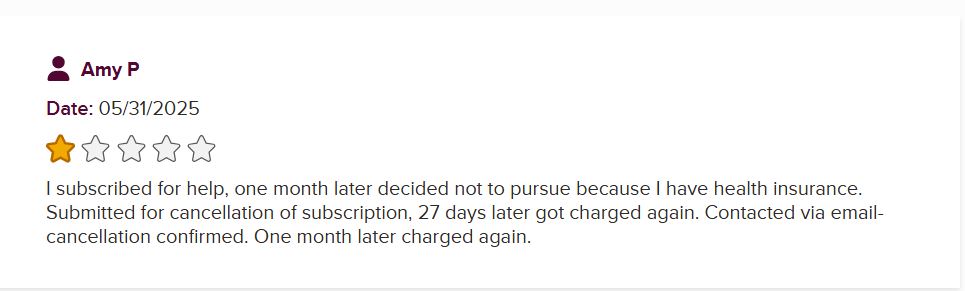
Even when cancellation is initially successful, or if the company confirms in writing that the subscription is cancelled (even repeatedly), the client can still be billed.
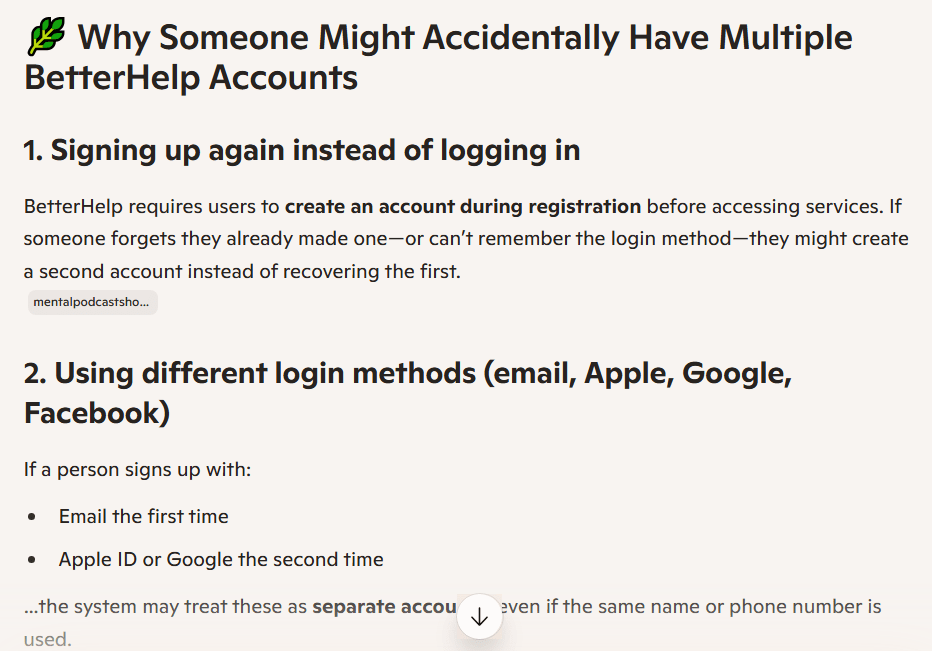
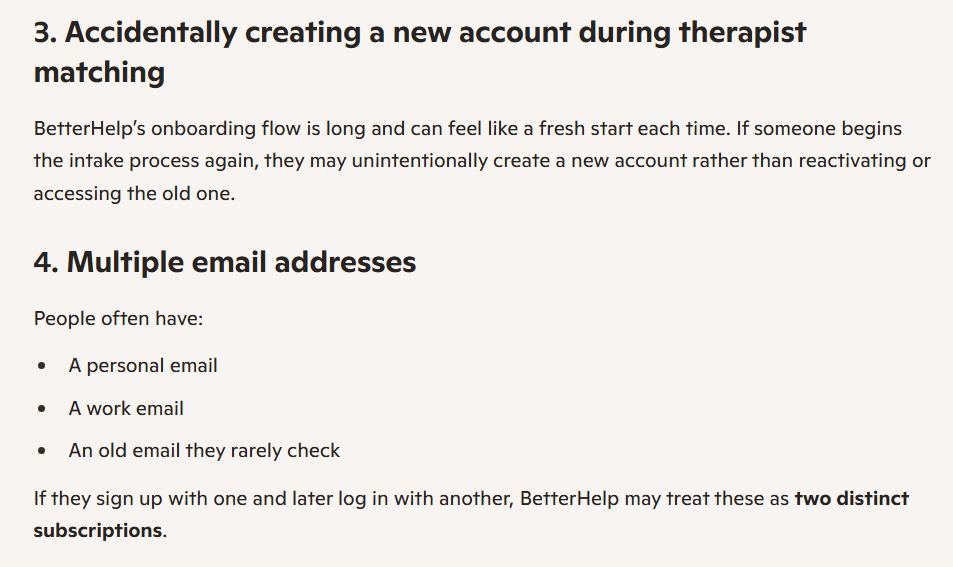
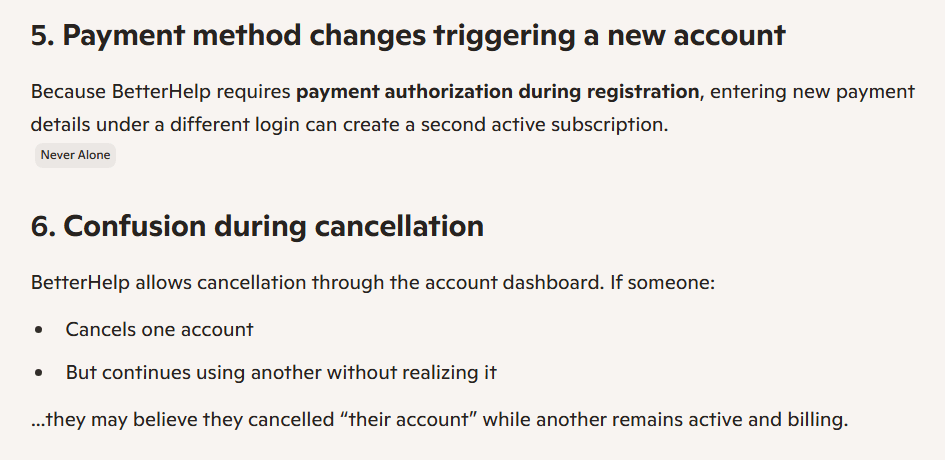
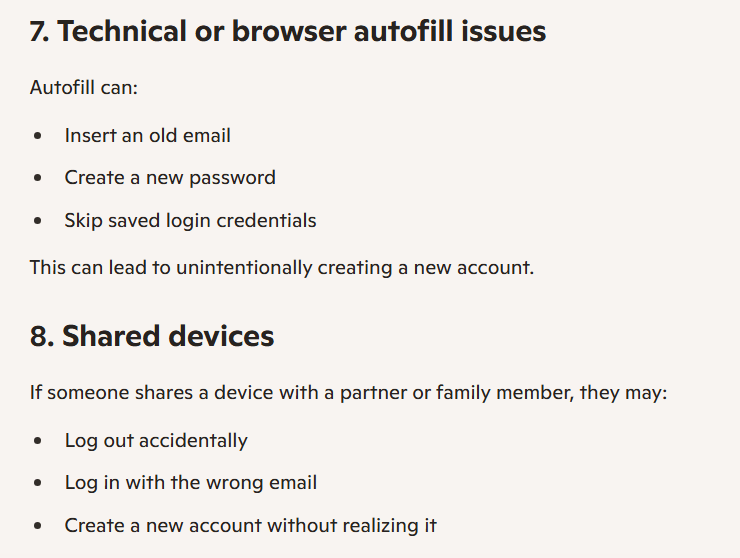
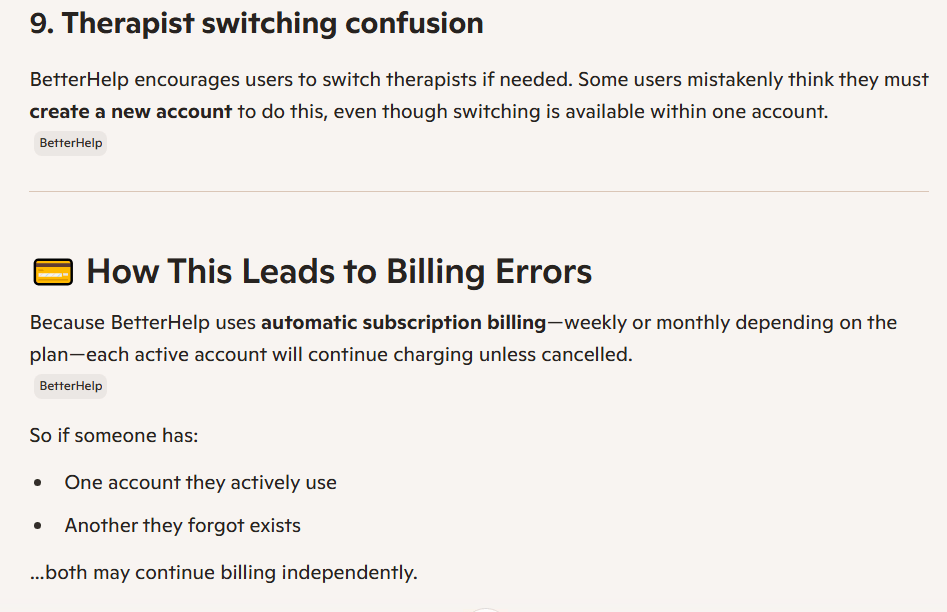
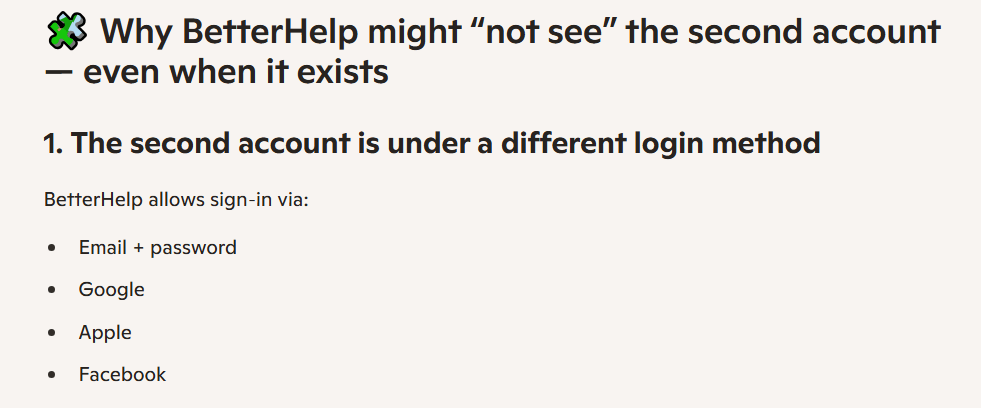
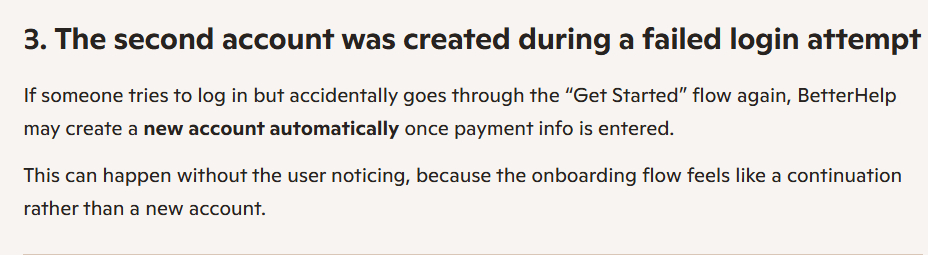
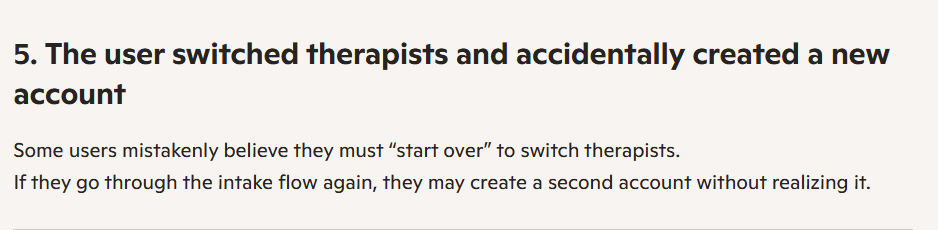
Courtesy of Copilot again, here is how someone may end up having multiple accounts without knowing it (again, the website does not warn people of this and provides no concrete explanations even after BBB complaints, so that others can be forewarned).
Please marvel at the sheer number of things that can go wrong by interacting with the platform, as innocuously as trying to sign in.
This isn’t a common experience with online platforms today
People don’t expect these errors since most platforms don’t behave that way. In fact, most have rigorous mechanisms in place to prevent duplicate accounts, as well as other issues clients encounter on BetterHelp.
Here is a detailed comparison:
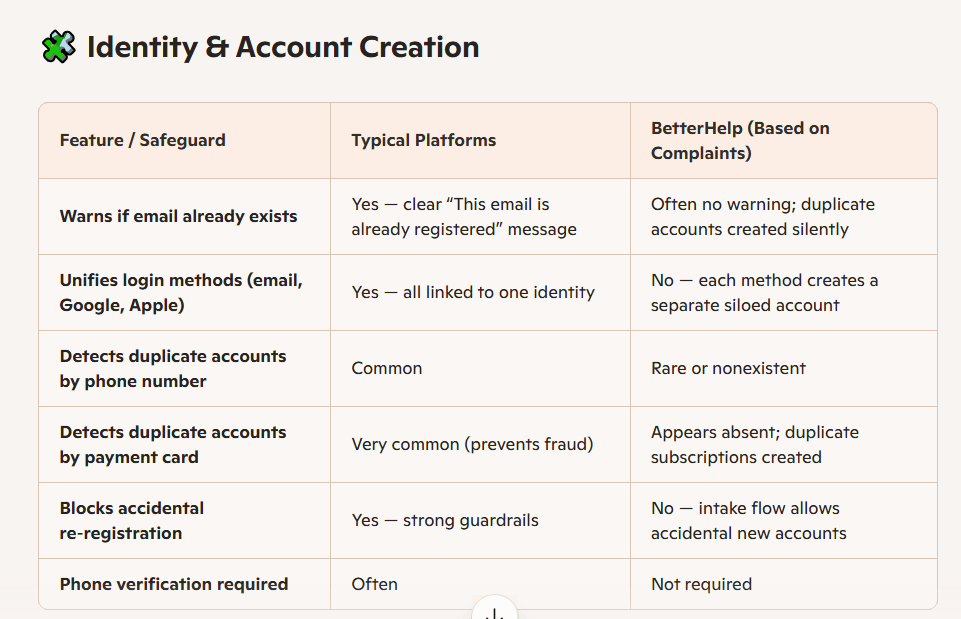
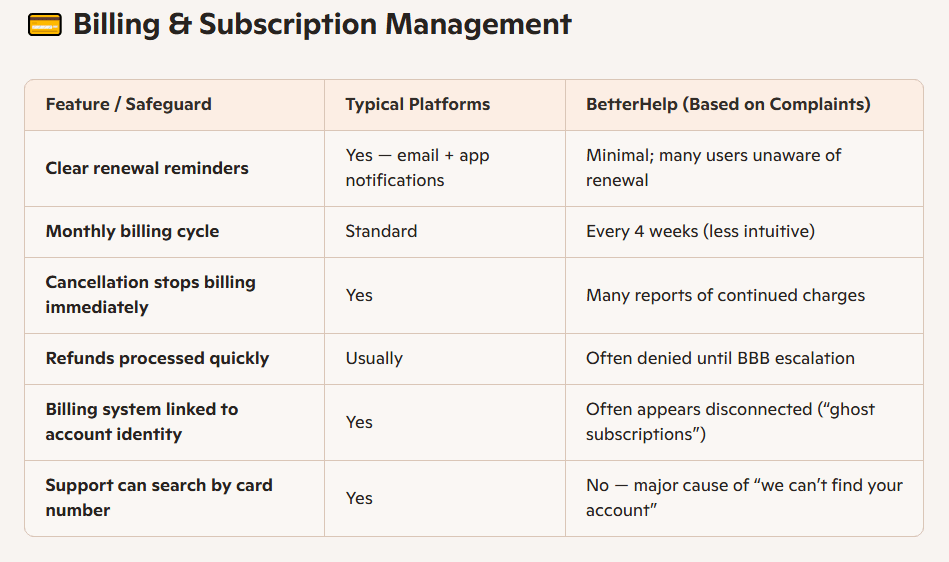
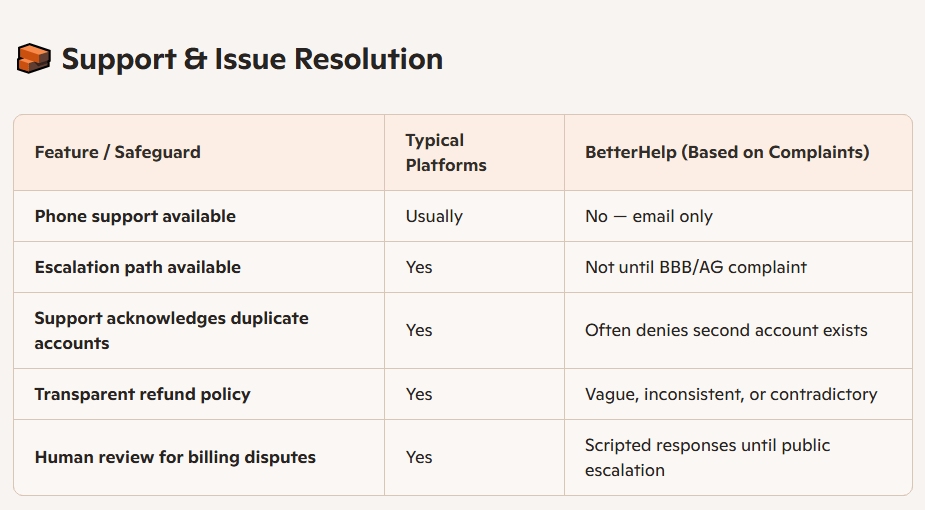
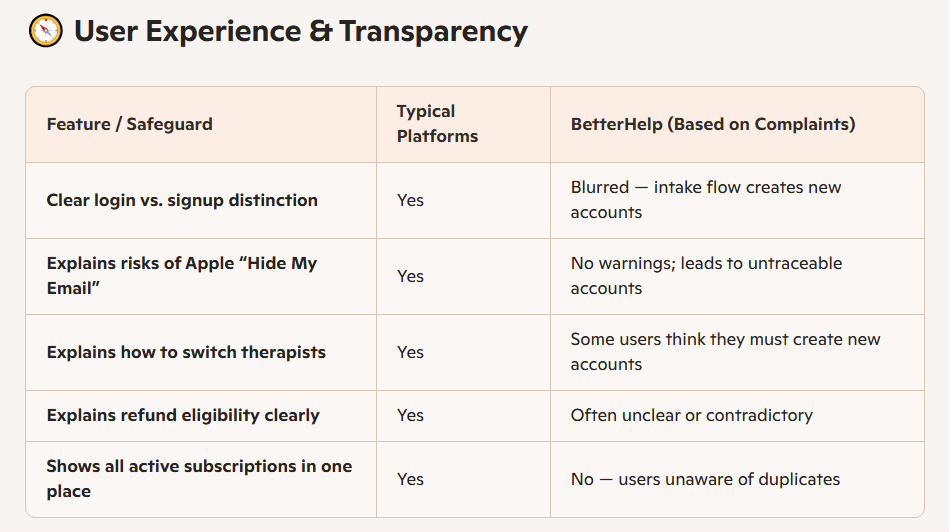
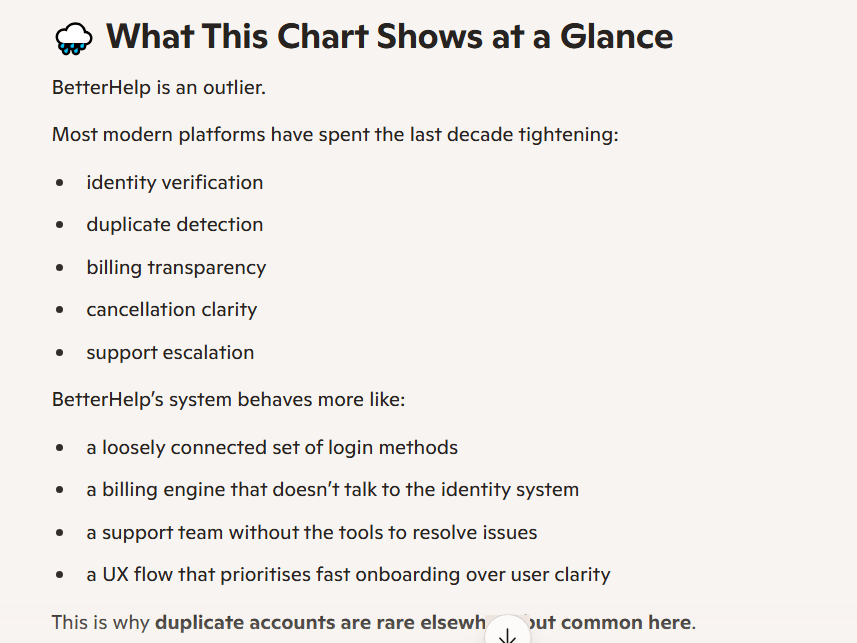
Not only are warnings regarding these potential issues not present when people visit the website – the errors are counterintuitive; people don’t suspect them as possibilities.
From the most generous angle, the company is irresponsible and careless, doing nothing to fix the issues or warn prospective clients. However, given the flurry of complaints over many years, followed by lack of action, the errors seem to be an integral part of how the system was designed.
We’ve already seen the following:
- A genuine inability from support to spot duplicate accounts;
- Only partial refunds offered when the billing in its entirety was caused by an error, with the client not at fault;
- Support trained to dismiss complaints; a fragmented support system designed to make the client give up on recovering their money.;
- No invoices, warnings of any kind, while money keeps being charged in the background for weeks, months or even years.
This gets added to the plethora of other issues with BetterHelp, such as:
- Therapists not showing up to sessions;
- The company selling user data to third parties (as per California laws);
- Other privacy concerns.
If all issues are complied, this is clearly a company worth avoiding, and its reputation should match that.
 The Artistry Of Glorified Bullshit