
This post is in support of intrafamilial CSA victims who were/are disbelieved, mistreated, ghosted, disowned or blamed by their families for the abuser’s mental state and actions post disclosure or conviction.
I am using male pronouns for the abuser and female pronouns for the victim as this is the most commonly observed dynamic – obviously, the same treatment is endured by male victims, and abusers can also be female. The source of all research interspersed is Microsoft Copilot (very useful for compiling data).
While victim shunning is common in religious or patriarchal communities, it can still be shocking among members of so-called liberal “polite society”, who otherwise advocate (at least superficially) for social justice causes, to keep up with the trends.
This post makes reference to a real situation, with the victim’s permission (and catharsis). For privacy reasons, I’m going to call her Anna. She was 10 when the abuse by her father began, 15 at the time of the disclosure and 17 when vindicated in court. Instead of apologies, the verdict brought even more opprobrium. She wishes she could address her former family directly – however, no contact is the only sensible option. There is no risk of the post being linked to people or events, as the trial was held in closed court, the abuser passed away before sentencing and his family is covering up his conviction.
The crisis
For similarly-minded families, the crisis begins on the day of the disclosure, not on the day their relative decided to sexually abuse a minor who trusted him. Their emotional response is not to the nature of his actions (or thought process), but to the actions being revealed, with ensuing and prospective consequences (including but not limited to the impact on them).
The impact of CSA on the victim, should they consider the possibility that it happened, is an afterthought, if even that. Equally, the impact of the disclosure, criminal proceedings and their own behaviour on the victim, psychologically and emotionally, is disregarded altogether.
The victim, regardless of her age, is now in an adversarial dynamic with the abuser and with them by association. She is to be treated like any person or group seeking to cause damage to the family.
The second implication is that they are required to pick someone to support and someone to shun, if not hate (the way of the troglodyte). There is an assumption that hatred and the desire to cause harm are present in this situation. That needn’t be the case.
Some victims disclose because they want it to stop. Others, because they are burdened with the secret and it’s causing them problems, or they are burdened by the injustice. Others, like Anna, whose father had a range of very difficult behaviours, because the abuser mistreats them/others in a different way, and victims suddenly become fed up with taking it.
Rights and obligations within the family
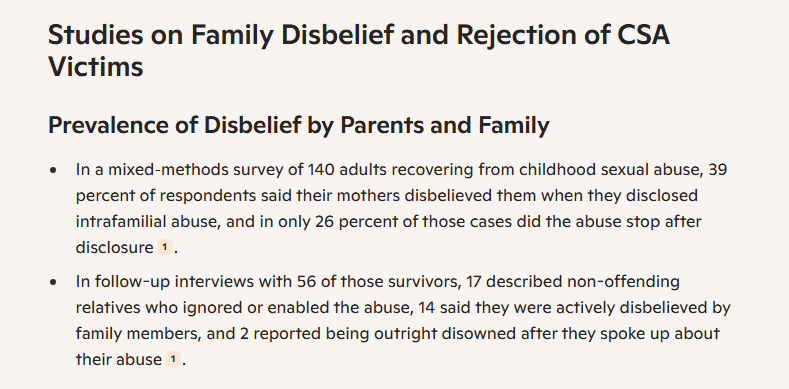
Specifically when the abuser is a parent, the issue of ingratitude is brought up, when disclosure causes him to be prosecuted. The simple act of a parent providing for his child/ children is thus described as a favour and sacrifice of sorts. It isn’t. It’s a legal obligation. It does not entitle the parent to treat the child as property, or in this case, as a sex object, with their otherwise normal caregiving role being prioritised, because he did more of that than sexually abusing.
The implication is that the abuser could’ve done worse and didn’t (he could’ve abandoned, starved or beaten the child, for instance). Anybody could’ve done worse (unless they’re a murderer); it doesn’t mean what they did do wasn’t serious and damaging.
This is a list of the rights the abuser is by default given by his family, in comparison to the victim, by logical deduction:
- The right to have his mental health considered by others – including his victim, who has the obligation to analyse the mental and emotional impact of her disclosure on him. The reverse doesn’t apply, in terms of the abuser being obligated to consider the short and long term effects of his behaviour.
- The right to have his future considered by others – again, the reverse doesn’t apply.
- The right to family support regardless of his actions – this is completely normal, but does not apply to the victim, as the victim is shunned.
- The right to support in general with his problems – this again doesn’t apply to the victim, who apparently has the obligation to keep her CSA trauma secret from trusted adults, who would have to report it. She can at best discuss it with friends. Logically, the victim cannot disclose in counselling either, until she is 18, as counsellors are mandated reporters. She should perhaps just bottle it up and live with it for a few more years.
- The right to the acknowledgement of mitigating circumstances. Even if the abuser is beyond doubt guilty, his conduct can be blamed on other factors, like substance use, or on a temporary mental health problem. The victim doesn’t get that grace. If the family believes she has done something wrong (like lying or exaggerating), the potential reasons don’t matter. She’s evil. Nothing the abuser could ever do (save for murder, maybe) could be worse than what she has done. His actions will be cushioned in justifications; she will be shunned altogether.
Three crucial obligations are relegated to the victim, when in fact they belong with the abuser:
- Protecting the abuser from himself. It’s self-explanatory that this isn’t her job. Parents are not perfect (nobody is); however, the act of sexually abusing and manipulating one’s own child is entirely different from other mistakes. The abuser knows the consequences of what he’s doing. In Anna’s case, he was discussing them with her.
- Protecting the immediate family (siblings, mother). When someone is removed abruptly from the home, drastic changes occur overnight. In many cases, one parent has to take on the responsibilities of two. There are practical and psychological ramifications for everyone. Ensuring such dramatic changes don’t occur is the responsibility of the abuser, as a presumed protector, not of the victim.
- Protecting the wider family from trauma and scandal. It’s not the victim’s responsibility to worry about the feelings of people who don’t give a toss about hers. Even if they did, it’s their choice how they handle such matters. In any case, it is still the abuser’s responsibility to avoid his family being confronted with such a grim reality.
Believe all victims, on Facebook only (maybe Instagram and Twitter)
Describing the middle-class liberal stereotype is unnecessary, as you see them all over social media, with their awareness campaigns, banners, rainbow flags, ribbons, events and hug emojis. They are full of virtues and community spirit. They love puppies and flowers. They gladly repost messages such as “believe victims”, garnering likes and shares.
Some are surely genuine, while others have a dichotomous view of the world; their principles are tested when shocking events take place within their families.
Their family of origin can be a complete basket case – as long as there’s the smiley, emotional group photo to post online on occasion, at an event, maintaining appearances for extended family and acquaintances. Since its inception, social media was a personal PR instrument, as well as one for groups, companies, organisations and states.
As long as appearances are maintained, all is well. The mistreatment happening behind closed doors, at times enacted by them (such as victim blaming and shunning) is far less important, as long as it doesn’t affect their image.
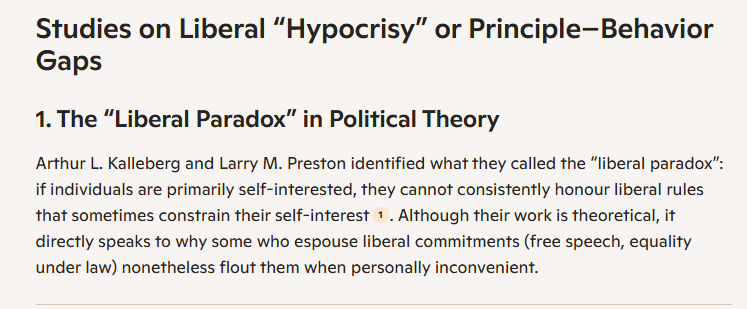

The implication all throughout was that Anna shouldn’t have disclosed. The reasons given varied:
- Person 1 didn’t believe her at all;
- Person 2 admitted the possibility, but urged her to retract her statement to the police, describing the consequences arising from a conviction, including the story being in newspapers;
- Person 3 said they were staying out of it and only shunned Anna after the abuser’s death (post conviction);
- Person 4 was supportive initially but became passive-aggressive months before the trial and shunned Anna at the same time as Person 3, along with her entire family.
Out of all, Person 3 and Person 4, the abuser’s siblings, were the so-called liberals with so-called social justice values. The abuser himself would describe them as snobs on occasion (especially Person 3), overly preoccupied with image and status.
Person 1 and 2 were not liberal in the slightest and reacted vitriolically at first (causing added trauma to Anna and her immediate family), yet seemed to change their minds after the verdict, indicating that they were, in fact – surprisingly – more genuine and decent than their highly educated, well-to-do, liberal family members.
Moreover, while Person 4 and her immediate family had remained in communication with Anna since the disclosure and had not blocked her on social media, they had stopped interacting with her months before the trial, for undisclosed reasons.
Due to the values such people purport to have, unacceptable things such as “you shouldn’t have disclosed CSA” or “your CSA disclosure is to blame for what happened to your father” cannot be said to someone’s face, or heaven forbid, written, lest they end up online, where colleagues and acquaintances can see them.
Instead, passive-aggressiveness is used, with the victim being none the wiser. Hints, clues, ignoring the victim in public on purpose and so forth. In Anna’s case, it was done to a minor, monitored to check if she was publishing information, and left to wonder what, if anything, she had done wrong, to cause their sudden rejection.
Everything is such situations is implied, not expressed directly.


No apology after the verdict
Zero. There were indications, as stated, that two family members had changed their minds, but relationships never truly resumed.
The word “sorry”, however, did not come out of anyone’s mouth, pen or keyboard.
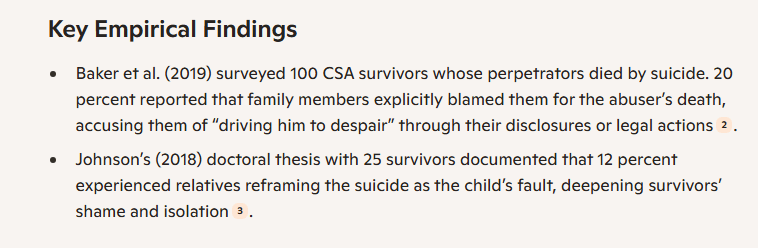
While there isn’t much data on the prevalence of this, it is blatantly illogical to ostracise a victim that was vindicated in court, and to keep treating her as a liar, or someone bent on causing harm for the sake of it.
Implying that the victim was responsible for the abuser’s decisions and fate
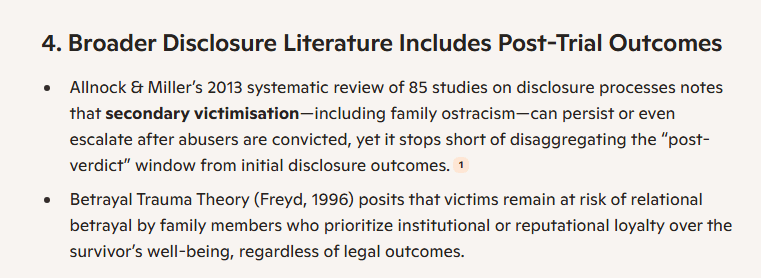
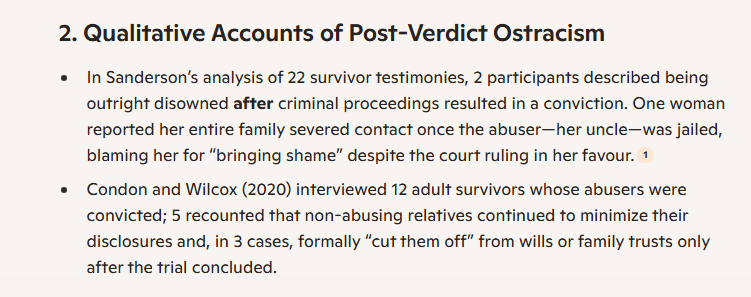
After conviction and before sentencing, Anna’s father was found deceased, either accidentally or of his own choice (the truth is only known to professionals who investigated and immediate family). The social media stalking continued, by Person 4’s family. They were only concerned about what she might be saying publicly.
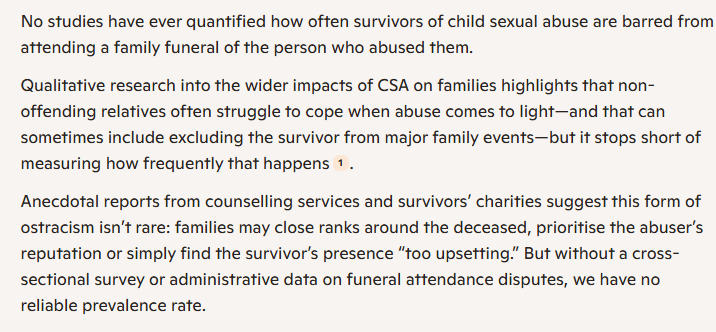
Anna and her younger siblings were bluntly banned from their father’s funeral. Person 3 (the snob) reacted almost with outrage when Anna inquired, given that the announcement had been posted online, for anyone to request to attend.
Person 3’s choice of words implied that Anna was harassing them as they grieved, although she had sent a short, respectful message and had not communicated with Person 3 in years; with most of the family, in 2 years. Person 3 used the words “leave us alone”. Ironically, she was the most distant in the family and Anna’s father had not spoken to her in years either.
The emphasis appears to have been less on denying his children closure (in the end his family only saw them as reminders of the events, not actual people). It seems to have been more on sweeping them under the carpet, perhaps pretending they didn’t exist, along with the 15 years the man had spent living with them. That is quite some time to erase with a magic sponge. Impossible, one might say.
Whoever was there to support them must’ve asked questions. Hey, didn’t he have some more kids? Why aren’t they here? They must’ve lied. Keeping the secret was the utmost priority after all.
Ironically, the funeral announcement included the words “devoted father”, while most of his children were banned from attending. More ironically, allowing them to briefly be there, to say goodbye, would’ve spared the need to make things up. They were obviously trying to cover up the circumstances of his demise. His children had not outed him publicly and had no intention of doing so. Implying that they would, or that they intended to cause trouble because they had reported abuse, was just another facet of victim demonisation.
There are quite a few implications to this gesture – again, everything was implied and deduced logically, not stated directly:
- Anna’s disclosure had led to her father’s death;
- The onus is on the victim reporting abuse, not on the abuser, to consider the consequences;
- Reporting abuse is disloyal/ wrong and one can or should be disowned by the entire family;
- The abuser had no free will in handling the court case and his conviction; this was inevitable and the victim should’ve known;
- Disclosing abuse means you have no love or attachment for your relative, even if it’s your parent, hence you shouldn’t be at their funeral;
- Victims and those supporting them cease to be fully human (they don’t grieve just like everyone else in the family).
Again, such types cannot verbalise these things in polite society, where they operate daily – they would be eaten alive. But they can treat a victim and her siblings in such a manner that these are the only conclusions regarding their beliefs and attitudes.
The case
If we forget for a minute that blaming a CSA victim for the consequences of disclosing is a non-starter, the reality in this case was as follows:
- The abuser chose, at some point in his life, to sexually abuse his eldest daughter.
- He then chose to keep abusing her for years, on and off.
- He apologised profusely to Anna over those years for treating her like a sex object, and even claimed he wouldn’t blame her for disclosing one day. He would alternate between abusing her and apologising, often blaming the abuse on alcohol. He was well aware of the consequences.
- When she did disclose, he chose to lie.
- He chose to claim he was the victim of a conspiracy, and pleaded not guilty, demanding a jury trial. This led to the prosecution building a strong case against him, adding his mistreatment of other people in the home. This could’ve been avoided.
- He chose to claim the conspiracy had been initiated by Anna’s mother, his former partner, who was “crazy and vindictive”. His attempt to scapegoat her led to her giving evidence regarding years of domestic abuse, parts of which were documented. This too could’ve been avoided.
- He chose for his relatives to demonise and disown his children, meanwhile lamenting how much he missed living with them and how much he loved them.
- He could have blamed the behaviour on mental illness or substance use or both. He could have feigned blackouts and lapses in memory. Instead, he chose to not only lie, but apply the DARVO strategy to his victims.
- Months before the trial, he had a brush with death by losing control of his car while over the limit. Drinking, he messaged Anna, again apologising profusely for having hurt her and claiming he would plead guilty at his next hearing. No one in his family, to this day, is aware of this conversation, but it still exists. She didn’t hand it to the police, as he was breaking his bail conditions by messaging her, and would’ve likely been remanded.
- He temporarily lost his driving licence and employment after the choice to drive drunk, which led to further demoralisation.
- The following month, he pleaded not guilty again, despite this written confession he was aware of, and Anna not revealing it to others to not make his situation worse. Hence he apologised in private, then once again pretended to be her victim in public, shortly after. The sporadic communication between them stopped completely.
- He didn’t engage well with his lawyer, who did a poor job, conspicuously having no knowledge of the case. Why ask for a jury trial and be so committed to a lie until the end, while not even bothering to prepare the case, lies and all? He had 2 years. This too was a choice.
- During the trial, he maintained the claim that he was the victim of a plot. The jury didn’t buy it and found him guilty of 5 charges.
- He chose to not express remorse, even after his conviction.
- He chose to not cooperate with the probation officer, tasked with writing a background report prior to sentencing. This is meant to help the offender and may result in a sentence that is lighter than anticipated, based on the probation officer’s recommendations.
- Finally, he may or may not have chosen to end his life, tragically and stupidly (the date suggests intentionality, but again, the details are only known to authorities and a few other people).
Given this string of horrid choices, which could’ve taken a different turn at any point – including cooperating with the probation officer and dealing with the situation, in the final months – it is unbelievable that the family would blame anybody but this man for how things turned out. It defies every ounce of logic.
If a person feels this level of revulsion and horror towards a CSA conviction, that they would do something extreme, why commit the acts for years?



Dehumanising the victim
While the abuser is correctly regarded as a complex individual, whose entire personality cannot be boiled down to this criminal behaviour, the victim is quickly reduced to an embodiment of the allegation. No history with her will matter going forward. At times her entire side of the family is binned (in Anna’s case, her younger siblings were shunned simultaneously).
The abuser can suffer post disclosure and conviction in many ways, whichever applies:
- Stress, shame, reputational damage, loss of employment;
- Fear of conviction; fear of the sentence; an uncertain future;
- Mandatory alienation from certain family members (including the victim);
- Legal restrictions (bail conditions);
- Thoughts of self harm or suicide;
- Self-destructive behaviours.
It’s very true that the abuser’s life is upturned suddenly by the victim’s disclosure.
It’s also true that a person of sound mind (not legally insane) knows and understands all of the above before deciding to sexually abuse a child, while doing it and afterwards, especially when the abuse continues for a long time. It’s not to say that a predator doesn’t have mental health problems; he clearly does. Yet that is different from not knowing right from wrong and not knowing the consequences, included for himself.
This is why predators employ tactics to keep their victims silent, such as:
- Threats of all kinds;
- Bribing, by offering things the victim badly wants and cannot get otherwise; promises of a good future;
- Enabling behaviour other adults would not permit;
- Manipulation (I love you more than anything);
- Emotional blackmail (I will commit suicide if you tell anyone);
- Feigning complicity and attributing power to the victim (You could send me to prison for life, said in a joking manner);
- Self-pity (I am so fucked up in the head, this is terrible, I know I shouldn’t be doing this);
- Feigned remorse, while continuing to engage in the behaviour.
The victim can relate to the abuser both as such and as a trusted adult, in some cases a parent. The abuse can be compartmentalised and locked away at the back of the victim’s mind, on daily basis. The abuser can act as a protector and provider, and if the latter applies to an entire family, that is also considered. The family may have been through many traumatic events and may be used to overcoming them. They may be relatively numb to the abuser’s general behaviour.
The abuser’s relatives also see themselves as able to have a comprehensive, complex perception of him, even while having to accept his guilt. The same grace cannot be given to the victim, who also may not have a black-and-white perspective on him. The victim disclosed, therefore she hated him; she wanted to ruin his life.
Why now? Why didn’t she disclose it at the time?
For an answer, they need only look in the mirror, as their reaction would’ve been the exact same – at the time, or at any other time. Disbelief, contempt, rejection, digging for an alternative explanation.
Families like these are the reason many CSA victims stay silent. They know what will happen to them if they talk. In such families, the only unacceptable crime is telling the truth.
 The Artistry Of Glorified Bullshit