
Despite the appearance that this company couldn’t possibly get any worse, the 2025 updates are quite something.
In a way, it was predictable: the arrival of orange Messiah Donald Trump, on the back of drugged-up donkey Elon Musk, has left regulators in the US more incapacitated than Trump’s teleprompter reading abilities. Scams of all kinds were going to flourish – not that any prior administrations had managed to stop this company. There were attempts to rein them in, the FCC fine being one; now there won’t be any.
On the good side – and this is the only good side, with limited effect – at least on YouTube, critical videos abound now. This is a very positive development; people are no longer legally intimidated into taking their videos down.
This post is based on recent TrustPilot reviews, from the past few months, as well as the company’s responses, which are indeed revealing.
Cleaning out the health insurance funds of US citizens
For many years, BetterHelp did not accept health insurance in the US and would only steal from people’s bank accounts (which they still do as well, obviously). Their rent money, their grocery fund etc.
It appears this has now changed:
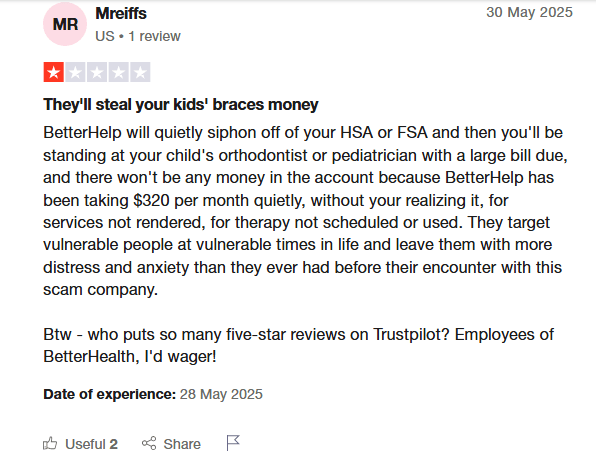

Note that the response doesn’t clarify the following: how on earth this happened in the first place. There is no acknowledgement of the immorality of operating a system that allows this to happen, without the former client being aware.
The former client is then put in the predicament of needing a medical procedure, of all things, and suddenly not being able to afford it, with the company being cavalier about it. You’d think they would employ more care when dealing with someone’s health insurance.
It’s an admission that there is no efficient system in place to detect accounts still being charged while receiving no service, for any reason whatsoever.
To that they add the gaslighting, mentioning “confusion”, as in “you’re/ you were just confused”. If you keep reading, they do this repeatedly, in different scenarios, implying the client has made a mistake, causing undue charges to continue.
To that we can add the fact that clients probably don’t check their health insurance as often as they check their bank account, making it easier for money to disappear unnoticed.
Even if the client forgot to cancel their membership, there should be safeguards in place. Clients are presumed to be in a difficult place mentally and emotionally while interacting with the company, making it more important for BetterHelp to take extra precautions, not less.
BetterHelp doesn’t send payment reminders, bills or invoices.
There is a system to track services being used in real time, like live sessions or missed ones (by clients only, which there is an extra charge for). They even track the number of words therapists exchange with clients, to maximise their efficiency in seeing as many people as possible per day. No client would allow the charges to continue if they were aware.
However, in this response to a different review, BetterHelp claims the following:
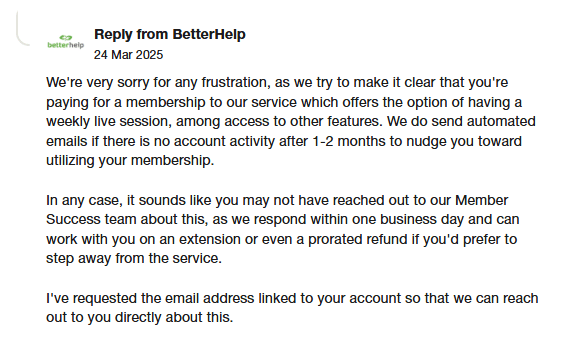
“We do send automated emails if there is no account activity after 1-2 months to nudge you into utilizing your membership”.
One to two months? Which one is it? If it’s automated, shouldn’t they know exactly when such emails are triggered? Never mind we’re talking about hundreds of dollars per month. They’re happy to keep taking that knowing there has been no account activity, before they react in any way. The reasons could include:
- The person forgot to cancel and their account is being drained;
- The person is in the hospital or otherwise incapacitated;
- The person is dead.
Live sessions are supposed to be weekly. A therapist is supposed to be assigned to every client. In all reviews and complaints I’ve read (one BBB complaint mentioned being charged over 2 years, no less), the former clients involved did not interact with the company at all. There was no therapist assigned to them; no activity; no communication. Money just kept being syphoned.
This isn’t cable subscription. Mind you, it’s supposed to be a mental health service. Diabolical scam, more like it, preying on people in vulnerable states.
What if a person is deceased? BetterHelp will take upwards of 600$ from their bank account for nothing, before even reaching out? Just like that? Then they will just nudge the dead person via email while continuing to take their money and continuing to not hear from them? It’s bullshit anyway that they notify people; I’ve read hundreds of complaints, if not in excess of 1000, over the years.
Even what they deceptively state they do to mitigate this is unacceptable.
Here’s another example of a client wanting to stop the charges and communicating this to a therapist who doesn’t respond with advice on ending the membership – unless the client, not being tech savvy, responded to automated prompts after the first message to their therapist. In any case, this was allowed to continue without anyone noticing that the client was attempting to cancel, was not engaging with the therapist etc. They just kept taking the money.
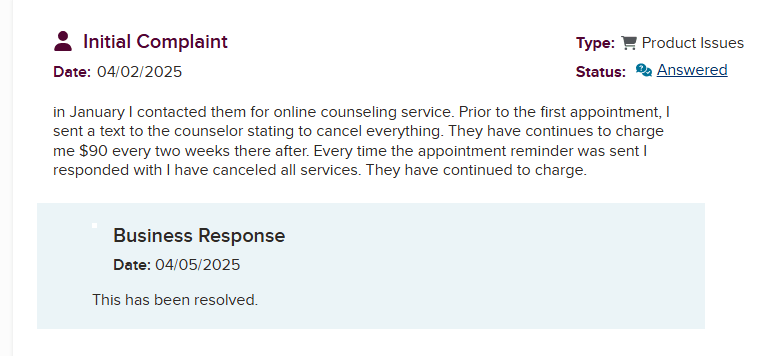
Clients charged for appointments they didn’t miss
The platform is designed to extract as much money as possible for any pretext, while shirking responsibility for monetary losses (or other damage caused) on its end. Mind that the therapist is not paid for services not rendered and is unable to address technical issues or clearly state why a session was missed, avoiding the client being penalised unjustly, on top of the subscription.
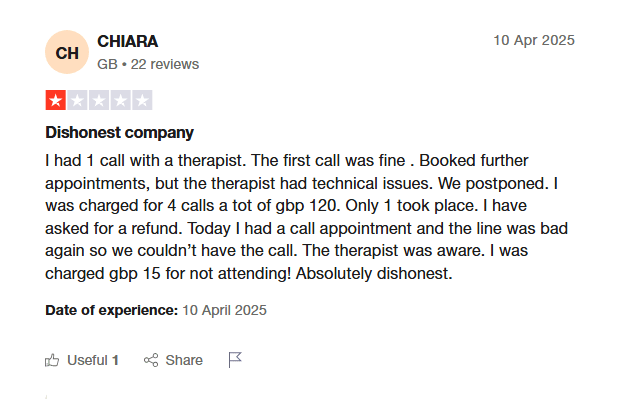
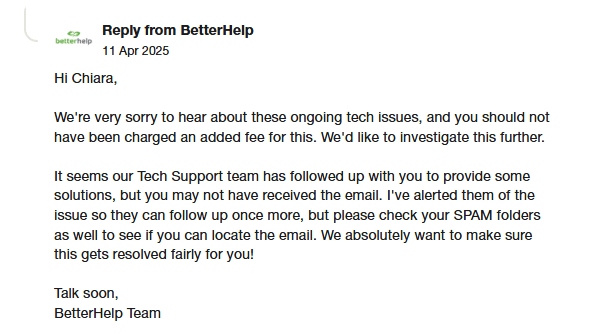
Mind that they only see the 15 pound charge as an issue – they don’t mention the subscription in and of itself, taking 120 for just one call instead of 4.
The “you may not have received our email” is incredibly common in these responses, in a variety of circumstances. Either way, it’s your email client, it’s your spam folder, it’s your lack of paying attention: it’s YOU, not us.
The following BBB complaint indicates malicious behaviour:
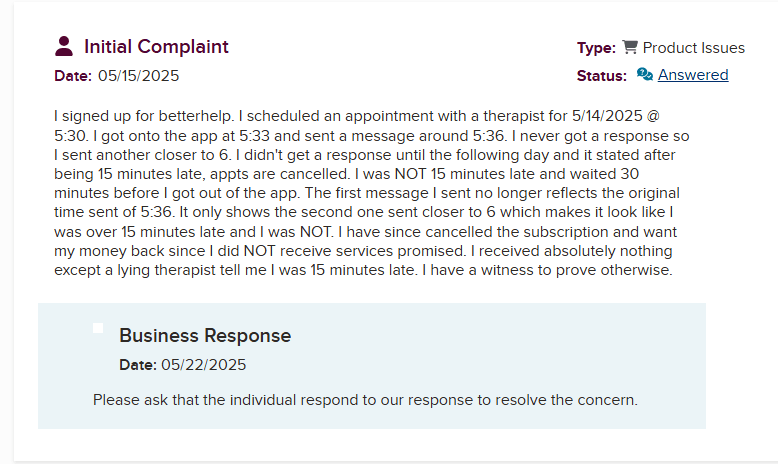
Looks like someone deleted the client’s first message, making them appear to have been 15 minutes late, to charge them extra money.
Refunding 30% of one session after (at least) a month of no service
Someone either made that decision or this is the company’s actual policy. The main question is how they would justify either to the public. They don’t.
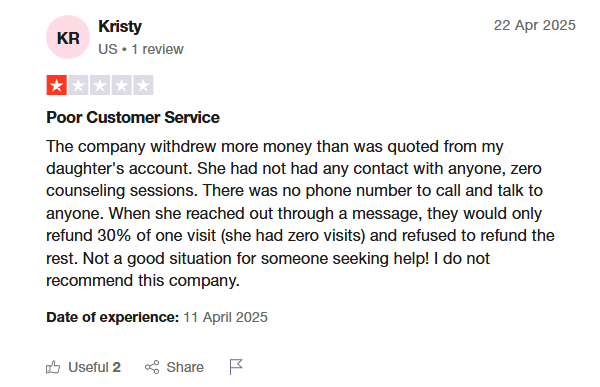
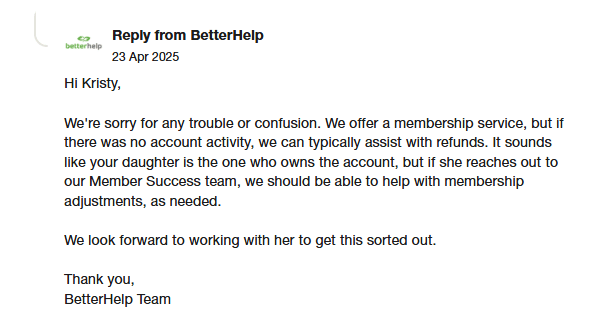
Note the word “typically” (as in no promises made, when the situation is very clear). Are there circumstances in which they don’t refund the money when there has been no account activity? What would those be and again, how do they justify this?
The company did assist with a refund: they offered to refund 30% of one session, after having charged in advance for at least 4. This isn’t clarified in their response. Is that the rule? If so, why not state it clearly? If they’re now offering to remedy the situation, it’s an admission of this decision being incorrect. So who made the decision and why?
They intentionally create confusion as to how things work, who makes the decisions, how wrong decisions are allowed to be made on the regular and what will be done in the future, if anything, to address similar situations.
Thousands stolen from client who was in care, unable to contact BetterHelp
As per the scenarios mentioned previously, some clients may not have forgotten to cancel their memberships – they may simply be unable to do so.
Ergo the horrible situation below:

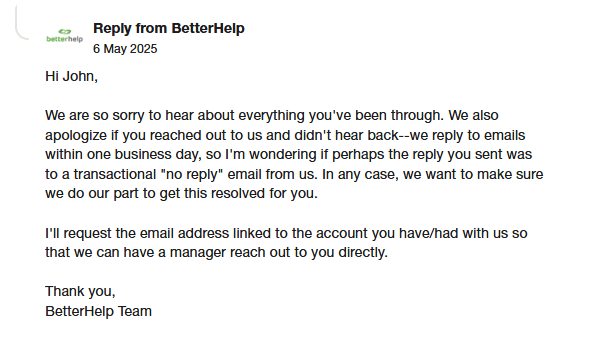
The implication is that John either didn’t try hard enough to reach them, or failed to do so. He’s just confused, like every other person they scammed. So confused he might’ve replied to an automated email that usually includes the mention “do not reply” or “this inbox is not monitored”. Logically, the amount was over 2000 dollars; reaching that threshold takes over 7 months. This could’ve continued for years.
With the risk of repeating, they don’t explain the following:
- How this person was charged over many months, without the company noticing they were receiving no service and no therapist was assigned to them;
- Why there are no safeguards in place for these predictable situations;
- Why this is portrayed as normal when it’s not.
Another case of someone who had 2800$ stolen gradually:
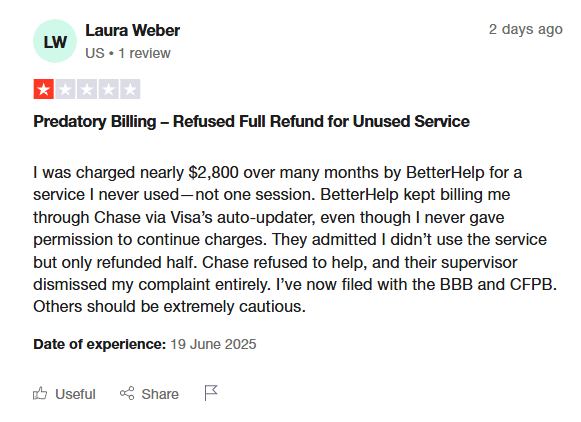

“Low activity”? How about no activity?
You cannot fool an inebriated turkey that the company believes these to be consensual situations, of people deciding to let the charges continue for no service, losing thousands. No one would do that. The response also doesn’t explain offering to refund half of the obscene amount they had stolen.
Useless matches and predatory behaviour
This wouldn’t be acceptable in any other context when paying for a service. Charging in advance, offering nothing of use, trying to dissuade the person from cancelling, then continuing the subscription and useless matching and refusing to refund.
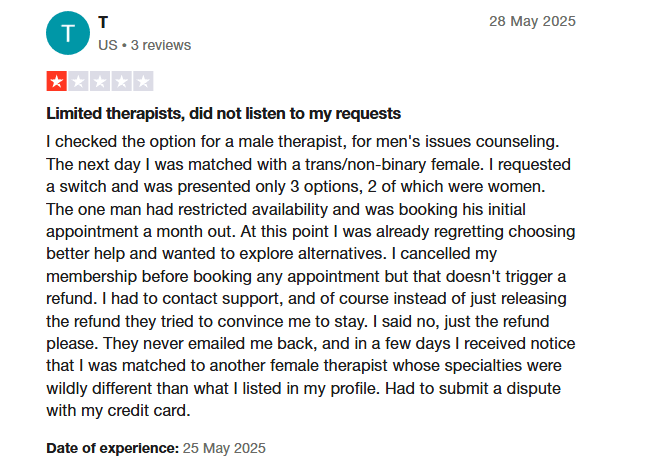
Imagine if this was a house repair and refurbishment company. The response would be something like this:
“Yes, Bob, we understand that you need the carpets replaced urgently, and that this was listed on our website before you paid hundreds in advance, but since we have no carpet fitters or carpets right now, we’ll arrange for your walls to be painted instead. Yes, we understand that you already painted them last week and you need the money for carpeting, but that’s all we can offer. No, you shouldn’t cancel and be refunded. We will instead send someone to install brand new sinks. We really want to help you make your home look better.”
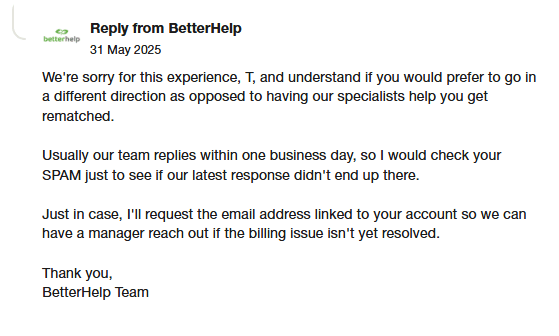
Here’s my question: who matched him in the first place, repeatedly, with the wrong therapists for what he needed, ignoring the feedback?
Was it the specialists? Or do the specialists only intervene when someone asks for a refund, and the process is otherwise handled by AI? That could work well, by the way, if it was programmed to take a client’s needs and requirements into account, which is clearly not the case.
BetterHelp pretends not to understand why the business model is predatory
After all the years of client feedback, they still pretend they don’t understand that ruthless capitalism and mental health services don’t go well together. This isn’t normal. It never will be.
The fact alone that they either don’t see it, or pretend not to, should inform prospective clients to keep away.
Their website still deceives people that they won’t be charged until they have been matched with a therapist. That’s not the case. The weaselly explanation now is that the 7 day billing cycle doesn’t start until the client is matched, namely the time they spend finding a match doesn’t count as the client having used the service.
As we’ve seen above, in more than one review, that is also bullshit, as people who were never matched with a therapist were still charged month after month, although according to this explanation, their official billing cycle had never started.
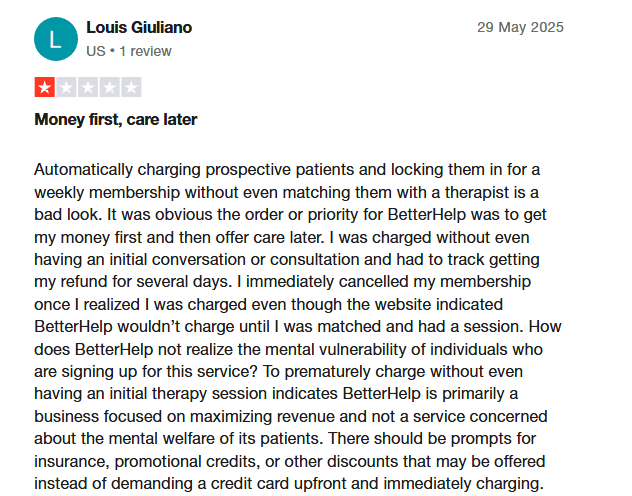
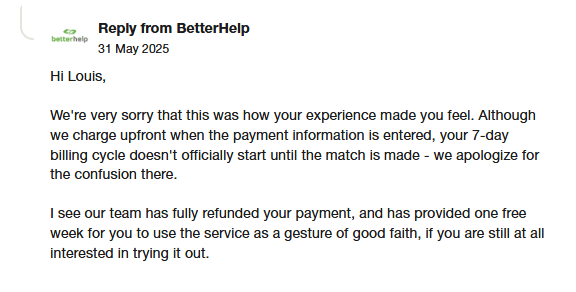
Boy, they’ve got a lot of confused former clients, don’t they? It’s not that their website is confusing them on purpose, to quickly enroll them into a financial agreement.
You see, the money left Louis’s account in a jiffy, without him knowing it would happen – just unofficially. He wasn’t officially being billed. As if that was supposed to matter.
Baiting someone into opening up in the hopes of receiving help, to then be faced with a paywall, is icky. This isn’t just any type of service. Yes, we all get annoyed when needing to convert one PDF file, finding a website listed as FREE, converting the file and finally seeing the paid subscription prompt in order to download it. It’s a waste of a few minutes. Yes, it’s naive to think that anyone today wants to personally help you for free, especially when working for a business, not a charity.
Vulnerability leaves people prone to trusting more than they should. Putting oneself into a mind space of verbalising their problems, in hopes that someone will talk to them, just to find out it was a commercial bait, is a very sour experience. It feels predatory and violating (not to mention BetterHelp will use the information sent in the intake form).
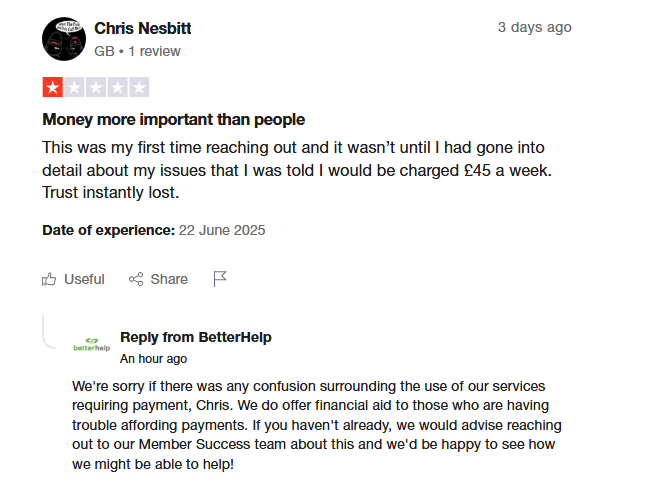
Given the sensitivity involved, it’s scummy to not show people exactly how much it costs before inviting them to make disclosures regarding their deepest problems. As mentioned, the company is after the data supplied in the intake form, which they can exploit even if the person doesn’t end up paying.
Clients deceptively told they would get a call back
This seems to be a new phenomenon; the answering service (which is not part of BetterHelp) is now telling people they will receive a phone call about their issue or refund. This doesn’t happen and as you can read below, the company denies giving phone operators such instructions.
Someone is obviously instructing them to say that. I’m patiently waiting for a whistleblower to one day disclose the inner workings of this scam.
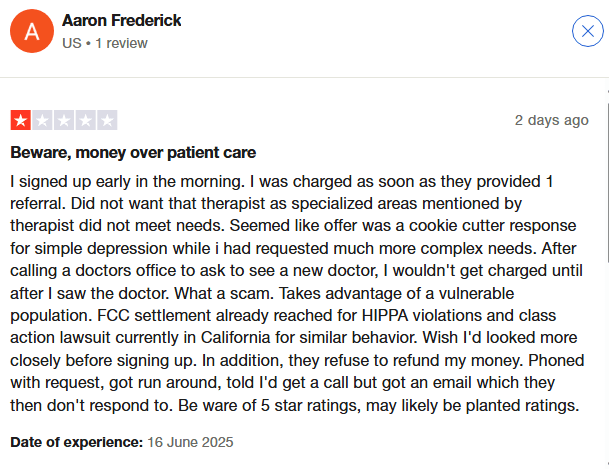


The only way the existence of this answering service makes sense is if BetterHelp is legally required to provide clients with a phone number. They do not want to be reached by phone.
Why would the following system be in place?
- The client can’t call BetterHelp directly.
- The client can email BetterHelp themselves and is supposed to receive a response within 24 hours.
- The client instead is told to call this third party answering service which is meant to take down their email address so that someone at BetterHelp can email them back.
The rigmarole is designed to again create confusion, so that the person the client eventually reaches can blame the lack of response on an earlier stage of the process. This is very common for subscription scams. They are as difficult as possible to communicate with and give people the runaround for as long as they can, in hopes that they give up.
- Did you perhaps reply to an automated email when intending to contact us?
- The phone receptionist wasn’t trained right to take your details.
- Did you check your spam? We typically reply within 24 hours.
- This situation is unusual; we TYPICALLY (introduce whatever)….
- This email address is not associated with a BetterHelp account; please provide the email address you used when you signed up.
Here’s another complaint regarding not being able to access the account despite being locked into a subscription and the company continuing to take money:
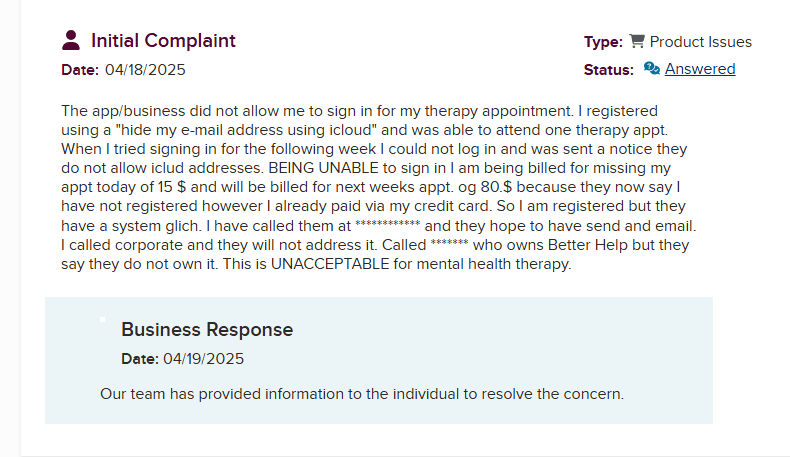
Being locked out of an account happens. Sometimes you lose your login details or access to your phone for verification. That’s what customer service is for! The company has enough details to be able to help you restore access to your account. There should be no need to go through a third party like the BBB to sort this out. Two questions:
- If BetterHelp can solve the issue in response to a BBB complaint, why can’t they solve it when the member addresses them directly?
- What is supposed to happen to the member, apart from replacing their card altogether so BetterHelp stops taking their money?
BetterHelp has people’s names and payment details, but claims quite often to be unable to locate their accounts, while charges continue.
Here’s another complaint where the client turned to the BBB only after extensive back and forth with BetterHelp, receiving the dismissal below, then finally a resolution weeks later:
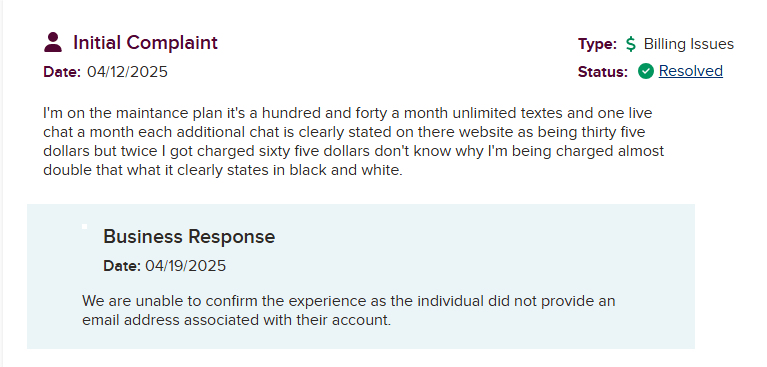
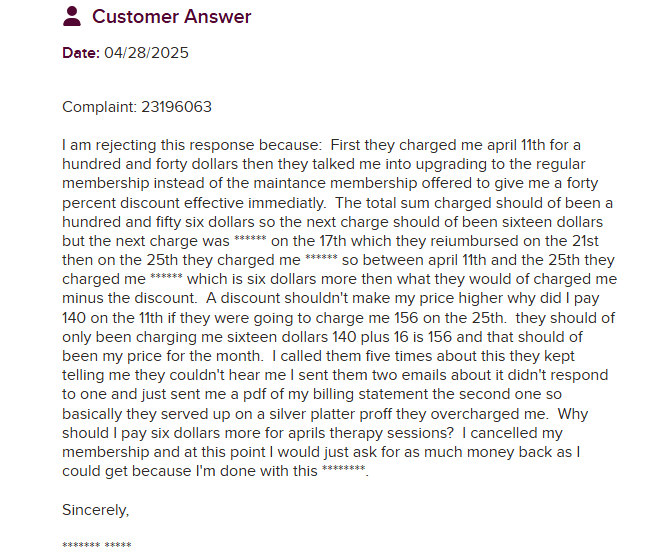
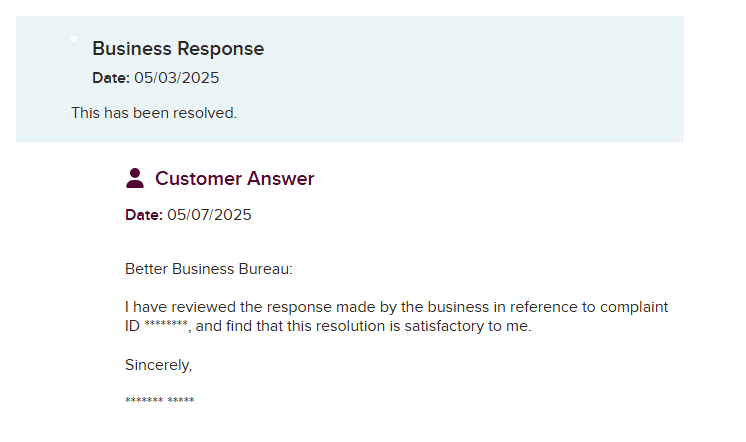
It’s fair to wonder why it took this long and what would’ve happened had the client given up after their dismissive response. If they eventually located the client’s account, could they not have done it in the first place?
Any assurance that a client’s account will be terminated is false if the client doesn’t know they need to cancel on their end as well:

The cancellation process is compartmentalised in such a way that its failure can be blamed on any part of the process, with no responsibility being taken. Recently, it is not specified for how long, the client’s cancellation button didn’t work because of a “bug”:

Spam – because BetterHelp needs to be in your inbox as well

Enter “third parties”, as one complainant described to the Better Business Bureau some time ago – they had been bombarded with BetterHelp spam from a variety of email addresses. They were unable to unsubscribe. After the BBB complaint and the company taking note, they posted an update that the spam had stopped.
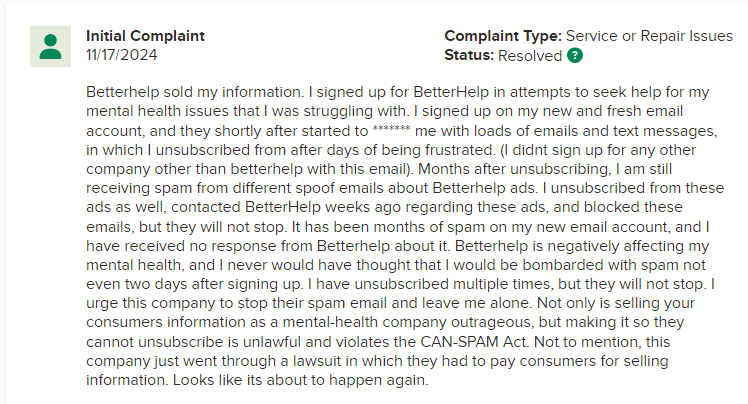

Selling clients’ and prospective clients’ data
This is a response to a review on TrustPilot:
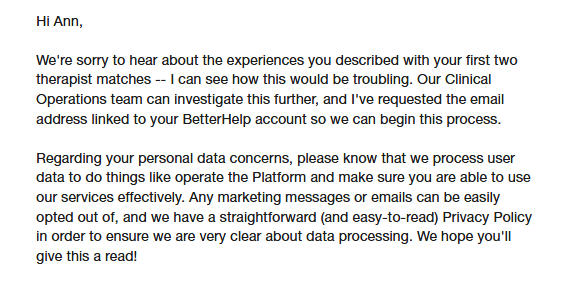
Below are two excerpts from BetterHelp’s Privacy Policy:
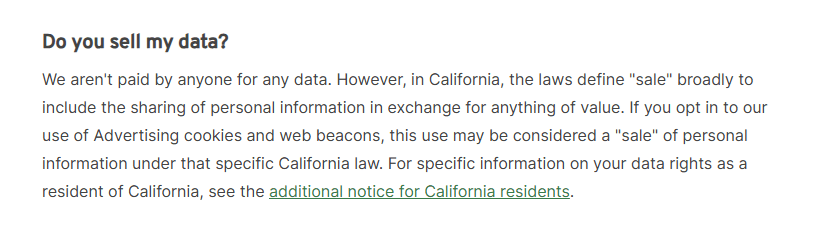
Just as I suspected, they don’t receive money per se for people’s data – they provide it as part of a broader arrangement with other companies, which in California is classed as a sale. Should people care how this data ends up in the hands of BetterHelp’s partners and for which specific benefit to the company, or that it does, being traded like a commodity?
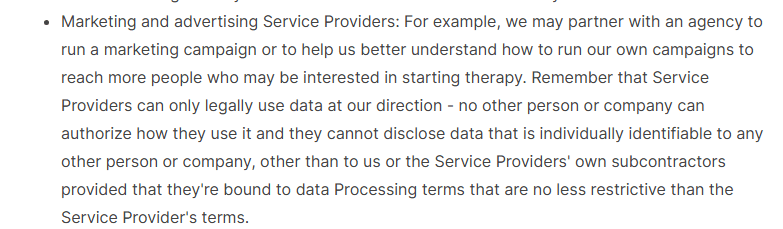
In other words, you’re the client, but also the product. Your sensitive information ends up with marketing companies seeking to peddle BetterHelp to as many people as possible. The goal here is financial and nothing more. Would anybody be comfortable with that?
To conclude – would anybody be comfortable with risking any of the above happening to them?
 The Artistry Of Glorified Bullshit