
This is hilarious.
The only explanation for such an offer ending up in my inbox is the process being handled by bots scouring the internet for any reference to BetterHelp, approaching websites en masse.
If sent by a person, the offer would be bizarre for a number of reasons:
- Every post on this blog referring to BetterHelp is entirely negative. It’s described as a company using legal loopholes to avoid the scam status, at least on paper.
- This blog is so small in terms of outreach that any offer of financial compensation is strange at face value.
- There are posts here specifically describing the company’s habit of paying freelancers for articles on mental health, with no psychology background, without the need to list any sources. This is described here as irresponsible and likely to spread misinformation.
- There are also posts describing the company’s habit of using other websites for covert promotion, with their affiliate status hidden in the small print, which is also deceptive.
By receiving a link to the partner program agreement, I was able to screenshot what partners sign up for. It’s exactly what you’d imagine. It screams “help us deceive the public while technically not breaking the law”. There is an extensive list of words partners are not allowed to use without permission; most refer to things one would expect from a mental health provider, such as confidentiality and privacy. Screenshots and commentary below.
To be clear, I didn’t show interest deceptively, to access this agreement. The first email I received made no mention of working for/ with BetterHelp.
A few days ago, I saw this very vague email:
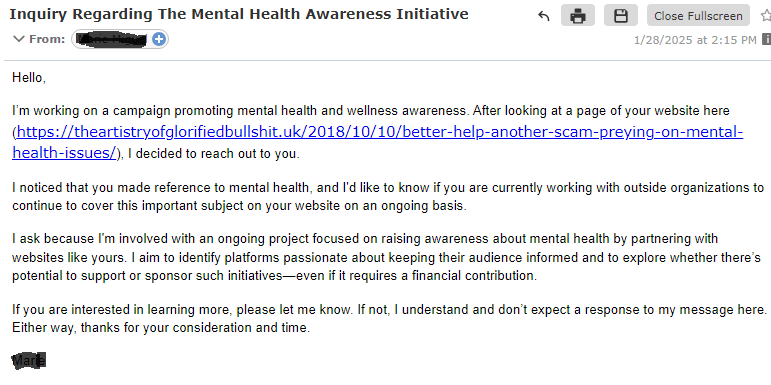
The sender (most likely non-human) not only failed to disclose any relationship to BetterHelp, but included a link which referred to the company as a “scam preying on mental health issues”. The language read a bit corporate, which should’ve been obvious. It wasn’t; perhaps I was too tired from my day job, which doesn’t involve scamming people.
Weird, I thought, but let’s not suspect bad faith immediately.
Someone can be forgiven for thinking the sender could be part of a campaign seeking to raise awareness about companies exploiting mental health problems, as they appeared to find that post relevant. Perhaps they were seeking to create a network of sites sharing information and publishing content based on it. It was a “project” and a “campaign”. Nothing to do with promoting a service for profit.
I responded with the following:
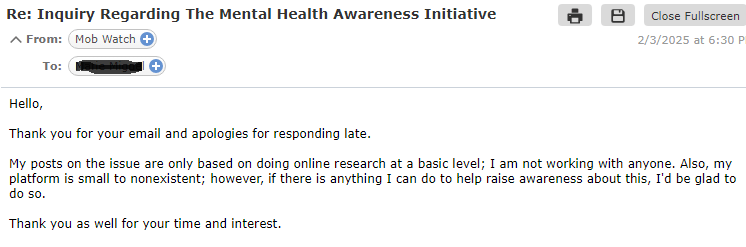
The reply was extremely funny. I’m redacting the names in case these are actual people – although, again, the link to my post and the generic “I noticed that you made reference to mental health” does point to this being a bot operation to pass on a form to random sites.
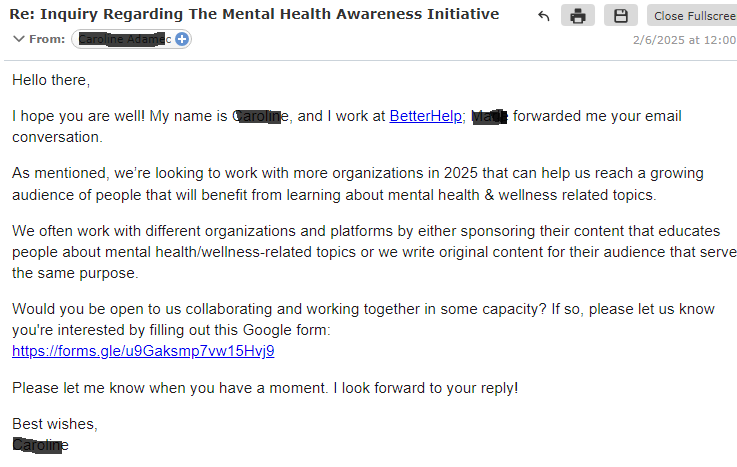
The form is basic and asks for your name, website URL, email address and ticking the box of having read the agreement, which is 4 pages long. The first bit is unremarkable legalese, unless I’m missing something.
As a disclaimer, I am not a lawyer; I am simply pointing out what is, in plain English, really dodgy in terms of recommending a service to the public.
Also, here’s what the agreement does not contain: anything related to trying the service before recommending it, to verify that what you advertise matches your experience. Many, many such recommendations include claims that the site or channel owner has tried the service and loved it. Could they have? Sure. But there is no requirement to do so. As you can see, the company approaches random people.


“C” requires the partner to avoid creating the impression that the content is endorsed by BetterHelp without permission, even if it’s paid for and reviewed by BetterHelp before publication. Remember all the blog posts and videos titled “My honest opinion” etc.?

“E” refers to the small print that one can find on websites (usually, if they look for it, on a separate page or right at the bottom), specifying the website is a BH affiliate. They’re outright telling the partner to hide their affiliation with BH aside from the mandatory disclosure they can produce if required. The intention is very clear, to avoid informing the public.
If a casual reader doesn’t look for this information and the content, title included, purports an honest opinion, they will never know otherwise. This is lying by omission.
“Out of an abundance of caution” is quite funny, suggesting they wouldn’t have chosen for the partnership to be disclosed otherwise. This is further reinforced by the end of the paragraph, forbidding the partner from openly disclosing they are being paid. If this doesn’t scream an intention to deceive the public to their best ability, I don’t know what does.
Again, we’re talking about platforms paid in advance to promote the company, whether the company wants them to disclose this openly or not.
The most revealing part, however, is below: a list of terms partners are not allowed to use in relation to BetterHelp and its services, which should raise red flags as tall as a stegosaurus:

“H” raises an eyebrow, as in relation to said practices, the partner is required to represent they are not engaging in them; there is no mention of actually not engaging in them. The mere fact that a partner must make this claim, loudly and clearly, means there have been concerns raised in the past regarding such practices.
To be clear, I’ve heard many of these terms used in BH adverts, vouching for the counselling services as private and confidential. Apparently making this claim is a problem! Why? Obviously, because it’s not true.
They have no qualms making these claims in fake reviews as well. These are not officially associated with the company and are supposed to be users’ opinions.

The word “confidential” is commonly used in videos sponsored by them.
The same caution applies to claims of deleting/ erasing users’ information after an account is closed. Bank details included, of course. We know this doesn’t happen as former users start being charged again out of the blue, months after closing their accounts and supposedly having them deleted, along with their information. I’ve read dozens of complaints to the Better Business Bureau on this issue alone. These are all public; previous posts on this blog contain some.
When the same issues come up for years, it’s not a mistake: it’s a business strategy.
The claims partners are not allowed to make mostly deal with the use of users’ personal information by BetterHelp. Namely all of these terms still pose issues, in terms of the company’s practices, in 2025. There are also references to regulations and compliance, claims which would break the law if made, clearly because they would be false.

From this list, we can deduce the following:
a. They are not doing what they are publicly expected to, such as being regulated by HIPAA and compliant with GDPR and CCPA, as well as protecting users’ personal information;
b. They are doing what the public does not wish or expect them to do, as in sharing, tracking, aggregating etc. users’ personal information.
BetterHelp were, of course, mandated to inform the public of how personal information is used; they have done so in legalese on a consent form that nobody reads and 99.9% of people wouldn’t understand. They just tick the consent box.
The reasonable expectation, regardless of country or culture, is that therapy is private and confidential (a word BetterHelp advertises yet still does not use in their TOS to describe their services; they now use “therapist services”, instead of the previous “counsellor services”, since they could not use “counselling”, as counselling is regulated).
They would not suspect that the company is not only after their money, but their personal information as well, as a commodity. This is a BBB complaint:
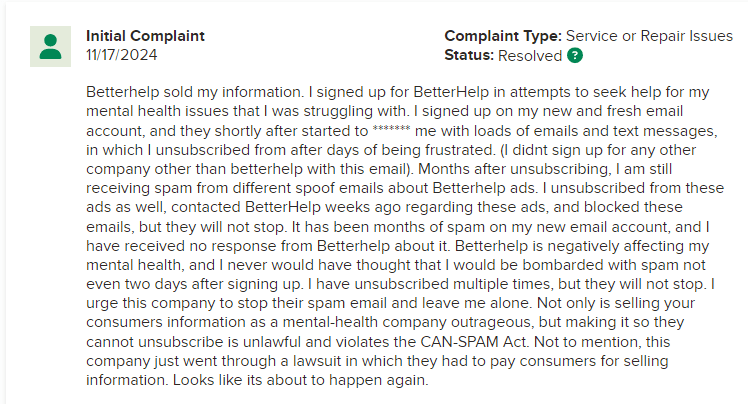
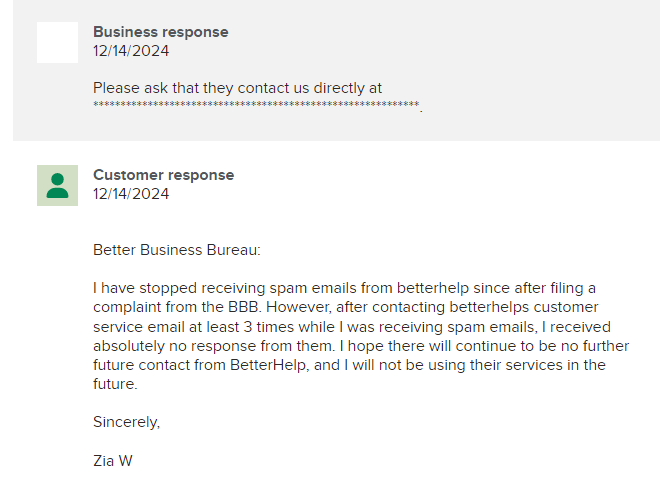
Perhaps this is why partners are forbidden from mentioning “third parties”?
It took a BBB complaint for the spam to stop. It generally takes a public complaint for any issue to be resolved. People try for weeks or months by addressing the company directly, with no resolution.

Again, not being a copyright lawyer, I can’t assert any technicalities regarding the “media” partners create and BetterHelp pays for and reviews before publication. The company clearly has control over the content. They approve it and it cannot be edited without their permission after publication.
Let’s take, say, a video to which the creator wants to make small modifications later. Maybe they noticed an imperfection or want to add another segment. Regardless of the theme, they have to go through the company first. They can’t just edit their own video, even if the modification is unrelated to their promotion of the company. So is the claim that they have all rights to it completely accurate? Should they be representing that to the public?

The rest is more average legalese making partners aware that they are responsible for their claims about BH and whatever may result from breaches of the agreement. This would, in normal circumstances, be straightforward.
However, this company engages in mass misrepresentation on its services/ false advertising, and one may very easily, inadvertently, make claims this agreement forbids, without even realising it. To the average unsuspecting member of the public, BetterHelp provides therapy and their services are private and confidential.
Exploiting the clearly vulnerable
The following is proof that their account termination system is designed to be confusing and prolong the subscription against the user’s wishes. There are many, many complaints on TrustPilot and the BBB, in the same vein, from people who had thought they had terminated their financial agreement with this company, to be charged again and again, with no notice and refusing repeatedly to end your recurring payments, which stinks of subscription scam.

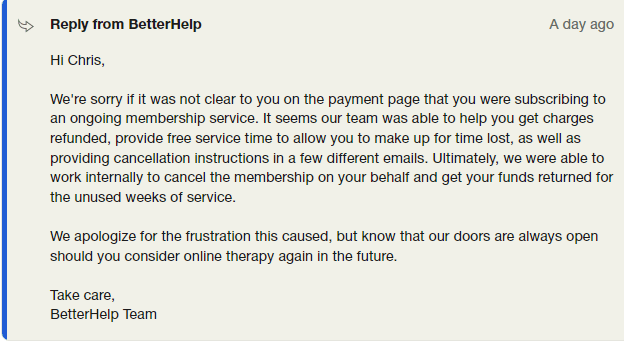
Using a system requiring two actions to terminate the account, one by the user and one by the company, is by design, in order to claim that one of these steps was not taken correctly. Not to mention it took weeks and multiple complaints for this situation to be resolved.
A BH mouthpiece replied on Reddit that accounts are deleted upon request, making further payments impossible. That’s clearly not the case.
Let’s assume this user didn’t cancel his membership successfully and relied on the company to close the account, which they agreed to. He was billed afterwards and they claim to have ultimately worked internally to cancel the membership on his behalf. How could this man have an active membership on a deleted account? The system is designed to trip people up, in order for the unwanted memberships to continue for as long as possible.
Another complaint from an elderly person duped by the religious branch:
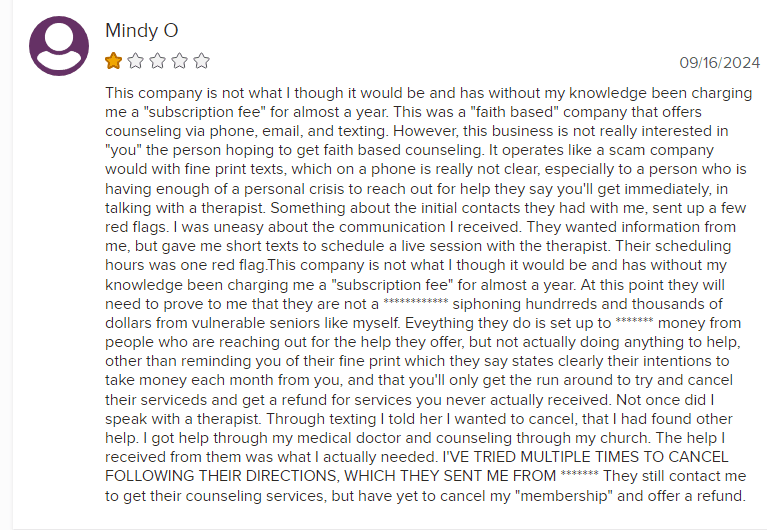
Logically, because this user had requested to close their account, she is now on the list of the people they pester to rejoin, while having a subscription she is unable to stop, despite communicating with the company or its bots repeatedly.
Again: SUBSCRIPTION SCAM, designed to make it difficult for the payments to stop.
Just like Hotel California: you can check out any time you like, but you can never leave.
Bank accounts left in the negative – targeting the poor
Among the plethora of horror stories are those of people BetterHelp was advertised as an affordable option to. These people were desperate enough to sign up despite having very, very little money. So little in fact that when unable to afford it and requesting a termination of their accounts, payments continue to be taken out, leaving them in debt with their banks on occasion:


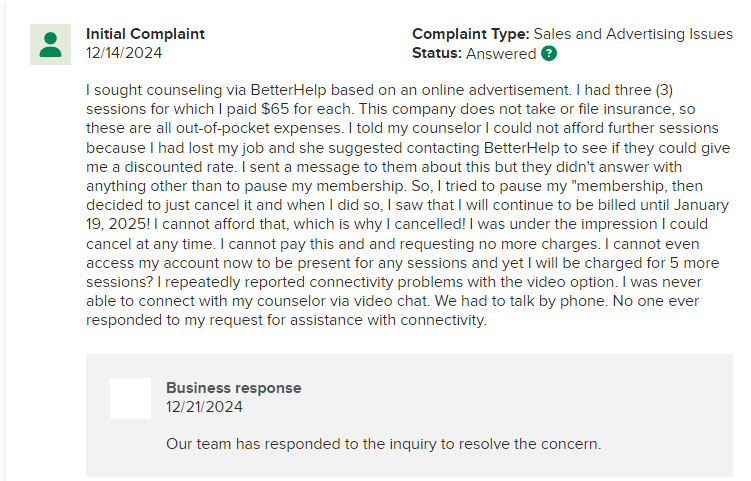
“They are one of about three companies that continuously get around my advertising preferences”

BetterHelp is comparable to strep or herpes, in that regard. How do they do it? Who are they paying off for privileged status? Welcome to unbridled capitalism.
Fake reviews continue
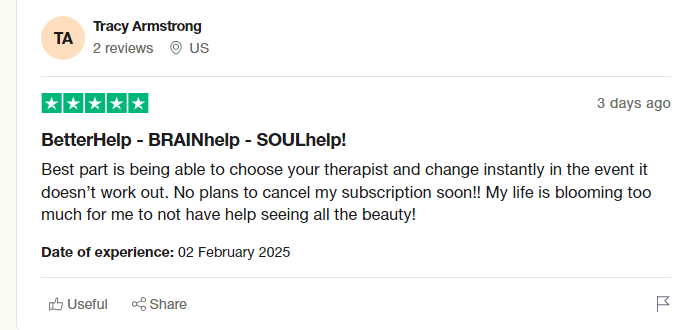
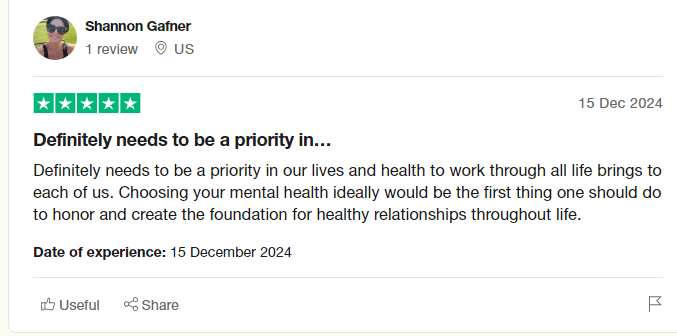
Through whatever method they’re using, all reviews on Trustpilot now appear as organic for the past 12 months, as opposed to invited, as used to be the case for positive ones. You can see multiple 5 star reviews daily, in clusters, from accounts with only 1 review each, namely the one for BH.

This screams use of bots.On their Trustpilot page, you can also see the following: may use unsupported invitation methods. I wonder if this being flagged at some point resulted in managing to make the reviews appear organic.

Their style of fake reviews continues to be the same. By scrolling through a few recent pages I found everything from bland content mill “produce” to used car salesman antics (those are hilarious) and the generic Zen ones (we all need this, you need this, mental health is so important).



Will the mostly ineffective ways to restrain them even be there in the future?
As a sad conclusion to this post, only weeks after Trump’s inauguration, it’s impossible to predict whether any regulator in the US will exist in the near future. Trump and Musk are decimating institutions designed to protect the public from being scammed, along with many others taken for granted for decades by the public.
What is to come in terms of these shysters and many other predatory companies remains unknown.
However, if a psychopath could take corporate form, in terms of exploitation and lack of empathy, it would result in this company.
 The Artistry Of Glorified Bullshit