
This was, of course, predictable a few years ago, when non-expert material began to circulate, treating the DSM with as much gravitas as one would treat a horoscope – except horoscopes aren’t typically used to demonise people.
Society now has an ambivalent approach towards mental health. It acknowledges the suffering of some and seeks to completely dehumanise others, whether they are themselves struggling or not. Whereas some people are indeed dangerous and malevolent, simply suffering from a condition does not class a person as irredeemable. Of course, today, they needn’t even suffer from one.
This post delves into the use of such labels more keenly than Harry Potter’s wand. It’s very interesting to observe how your average coffee shop Freud moves from point A to point B in their assessment. It is also proof that these labels fuel smear campaigns, since as soon as they are placed on someone, the crowd believes any lie or rumour seeming to fit the profile.
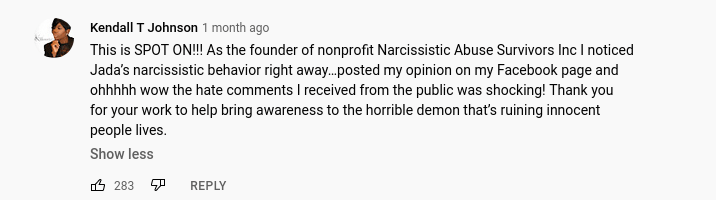
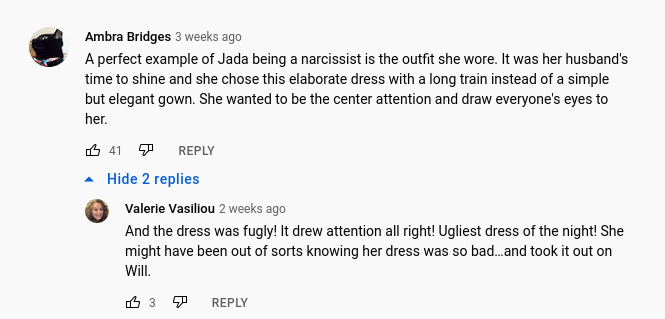
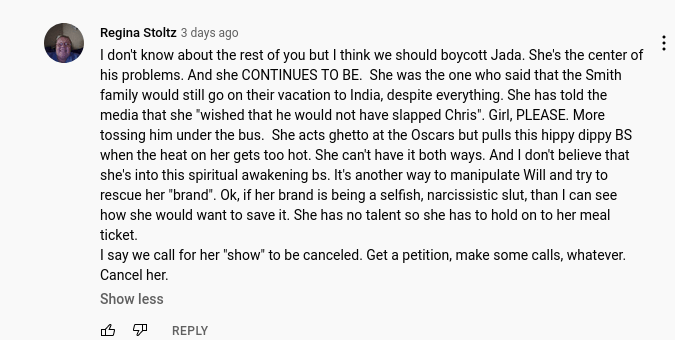
If therapists don’t armchair-diagnose strangers, as it would be unethical, why would the average Joe? For anyone else to have a serious suspicion that someone is suffering from a personality disorder (save for extreme acts) there is one basic requirement: that they know the person well enough.
Sadly, we live in a world were the following are prerequisites to seem normal:
- Having strong opinions, even when based on very little;
- Displaying as much knowledge as possible, even if it’s truncated or diluted;
- Expressing outrage and demanding action;
- Exulting one’s virtues by identifying victims and villains in every situation;
- Hyper-focusing on a small event and giving it worldwide importance;
- Associating an individual’s behaviour with a group they belong to and raising the discussion to the level of group squabbles.
The following phrases have all but been forgotten:
- This is none of my business.
- This isn’t a matter of public interest.
- I don’t read minds. I don’t know why someone behaves the way they do.
- I’m not a psychic, to predict what this person will or won’t do in the future.
- Things may appear a certain way and be very different in reality.
- I dislike this person/ they give me bad vibes, but that doesn’t mean I wish them harm.
- I disagree with this person’s behaviour, but I can only comment on what I know.
- I can only point out a trait or two this person seems to have.
- This person’s behaviour triggers me, as it reminds me of others who harmed me, but that’s my problem.
- I have an opinion on how this person could handle a situation, but at the end of the day, it doesn’t concern me.
When it comes to the NPD label, public figures receiving it from the crowd have only displayed snippets of certain behaviours, natural or not (one ca never tell what is real or staged). Furthermore, their image is heavily distorted by the gutter press.
Let’s, for one second, compare these crowds to an actual lynch mob. The scope and results may be different, but the process is very similar.
- They use prejudice (in this case, a strong dislike) to blame the target for certain events, even against common sense;
- They project their own frustration by comparing the target to others who have personally harmed them;
- They congregate and emit theories about the target with little to no evidence, taking them as far as they can;
- They use unsubstantiated rumours and distortions to amplify their narrative;
- They reach the conclusion that the target is irredeemable and likely to cause harm to others;
- They engage in calls to action against the target;
- They anticipate the target suffering as much as possible, to their prospective amusement.
Sourcing a label from the DSM is merely a prop in the process of good old-fashioned mobbing.
Support groups for people affected by someone else’s potential disorder are not Al-Anon
With Al-Anon, for instance, the issue is straightforward, namely trying to cope with someone else’s alcoholism. Alcoholism itself is a pretty straightforward issue; it doesn’t take expertise to determine that someone’s drinking is affecting their relationships. With suspected personality disorders/difficult behaviour, congregating to discuss this can be murky, especially when lacking a diagnosis. Being misled is very easy, if no one you speak to has actual expertise.
Such groups can be started by anybody. A few self-styles titles are now in circulation, such as recovery expert and recovery coach. These sites may be associated with certain “services”, such as coaching sessions. These people are encroaching on the mental health field with no expertise whatsoever.
Even more dangerously, some tell their audiences that therapists, who are cautious in terms of diagnosing, sometimes don’t know what they’re talking about – instead, you should listen to them, because “they understand”.
YouTube channels based on disorders, when not run by professionals, expose viewers to the same peril. They have emerged to capitalise on a trend, some in a shameless manner, putting out daily “information” which might as well be scripted by a text spinning bot. Honestly, how can someone who has not studied this matter put out daily content because X number of years ago they dated someone they thought had NPD?
Here’s just one example:

Nowhere on this channel is a psychology degree or at least a life coaching course mentioned. Nonetheless, its owner offers private coaching sessions, to “rid you of psychopathic abuse”.

This is not a mental health professional, legally obligated to maintain confidentiality. There is zero accountability for this type of interaction. If the paragraphs above are reminiscent of “Peace” from Psychopath Free, it’s because his grift has developed into an industry by now.
Narcissistic abuse victims “have a magical ability to detect narcissism in 5 minutes” (apparently).
Let’s take the recent case of Jada Pinkett Smith, whose failure to laugh at a joke triggered an avalanche of vilification. For the record, I don’t care if she’s an agreeable person or not, or how she handles her marriage and family life. It’s none of my business.
I’m just here to marvel at the crowd.
Narratives built on speculation are fascinating (or horrifying, rather), as they build up from one speculation to another, with the previous already considered fact by the time the new one emerges, having a cumulative effect. Have you ever heard the song The Rattling Bog?
The foundation itself can be a false premise. In this case, the narrative began with this woman being accused of causing her husband to assault someone by rolling her eyes at a joke, which was completely irrational.
This is how every piece of information evolved, to paint the final picture. Please bear in mind these people haven’t spoken publicly about their marriage since that incident; the following distortions were made by the press and crowd alone. As a personal note, these are people you wouldn’t want to take an order from at McDonald’s; a perceived wrong look from you could cause Armageddon.
1.She rolled her eyes at a joke. This turned into the following:
- She wanted her husband to commit assault.
- She made her husband commit assault, knowing he would, because she controls him.
- She ruined his career out of momentary selfishness.
- She ruined his career intentionally, out of jealousy; she’d been plotting the right moment to do so.
- She is now happy to have ruined his career. Typical narc!


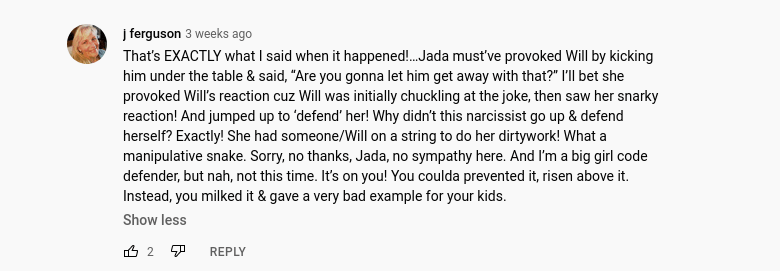
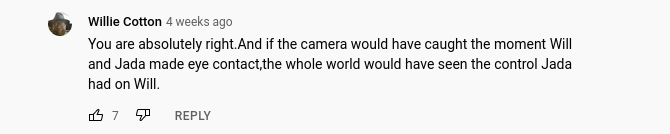
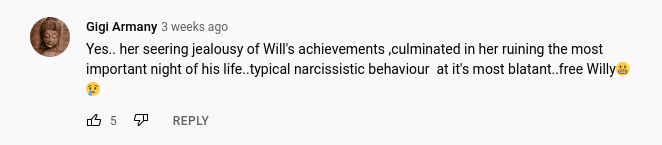

2.She apparently made a statement that she regretted the incident, saying her husband had overreacted. This turned into:
- She turned her back on him!
- She’s ungrateful!
- She threw him under the bus! Typical narcissist!
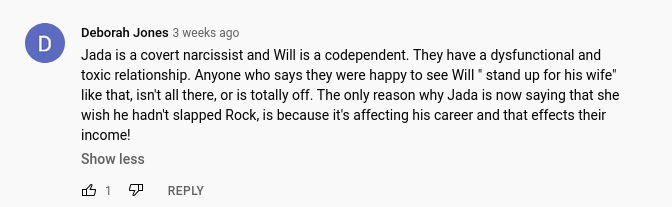
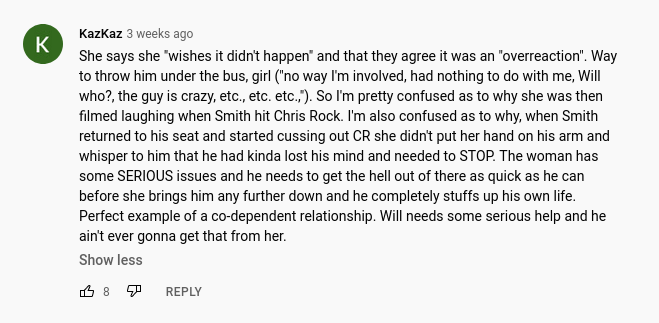



3. An old promotional video popped up (genuine or scripted, no one knows, as it’s been public for 3 years) in which her husband said he was annoyed at being filmed. This turned into:
- She has clearly been abusing him for years! He looks like a broken man!
- She’s been ruining his life; he should run!
- Typical narcissist/psychopath; she doesn’t respect other people’s boundaries!




4.A rumour emerged in a tabloid that she and her husband were getting divorced. This turned into:
- Of course she wants to get rid of him now that she has ruined his career on purpose!
- She destroyed him and now the bi**h wants half of his money!
- This is the best thing that has ever happened to him!

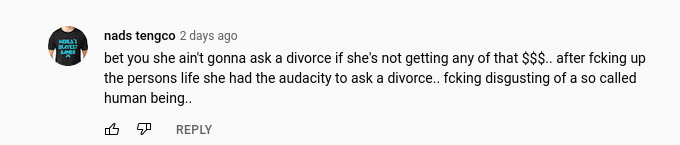



“As victims, we see things other people can’t; we don’t need a degree!”
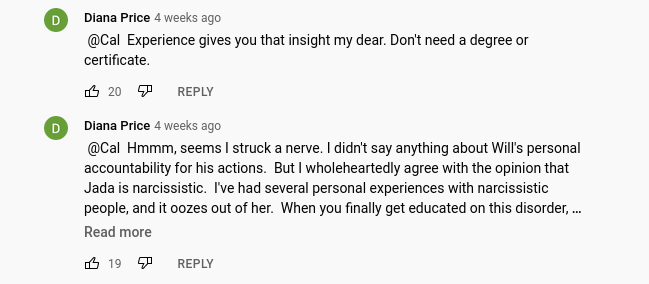
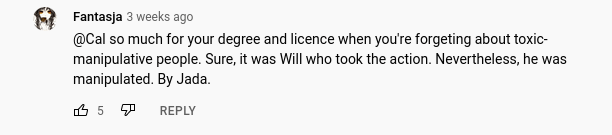
I’m sorry to tell them, but no. Some things their ex-spouses/partners or family members did, that they see reflected in the behaviour of complete strangers, may trigger them – but that’s about it. The following chain of comments displays a typical swarming in a “support group” of this ilk, when these fine people are reminded that in order to diagnose a person, one needs qualifications.
The user challenging them seems to have deleted their comments. From one of the replies, it seems they may have been a licenced therapist. It’s the pinnacle of irony when these people choose DSM terminology while disrespecting the field and those trained in it, claiming they have better methods.
Please have a look at the ire and passive-aggressiveness they display.
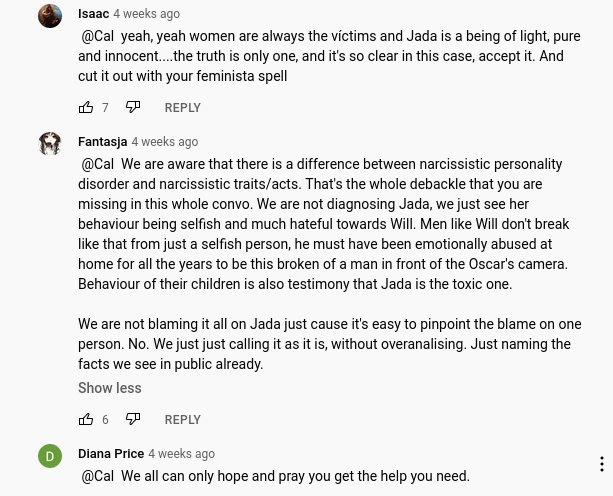
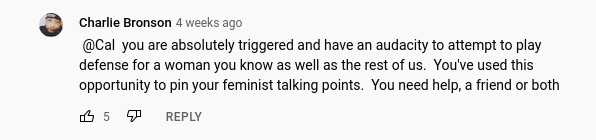

One thing to point out here is that the infection has spread well beyond SJW circles, where it started initially. The terminology is now well in use by the Red Pill crowd, to – you guessed it – further stigmatise women. I’ve also noticed it being used by Christian channels who “specialise” in narcissism – to, you guessed it, portray people suspected to have NPD as the embodiment of evil.
 The Artistry Of Glorified Bullshit