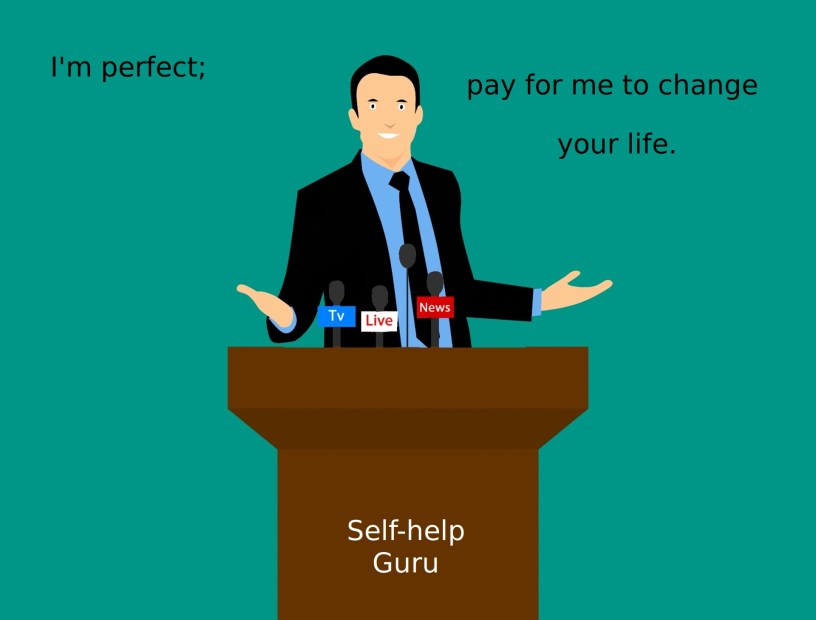
In recent months, the Dave and Rachel Hollis debacle has once again shed light on the troublesome self-help guru business. Not only were they charging hundreds of dollars for marriage conferences, setting their marriage as an example, while on the brink of divorce (for several years) – their tone-deaf interaction with the public showed both solipsism and entitlement.
To clarify, this isn’t about their personal life, which shouldn’t be anyone’s business (regardless of them having turned it into a product). It’s the principle of it. What happened to Dave Hollis is sad, and it’s a product of our current culture, of marketing oneself as a source of inspiration for the masses while being an internal mess, as if there were no other avenue to make money.
After his divorce from Rachel, Dave Hollis, still determined to maintain his guru status, released the book Built Through Courage, an exercise in navel-gazing, filled with platitudes and strained nautical metaphors, which at the end of the day gave no practical advice on how to pull through hardship. Sure; people meditate; they write their thoughts and feelings down for later reference. One can use a journal or a blog for that. When someone markets those thoughts as life-changing for the public and slaps a price on them, peddling them incessantly, scrutiny will follow.
It’s only fair to record such thoughts and develop one’s understanding gradually. It’s therapeutic. But that does not entitle a person to proclaim they are an example to follow, or that their coping mechanisms can help anyone.
As his books sales were not spectacular, Dave had a live internet meltdown, berating his followers for failing to buy his life-changing product, which generated second-hand embarrassment and laughter. Shortly after, he checked himself into a facility, not doing very well mentally, and has now emerged to promote a fresher perspective.
What happened isn’t speculation, as he was very open about it: he drove himself into a state trying to climb onto the illusory pedestal he had built.
It never once, through this process, dawned on him that he was inflating his capacity to help his audience through said book (or any other subjective material). It never dawned on him that if he couldn’t manage his own life, mental health and emotions, perhaps he should reconsider that line of work. Or that he had no credentials or training to market himself as such to begin with (and still doesn’t have them).
The facade must be maintained, no matter how ridiculous the discrepancy becomes at some point. He must, pardon my language, continue to fart out inspirational platitudes for the masses to consume, using his daily experience as fodder, and even his own mind, which he publicly dissects in order to extract marketable bits of wisdom in real time. It must be exhausting!
Self-help gurus are per se a curious phenomenon, especially when they start in their field of expertise and branch out to offer comprehensive advice on living one’s best life, as if they had everything figured out. They never do. They are, after all, human – subject to the vicissitudes of life; subject to crises, moral failings and emotional meltdowns.
Marriage conferences…?
Once upon a time, when people experienced marriage problems, they turned to elders in their family or community, or alternatively, to clergy. Of course, that could have disastrous consequences as well, if said advice was based on rigid cultural norms, such as tolerating adultery or abuse.
In recent decades, the habit of seeing a therapist has become more popular. However, therapy takes time – and in today’s world, people are looking for immediate relief and solutions. Why spend half a year in therapy, analysing your situation, when you can walk out of a marriage conference with the ultimate recipe for happiness?
As appealing as a quick fix sounds, here are some reasons why these placebo events are a huge waste of money (as well as hope):
- By looking up organisers, you will notice some have never studied psychology. They became popular for other reasons altogether, such as flaunting their business skills. Dave and Rachel Hollis, very successful before their divorce, were just one example. These people base their expertise solely on their temporary situation. There’s no way to test the validity of what they are selling; not even for their own future, let alone someone else’s.
- There is no one-size-fits all solution. It’s ridiculous to claim that what works for two people with unique personalities will work universally.
- You have no guarantee that those parading their stellar marriages are telling the truth (again, Dave and Rachel Hollis, who had been on the brink of divorce for up to 5 years while selling tickets to school others on how to better relate to their spouses).
- Life is fluid and unpredictable. A stable, happy situation, albeit genuine, is always momentary. Things could change at any point (some people divorce in their 60s or 70s). In fact, some people wake up one day to discover they didn’t know their spouse in the slightest.
The industry that will “change your life”
Self-help gurus are as invested in your happiness as your drug dealer. Sure enough, he doesn’t want you to die; he’d lose a customer. But at the end of the day, he doesn’t care whether you buy his merch to relax on a Saturday or to commit suicide by overdosing. If your use is caused by suffering (and it often is), the more you suffer, the more money he makes.
One may look at self-help as a journey with a clear starting point and destination. The (improvised, unscientific, superfluous and often plagiarised) material, however, is not designed for that at all – but to provide you with a momentary high, so that when it eventually dissipates, you return for more.
One may also think self-help and therapy share the same goal: to improve one’s well-being. Whereas a therapist seeks for you to reach a point of no longer needing support, self-help material has the exact opposite effect. You are never functional, successful, zen enough; you should keep trying for more, with a missionary zeal.
The self-help guru seeks an ongoing para-social relationship with customers, the latter being utterly unaware they’re not just buying one book or going to one conference, to emerge with new skills. Interacting with one product comes with encouragement, if not pressure, to keep “investing in yourself” through further participation.
That’s how some people end up attending Tony Robbins seminars three or four times, spending thousands for the privilege. It doesn’t occur to them that if those seminars were as effective as portrayed, there would be no need for a second one, let alone a third or fourth. Likewise, people get stuck in LGATs such as the Landmark Forum for years.
Where does the addiction end? One either realises its nature and futility, or they run out of money. Additionally, they may look back on radical decisions made during these quasi-maniacal phases, such as getting a divorce or alienating friends and family members.
 The Artistry Of Glorified Bullshit