
In recent years, especially since the MeToo movement, a new profitable venture has emerged for the press and online content creators – that of supporting allegations of mistreatment, at times in the absence of any proof. It’s no surprise some build their personas specifically to mirror society’s desire for such things to be brought to light.
One might even call this new venture the allegation industry.
People (generally women) with at times very serious accusations against public figures, some claiming to have evidence or even showing part of it, turn to large channels to make their stories public, instead of going to the police. Not only is this to their detriment, as it could endanger any case they might have – they put their trust in shady characters and help them create a facade behind which their behaviour unfolds unperturbed, giving them legitimacy.
If the cases are genuine, they are exploited and weakened should they go to court. If they are not, which is also very common, these channels create smear campaigns and witch hunts, causing untold damage to innocent people.
The case of YouTube creator Edwin Costa (recently featured in an Investigation Discovery “documentary” based on false accusations) is a fascinating one. Behind the appearance of giving a voice to alleged victims, his behaviour and views could not display more dishonesty, less empathy and more actual misogyny if he tried. Whilst it’s impossible to link individual clips for every issue mentioned, you can find compilations of all relevant evidence, consisting mostly of Mr Costa’s own footage (which leaves no room for interpretation), on this channel.
The contrast between his sensitive, moralistic SJW persona and actual behaviour makes for a perfect caricature of our times, in terms of the facades crowds worship.
To list just a few of the behaviours he can be seen engaging in for years, if you click the link above:
- Repeatedly and un-ironically referring to women as their genitals, at times in their presence; sexualising women in public and making inappropriate comments regarding their sex lives;
- Behaviour which bordered on – or was – sexual harassment, by touching, grabbing and attempting to kiss women without consent. This included rubbing chocolate on his genitals, offering it to an unsuspecting woman and then asking verbatim how his testicle sweat tasted.
- Outing his girlfriend as potentially LGBT in order to advertise her OnlyFans page (nude content) against her will, and refusing to stop discussing it at her request, claiming if she refused, he would “speak for her”. In the same context, he described to his viewers what she could do for them with a price listing, as if he were pimping her out.
- Creating sexually explicit content aimed at minors, which he referred to as educational, despite it being nothing but a nausea-inducing display of vulgarity, with an emphasis on talking graphically about genitals and bodily waste;
- Making a ton of content now considered racist and recently, impugning others who had created similar “comedy” at the same time, partaking in their cancellation with utmost hypocrisy;
- Falsely accusing people of publishing his private information, as well as stalking him, in order to deflect their criticism of his public actions and language.
All of the above, while still public on his channel until recently, is unknown to his SJW audience, recently cultivated after he hopped onto the MeToo bandwagon. Akin to some other characters discussed on this blog in previous years, Mr Costa and many like him give a shoulder to cry on to those who claim to have been in abusive situations. And like said characters, when alleged victims don’t conform to their wishes or plans, these “white knights” simply turn on them.
Nightmare on Ed’s street
There’s nothing more endearing to young audiences than someone opening up regarding a traumatic event, appearing raw and emotional, and ultimately claiming victimhood. One such claim alone, even if defying all common sense, can attract a large following and convince people the person in question deeply understands human suffering (as in they are not choosing to push stories of abuse for views and money).
Edwin’s claim relates to – I kid you not – being asked to leave a shared apartment, after engaging intimately with his best friend’s girlfriend, whom he subsequently took off with. The predictable aftermath of this betrayal, which only consisted of an online conflict, is what he describes to this day as his “trauma” and “abuse”(he’s a grown man, now in his 30s). Here we notice how the mere use of the word “abuse” obliterates the cold hard facts of a situation.
Since 2017, Edwin has been slandering his former best friend of 8 years and his current girlfriend (portraying her as a psychopath, accusing her of poisoning with a ridiculous story and threatening to call ICE on her), in order to paint them as malicious and disguise the reality of what occurred. He managed to run them both off the platform. To this day, his audience of almost 300.000 sympathises with his “trauma”.
Fake crying – a silencing tool for the faux feminist man
YouTube audiences haven’t wised up yet to the fact that on a public figure’s part, crying, particularly as part of edited content, is often a manipulation technique. Politicians, for instance, are lambasted for such comical displays; most people see right through them.
Mr Costa has taken note of this appetite for sensitivity and can often be seen mimicking this state (although ineptly) whenever issues arise with his reputation. Surprisingly, a large crowd (which includes adults!) flocks to comfort his simulacra of emotion over the smallest bruise to his ego.
At most, if people did believe such scenes, they would think the person had mental problems, in order to cry over inconsequential issues, such as being disliked, criticised or questioned. They wouldn’t validate such episodes and seek to resolve them by attacking those who presumably caused them. Welcome to the 21st Century. It doesn’t matter how much callousness and deceptiveness someone displays on a regular basis – as soon as they contort their face and strain their voice, as if they were almost in tears, they are believed and sympathised with.
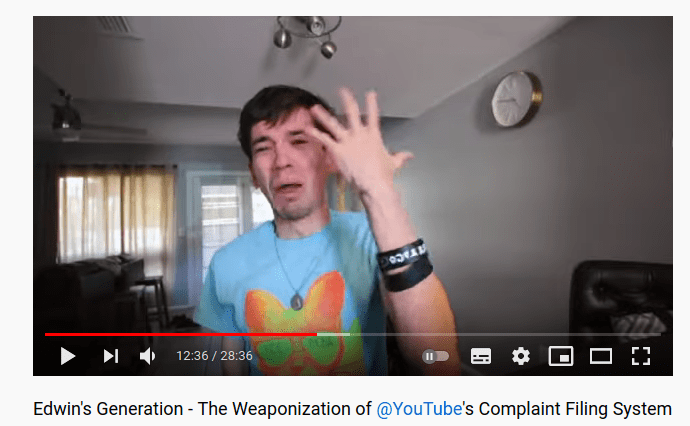
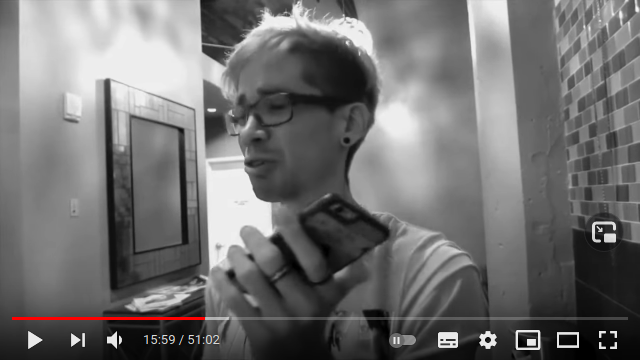

Needless to say, such theatrics are insulting to viewers’ intelligence – though in some cases, the insult seems deserved.
“Pussies” and “bitches”
In his preformative act of supporting victims of abuse, Mr Costa uses the popular vernacular decrying the objectification of women. He speaks to them in a soft voice, never pressuring them to reveal what they’re not comfortable with and pledging his support, if not his friendship to them in the future.
He indeed seems horrified that anyone could disregard their humanity and treat them like pieces of meat. Give him a few drinks however and his character, as well as actual vocabulary and views on women will shine like phosphorus.
The channel linked to at the beginning of the post shows an abundance of instances, some recent, of his objectification and unnecessary vulgarity, not expressed in anger but very naturally – jovially even – towards women who hadn’t wronged him in the slightest. It’s anyone’s prerogative to be vulgar, demeaning and misogynistic – however, this individual portrays himself as respectful and sensitive, impugning views similar to his own in order to make a profit.
How Mr Costa ended up on TV as a supporter of alleged victims
In 2020, Edwin agreed to participate in a “true crime” documentary based on fellow creator Onision – now proven to have been defamatory, as the police cleared Onision of any accusations.
Arguably, he was not their first choice – when recruiting for this fickle and slanderous production, they approached many creators, who knew this project was bound to fail and attract negative reactions from their audiences. They were aware for many reasons – chiefly the person behind it (Chris Hansen), as well as the refusal of most alleged victims to take part. Despite their avidity for fame and money, they were smart enough to steer clear of this trash fire.
As shown by leaked conversations, Edwin agreed to take part in August and gave his interview in October. The public found out much later. Publicly, he was fiercely supporting the alleged victims’ outrage at their stories being used without consent. Privately, he was even boasting at some point of having managed to convince two of them their image and stories would not be used – and they were, of course, used, with minimal blurring. He even signed a contract stipulating his participation would not be disclosed to the media in advance; that’s how aware he was of the inevitable backlash.
After 5 months of decrying this documentary and dissuading others from taking part (not that it was needed), a trailer was released, which included him. He lamented having been “robbed” of the chance to inform his own audience (to gently use manipulation playing off his duplicity). He further claimed to have been duped by producers, lamented the final cut and victimised himself.
In the first 3 episodes combined, he was on screen for a grand total of 5 minutes. He did all this for 5 minutes on the small screen.
Of course, it is now certain the entire production was based on false claims – but at the time, he at least pretended to believe Onision’s accusers and act in their support. Imagine if these had been actual victims of crime, outraged at being exploited .
 The Artistry Of Glorified Bullshit