
Whilst the previous post attempted to explain some basic concepts they use, this one explores those specifically related to recruiting new people and deflecting their concerns, which, as usual, entails using manipulation. The quotes below were also found on Quora, on various threads about Landmark. The mental gymnastics to avoid meeting the interlocutor halfway, while still pretending to keep one foot on Planet Earth, are something to marvel at.
Do you feel forced into signing up? Go to Landmark and learn how not to be a pushover!
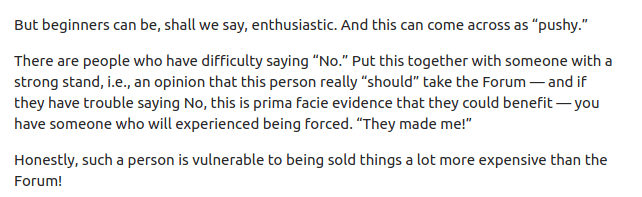
The level of mind-fuckery is astounding.
In other words, it’s not usually OK for people to be forced into things – unless it’s Landmark. In that case, being forced is an experience. It’s the pathway to never being forced again, and to fix their weakness, even though the Forum doesn’t mind exploiting that weakness initially, for its own purpose.
At the same time as claiming someone should be “coachable” and open-minded, they agree they have people in those seats against their will – and they think that’s fantastic.
Here’s the reality of it – some people go because they are threatened with a divorce; others are threatened with being fired (or it’s heavily implied they won’t last long at their jobs unless they go). Others are manipulated by relatives and made to feel inferior. Others are minors and don’t have a choice. Forcing someone into a thought-altering program is never OK, regardless of the circumstances.
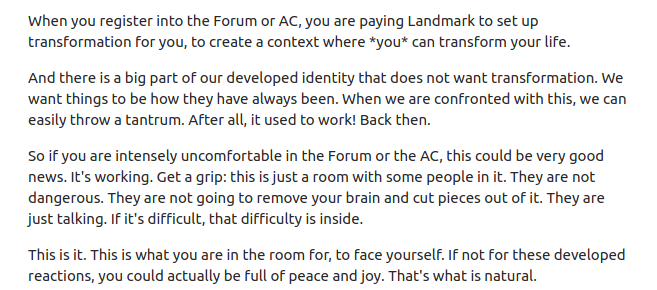
What about those who are unwilling from the beginning, and are dragged there by others, to be berated with no limits? What about those who are there under serious threats? It doesn’t matter, apparently. They are teaching people it’s OK to force others, no matter how awful that experience will be.
In fact, what Landmark does is almost identical to confession nights used by cults to demean and de-personalise their members, whereby the group gathers, everyone confesses their sins and they are torn down verbally (and sometimes physically abused as well). It’s very traumatic and with time, members learn to be numb. In the previous post something important came to light – Landmark seeks to detach people from their emotions. That’s why this person is so comfortable saying it’s natural to have no reaction to verbal abuse.
In terms of the benefits of making someone uncomfortable, it all depends on their intentions and perception of what is happening – in other words, if they are willing. When someone goes through an experience likely to be harmful, without their consent, it’s just abuse. We can compare this to BDSM, for instance, which entails one person enacting sadistic tendencies on another. The crux of the matter is that the latter trusts the sadist (for some reason, as those tendencies are not a good sign). In other words, there is consent for what is happening and the experience is perceived as positive. If the next day, the sadist were to do the exact same things to someone who did not consent and found it horrifying, it would be abuse, which leads to trauma (and prison).
That is the difference Landmark adherents refuse to understand when they talk about forcing people to be “uncomfortable”.
Do you want to refuse an invitation to Landmark? Go to Landmark and learn how to say no!

What a mind-bender: if you had been to Landmark, you would know how to decline his invitation, so go there and learn (even though your intention was precisely to avoid going).
I added this to show there is nothing that can’t be turned around to how Landmark is the solution to someone’s problem – not even when the problem is Landmark itself! It would be funny if it weren’t so sad.
Harassment – which their constant calling certainly “isn’t”

It’s a myth, even though it’s admittedly happening, because “graduates are unskilled”. People are not called by some abstraction known as Landmark, but by graduates on its behalf, under pressure to recruit more people. It doesn’t matter if most of them do it, and they do it all the time, as has been reported for years. It’s still not Landmark calling, hence not Landmark’s fault. Do you see how they separate language from reality?
That’s like saying alcohol consumption can’t be held as the cause for people getting DUIs after crashing their cars. Fair enough, they all crashed their cars and they all got DUIs. But the presence of alcohol in their blood is just one big coincidence! It’s not the one thing that made them all behave the same way; the one thing without which they wouldn’t have done so.
Also (and I’ve noticed this often from the person commenting above), note that there is a clear differentiation made between “fresh” graduates, who are unskilled, and those who have completed more Landmark courses. That is to say when someone pays for the initial seminar, if they don’t go further, they will remain at the stage of inappropriate and alienating behaviour. No one advertises Landmark as a series of courses, but as one single experience. According to the person above, if a graduate wants to lose said behaviours (instilled into them by the Forum), they have to take more courses, and therefore spend more money (as in the Forum fixing what it broke in them).


Again, see how they detach language from reality?
“Over and over is a story, an actual number would be what happened”. Not the frustration, the annoyance, the inconvenience, the invasive nature of those calls (which involve manipulation) and the knowledge of being the target of someone’s unwanted attention. A number. Why attach any emotion to anything you experience? It bothers them when you react like a human being to your boundaries not being respected.

This was in response to a fragment in the French documentary, involving a woman who had asked the leader why she had been harassed by the company with 4 calls in one week – to be told, of course, that harassment was an interpretation.
Debt collectors don’t call 10 times a week to ask you out on a date either! It doesn’t make it appropriate.
Once again, this removes something essential from the equation – the other person’s nature and intentions. When someone harasses, their sole purpose is to apply pressure, causing their target to acquiesce to their will to make the harassment stop. What does that say about them? That they lack boundaries, that they seek to control or exploit others and that they lack human decency/ empathy/ manners. The behaviour is predatory, even when all the harasser gets is joy out of pestering.
For the target, it’s very clear that the person does not operate in good faith (or isn’t sane) and the interaction isn’t safe. The comment above legitimises control and suggests people should allow their boundaries to be crossed. Remember that at that stage, the woman hadn’t even been to Landmark yet, to be brainwashed into seeing any behaviour on their part as acceptable. They are just so entitled.
Landmark is more important than any event you can EVER attend (including weddings and funerals)
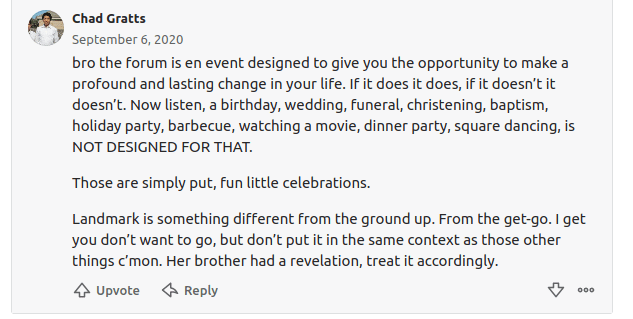
I hope I’m not alone in finding the grouping of funerals with barbecues and square dancing, followed by “fun little celebrations”, as odd. Sorry I can’t make it to Aunt Margaret’s funeral, but no worries, I’ll make it to her next one!
Landmark seminars are, presumably, easier to reschedule than those pesky weddings and funerals. But that doesn’t matter, since any major life event pales in comparison to flattening your behind in a basement, trying not to empty your bladder on the floor, absorbing the wisdom of a used car salesman who called himself God.
Do you hate Landmark? Go do it!
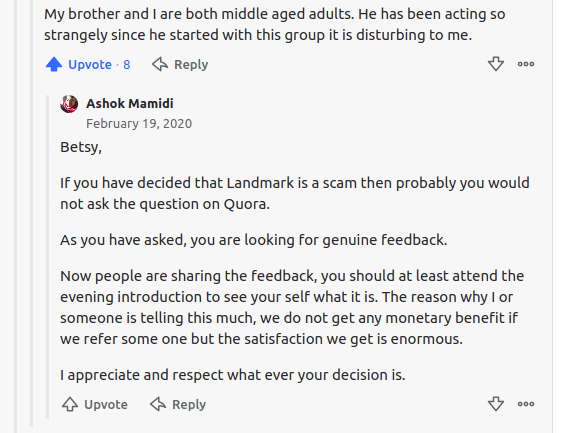
It wasn’t a question and Betsy going to Landmark was never on the table. She was merely describing her brother’s bizarre behaviour. Now she should “at least” attend an evening introduction because some people replied to her comment on a public forum. Great logic! Not cuckoo in the slightest.
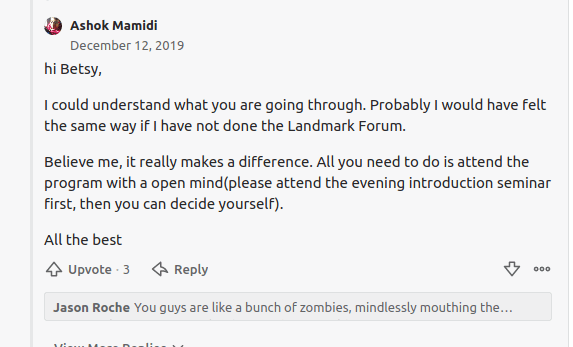
If you had done Landmark, you wouldn’t have a problem now with someone’s strange behaviour – you would be the same! You’d stop seeing it in other people. And if anyone had a problem with your strange behaviour, you could recruit them!
Problem solved.
It’s not your fault, you are at cause

Without repeating what is erroneous regarding the notions or right, wrong and fault, what I want to point out is using different language to provoke the same reaction in normal people, to avoid the observation that they are saying something absurd, if not gross.
It’s no different to say you caused that priest to molest you (even by merely existing and being there) than to say it’s your fault that the priest molested you. Neither applies. The priest is a paedo, he caused it and it’s his fault. End of story.

“It’s not brainwashing”; you only need to put aside all your prior knowledge and beliefs!

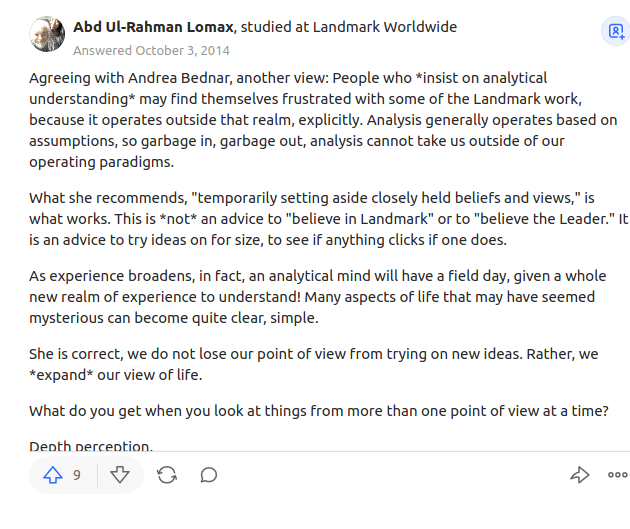
Analysis doesn’t solely operate on assumptions – it operates on knowledge (based on undeniable facts), observation and life experience. Of course, Landmark invalidates all of the above.
Having an open mind does not entail being a blank slate, after having silenced any tools for critical thinking. It does not entail being willing to give up your sense of reality, to be replaced with whatever a stranger wants to pour inside your head with a funnel. And as we know, Landmark seeks to detach a participant from reality as we all experience it.
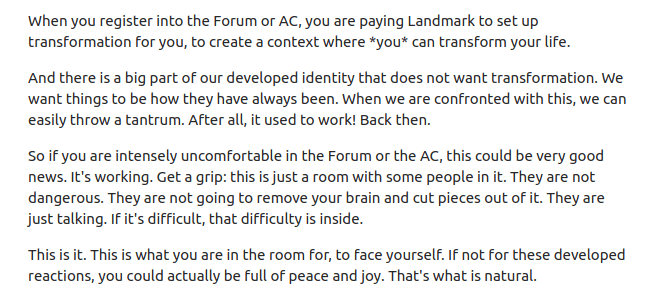
When someone goes there, they usually haven’t been given the most basic information. They are somehow expected to go in with a mindset of submission, even though nothing legitimises the Forum but word of mouth – the curriculum was designed by a used car salesman with zero background in psychology. Why would they leave their critical thinking at the door?

Note that the comment above pointed out facts – Erhard was a charlatan. He was run out of town. Why then would someone be expected to be “open to the experience”, knowing who designed it? The responsibility is placed on the person for having a certain attitude, with no acknowledgement of those facts. You see, reality doesn’t matter.
Don’t question the Leader (but “this is not a cult”)

Effective, sure, but for their own purposes. After all, in one Leader’s words, “rape is interpretation, brutality is interpretation”.

That’s the same thing religious charlatans say when the miracles they promise in return for donations fail to manifest – it’s the person’s fault, they must be a sinner, they haven’t been touched by the holy spirit. It’s not that they can’t ever prove they can ever deliver what they claim.
If a program is efficient, it should work for normal people who engage in critical thinking. It shouldn’t require altered states of mind. Therapy doesn’t require the client/patient to leave their critical thinking behind in order for it to function – quite the opposite.
“Saying no keeps you small”
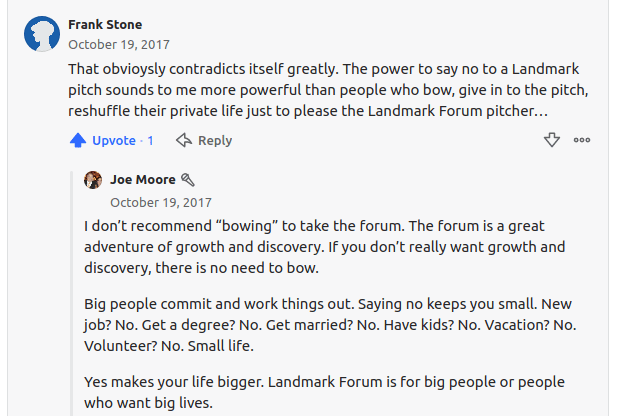
I can imagine someone saying these things while high on cocaine, “bigly”, to quote an orange man with a bad wig.

You see, if you don’t go for it, it’s not because you distrust it for logical reasons. It’s not because most reasonable people would distrust it in the same manner. It’s because you want to live like a roach!
Anecdotal evidence, such as some people being ecstatic with their choice at one point in time, is not sufficient. Those who had their lives ruined by Landmark were also ecstatic at one point in time. The members of Heaven’s Gate were the happiest people on the planet – until they decided to leave it, to move on to greater things. They were committed to leaving on a space ship after dumping their bodies on Earth in a mass suicide.
There are so many accounts of people who, after attending Landmark, embarked on forging their “big life” – some got divorced in a hurry and others started businesses that failed. Landmark had them convinced they could create any kind of life at all, without looking back. A lady in India set up a program to help orphans. When it failed, as it was not sustainable, she committed suicide out of despair and disappointment. For something to work, it needs to be realistic, otherwise it will result in shattered illusions.
Why doesn’t Landmark set up shop in countries ravaged by war and famine? Don’t those people want “the big life”? Or is it that they can’t afford the “tuition”?
Pressure is a “story” and an “excuse”
As usual, the manipulation here is very, very subtle. The response to a question about being pressured starts by acknowledging one fact – that a person can feel pressured.
It does not acknowledge the following: that this person might be correct about someone applying pressure on them, that pressuring people is wrong, and that their choice to not do Landmark should be respected. Au contraire. It puts the onus on the person to still go to Landmark, but ensuring they have the right mindset beforehand, increasing the probability that they will buy into it (which is far more profitable than someone hating it and asking for a refund).
The purpose of this entire interaction seems to be to excuse the actions of the cult, and to benefit the cult, prepping the future member to ensure they are as open as possible to the “transformation”.

The graduate doesn’t actually care about the inappropriateness of what is happening – what he wants is to ensure the prospective member renounces scepticism before going.

Again, this is about prepping. The person announced their unwillingness to go. The graduate doesn’t even entertain the possibility of them not going , even while knowing they are unwilling. He presents it as an inevitability and pretends to care, suggesting ways to make it easier, such as going to a “special evening” beforehand.
The word “no” just doesn’t register here.
It’s like you saying “I don’t want to get f-ed up the arse” and them saying “Here’s where you can buy the best lube”.
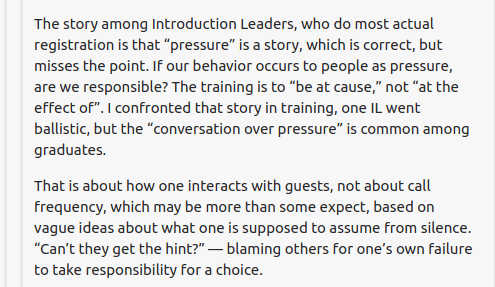
Once again, this is about eliminating social awareness. One is not to expect another person to acknowledge boundaries or to have manners (even though it’s a tacit agreement in society to not engage in certain behaviours, and we all learn that by schooling age).
It’s the responsibility of the person being harassed to make things clear – graduates are under no obligation to respect social norms! The person who doesn’t want to be as aggressive and rude as they are and simply avoids them is at fault here, apparently.
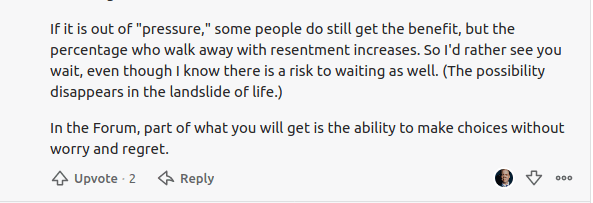
The detachment from the experience of those being pressured is visible, as well as from the untoward behaviour graduates engage in in order to get them there. As previously mentioned, some people are threatened with separation/ divorce if they don’t attend, or with being fired. There’s no concern for the mental strain caused to them by the involvement of their loved ones with this company.
The only concern the graduate has is for the success of the Forum – “The number of those who walk away with resentment increases”. It’s being phrased as if the discussion concerned cattle, not people.
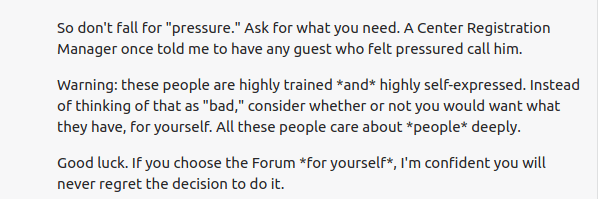
There’s no shame in recommending that someone who is reluctant subjects themselves to further manipulation (sales tactics), so that they can be convinced that it is indeed their choice.
Landmark will teach you how to manipulate (and that’s good, apparently)
Let’s put aside the fact that this person comes across as being on cocaine. The conclusion would be that one should commit to anything offering a great promise, otherwise they keep themselves small. Need I mention that extraordinary claims should be backed up by evidence in order to be considered? Need I mention that most scams also offer extraordinary promises, with nothing to back them up? Do you randomly commit to anything just because you’re in awe of its claims? Quite the opposite. The greater the claim, the greater the scrutiny.

In other words, do you want to learn how to manipulate, how to overpower other people’s will, how to not take no for an answer? No wonder people often call graduates narcissistic – it’s all about them and what they want, with no consideration for others. And no wonder Landmark is closely associated with other MLMs.
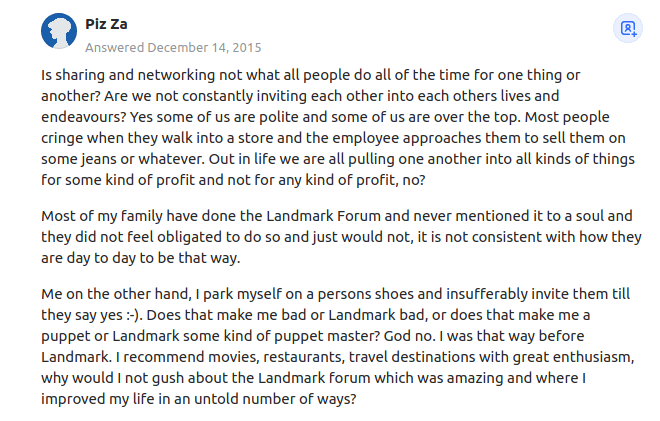
It does, at the very least, make you unbearable to a great number of people. When you recommend a movie, it doesn’t entail paying hundreds, on the presumption that one needs their thinking and life changed. Yes, it makes you a puppet – you’re getting people to part with their money and enrich others, for some nebulous promise of betterment. MLM reps do this all the time, to sell potentially rubbish products (Monat anyone?) or draw others into their schemes, causing them to lose money. They target people with no disposable income, with great promises. They butt into people’s lives on social media, inviting them to join. And they think their enthusiasm is seen as cute or quirky. It’s not. It’s slimy.
“It’s not pressure; I would just ask what might be stopping them”
When you pressure or force someone to do something, you don’t need to explicitly say “I am pressuring you” or “I am forcing you”. It’s a combination of tactics, some of them subtle and others, not so much. What you require of the person might be implied. The negative implications of them failing to provide it might be merely suggested, but enough for them to register the issue.
As an example, taking someone aside and asking them what might be stopping them from doing something, and having a lengthy conversation about that, is not described as pressure – when it clearly is. The action comes across as a requirement and their unwillingness to go through with it, as failure.

For the umpteenth time: zero social awareness, plus the inability to admit the disingenuous nature of one’s behaviour.
Here are the facts: someone is unwilling to recruit. You want them to recruit, because it benefits the company. You look for methods to get them to do it, while convincing them it’s their own decision.
That is manipulation, plain and simple.
If someone asks you to sign up, there must be something wrong with you
In response to someone refusing to go, besides the pitch they always throw at people, this graduate advised the following: “take a look at what had him recommend you attend the Forum” – as in he must have identified something you need to fix in yourself and he must be correct.
Sowing the seeds of inadequacy in people to get them to buy a product is the slimiest commercial tactic, apart from selling snake oil to those with severe health conditions.

Companies employing this tactic couldn’t give a monkey’s about the customer, since from the very beginning, they use manipulation. It feels personal because they use relatives and friends to recruit, but the process has nothing to do with the person being targeted.
“It’s not recruitment, it’s sharing yourself!”
Let’s put this into perspective – it’s a 3 day self-improvement course. Somehow, it ends in recruiting for them becoming part of your new identity. And that isn’t meant to be suspicious…?
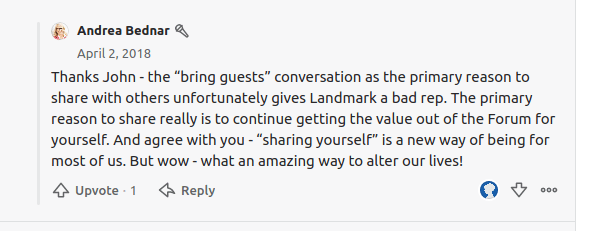

Let me get this straight. By engaging in sharing yourself (which includes recruiting for Landmark), you are overcoming the stumbling blocks in your life. It has broader implications. They have these people so brainwashed they think bringing more money to the company is a way of bettering themselves.
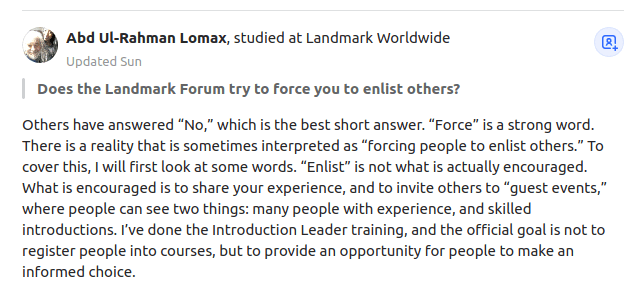

“Enlist is not what is actually encouraged” – if the goal is the same, the process is the same, the techniques taught to graduates are the same, why try so hard to avoid this term or similar ones?
And get this – you are not serene and free until you learn to do this completely of your own volition. The graduate doesn’t say don’t do it if you feel forced – he says do more Landmark, until you no longer feel forced and it comes naturally. In other words, until you are completely brainwashed and you abandon all resistance to what they ask of you. And remember that as long as you feel forced, you are deficient – you are missing a breakthrough.
“It’s compatible with and comparable to 12 step programs”
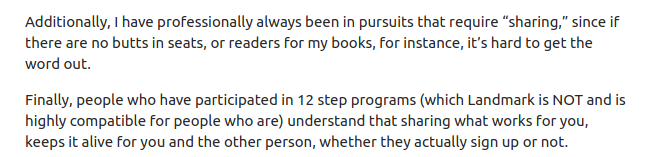
No, it’s not! First of all, 12 step programs are free. Everyone going there has a problem they are aware of – unlike going to Landmark to nebulously change your life because a friend pestered you for months. Everyone is there because they need to be, and they share because it benefits them, knowing exactly what their goal is.
Most of all, these programs are designed to reconcile the addicted person with reality, not encourage them to create their own, which for many I assume is an issue going hand in hand with addiction.
This person is comparing sharing experiences in that environment, where everyone has at least on dominant issue in common, with selling Landmark in order to recruit.
A graduate’s behaviour as a result of the Forum is never the Forum’s fault
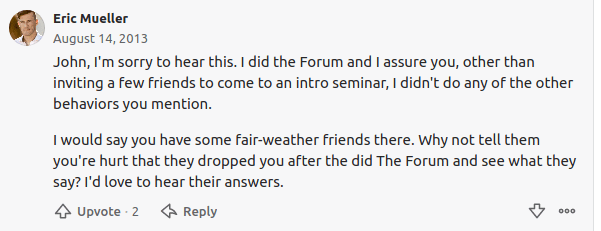
This was in response to a comment describing how a guy was alienated by his friends after they did Landmark, as he wouldn’t do it. It is, very sadly, a common story. And as we know by now, after Landmark, all relationships become “inauthentic” by default, with non-graduates declared inferior.
Again, I’ll make the comparison with people crashing their cars and getting DUIs – the fact that they had all been drinking is just a strange coincidence. It’s all down to the individuals in question, not what they had consumed, or that it’s a common occurrence for those who drink and drive.
Isn’t it the damnedest thing that these people, who admittedly try to recruit everyone around them for a renewed authentic relationship, so often abandon their friends for refusing to join!
“Living life after the Forum” (for a day and a half, but never mind)

“Life after the Forum” here refers to Sunday night, Monday and Tuesday morning. Some people take longer than that coming off of drug binges. How is a person going to know, in such a short time, that it has worked for them?
In fact, they would love it if something had left you confused, because if you haven’t yet signed up for the next course (which they’ve already pitched for a third of the first seminar), they’re about to pitch it to you again, as well as pressuring your guests to sign up.
Your new language – gibberish

If you embrace “Landmarkese”, enjoy reading or sounding like an Alexa after you spilled a glass of coke on it, or text that has been poorly translated by an app. Hey Siri, does an iPhone break if you drop it in a pot of boiling water?
On the serious side, when people say Forum graduates are unintelligible, this is what they mean. And it’s far from the only example. When dealing with non-graduates on public platforms, graduates tend to express themselves more clearly, but obviously not always.
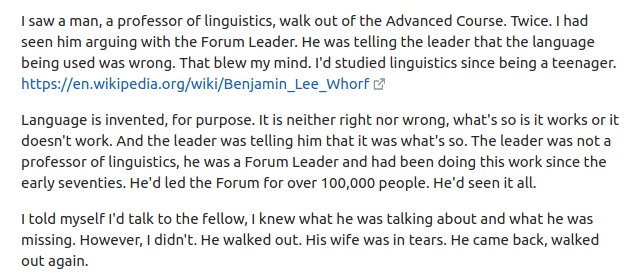
Whereas language is indeed invented, one needs to ask themselves what the purpose is, as well as whether it’s applicable or not. Groups invent new language all the time, according to their purpose. Some of it represents fully artificial notions, such as “sin”,”body thetans” or “reptillians”. The language is as useful as the notions behind it. These notions are wrong in the sense that they neither depict something real, nor are they beneficial – instead, they lead people on wild goose chases, damaging their mental health.
Thought reform (common in radical political groups, religions and cults) operates much like a virus – it doesn’t destroy the mind, but it corrupts its natural functioning, leading to disorientation. It distorts commonly accepted notions and introduces new ones, to create a new sense of reality. This obviously leads to alienation and communication difficulties. Ironically, all radical groups claim to set people “free” from one thing or another, while imprisoning them into an artificial paradigm. The way a Christian may have 100 knee-jerk reactions per day to innocuous things, labelling them as blasphemous, the devil’s temptation or what have you, the Landmark adept learns to label normal psychological processes as “rackets” and “stories”, dismissing any aspect of reality with a word.
People become “inauthentic”, “un-coachable” or “determined not to get it” (Scientology, similarly, labels its detractors suppressive). A commonality is created between people who in the real world might have nothing in common – their opposition to the group. The audacity of placing such labels, when it’s only the adept who has embraced this fictitious paradigm, is enormous.
So what if they don’t tell you what you’re paying hundreds for?

Of course such answers come across as entitled (as in the stranger should know it’s the best thing since sliced bread), as well as counter-intuitive. What would the criteria be for a person to want to do the Forum if they had no idea “what the topics or curriculum were”? One wouldn’t even accept a free invitation to a gathering they knew nothing about, let alone pay a large sum for what might be utter rubbish. But I suspect the reason they don’t describe it is because they either can’t, or they can’t do so in plain English, without sliding into gobbledygook.
Creating your own reality is not delusion

Tell that to people who have lost their entire families or limbs when a bomb fell on their building, because some other country got greedy.
No one is suggesting living life “as a victim” accomplishes anything; however, distinguishing one’s surrounding reality, before building from the ground up, is a prerequisite for sanity. What can people change if they lie to themselves about their circumstances to feel better? In order to improve something, you have to see it for what it is first. There are situations a person can’t do anything about.

I’m trying to think of other scams that lay the blame and shame so hard on the person being scammed, and I can’t find any, apart from other LGATs.
“It’s not blaming the victim”, even though it clearly is
Below is yet another example of how the use verbiage to express exactly what they claim not to be expressing, replacing “at fault” with “at cause”. That’s because being at fault implies having done something wrong, and they don’t believe in wrong.
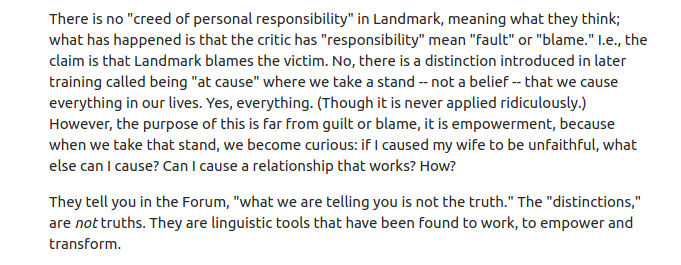
It’s untrue that it’s not applied ridiculously – remember that “rape is interpretation”. The onus is therefore on the victim to change said interpretation, not on the rapist.
Let’s say I am hit by a drunk driver and I’m left paralysed. I am at cause, apparently, of everything that happens to me (I placed myself there at that specific time). They don’t understand that there are moral implications even to many accidents – that someone made a decision to get behind the wheel intoxicated and damaged someone else physically for life. Can I now cause myself to walk again?
And that’s not even a really strong example – it’s easier to forgive whatever was caused unintentionally. What about those whose perpetual intention is to cause harm? Some people enjoy it and seek to repeat it; they plan it meticulously and then select a target. Is each and every one of their victims at cause of whatever these sociopaths do?
I guess they don’t need to worry about explaining that to murder victims because they’re…um…dead.
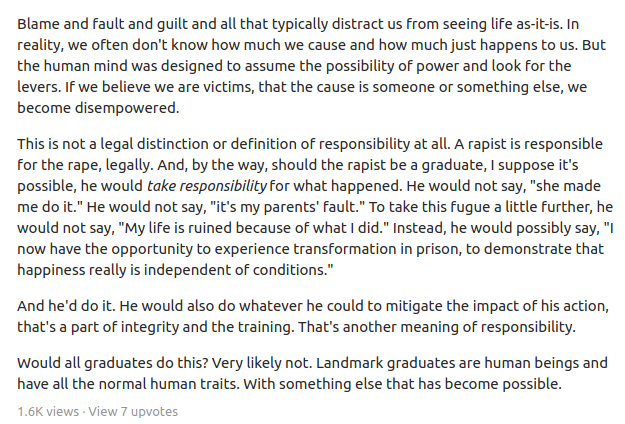
About the possibility of a graduate raping someone – after taking the course, presumably, as they don’t do Landmark in prison… – it wouldn’t un-rape their victim. Of course rehabilitation is something to aim for in any case, but the do teach at Landmark that rape is interpretation, so… If the victim walked into Landmark and not the perpetrator, they would tell the victim to “take responsibility”.
You can say “being at cause”, not “at fault”, when someone causes an accident (unless they knew they were being careless). When there is malicious intent, to harm another person, things are very different.
They muddy the waters when there’s no need to do so. Some things are wrong and that’s the end of it.
Negative press
This is commentary on a Mother Jones article about the Forum – again, the manipulation and deflection tactics are very obvious.

They omit that those being asked (the 90%) had just taken it and it’s a known fact that it leaves people in a stupor for some time. All cult members say their cult is wonderful while being part of it. All drug users say the drug is wonderful while on it, until they have to deal with the side effects.
The onus is once again placed on participants. They are “determined not to get it”. There’s something amiss with them and their attitude.

The author attended the Forum and found it as such. Apparently, her opinion isn’t valid because it’s not a positive one. Here’s the proof that they invalidate anything but praise, claiming it’s the person’s perception or style. The only ones capable of objectivity are graduates. Despite not wanting to make people wrong, the graduate claims “she believes she understands what is going on with participants better than them”, as if this were impossible when one sees others subjected to techniques meant to alter their thinking. It’s not that she reports what she sees and hears, which any normal person would have the same reaction to.
“He told her the truth about how he was being in a way that she could not a avoid” – what a lovely, innocuous way to phrase berating and bullying, which leaders are trained to apply to anyone going there, for any issue they might have.
“Sane people never cry in public?” Of course they do. But sane people, or non-disordered ones, typically don’t make others cry in public by humiliating them. It’s not the act of crying; it’s the situation.
Apologies for the length of the post; there was simply too much to dig into. These would be a few conclusions:
The only answer to issues you have with Landmark (whatever they are) is to do (more) Landmark.
Do you want to refuse an invitation? Go anyway!
Did you hate it? Do some more!
Do you completely distrust it? Ask a leader!
Do you feel forced to do things for them? Do more Landmark, until it feels like you’re using your free will!
This is probably the most entitled, shameless, off-the-planet group I’ve ever come across. Sure, these people might be living successful lives – they might be excellent at making money, for instance. Maybe they’re in a position of seldom hearing “no” for an answer. But do they hear themselves?
The non-graduate’s will doesn’t matter; the non-graduate is deficient/unhappy by default and in need of fixing.
First of all, let’s point out that non-graduates constitute the overwhelming majority of the Earth’s population, and it’s ridiculous for them to be labelled in opposition to a group (even one of a few million). You’ll see elaborate pondering on why someone wasn’t convinced to sign up – it is often presumed the person trying to convince them had done a poor job. It’s never a matter of the non-graduate potentially being correct about the Forum, or at least about it not being right for them. Their reasoning or will is negligible.
Landmark should be able to get away with behaviour people wouldn’t tolerate in any other circumstance.
This ranges from requesting large sums for courses while offering hardly any information on them, to pestering people to attend, suggesting that others force them (which of course they will officially deny, but it’s so prevalent it’s undeniable), to humiliating them in public and placing the blame on them for not finding value in the courses.
Graduates and leaders are presumed to have good intentions at all times (as if there were a Landmark hive mind, when they deny it’s a cult).
Please note these people are talking about complete strangers, whose circumstances they find described in a few lines on the internet. If they are Landmark graduates, other graduates instantly claim to know their intentions and the reasons for their behaviour, as if they possibly could. Non-graduates, on the other hand, are presumed to be incorrect and unable to see things clearly.
 The Artistry Of Glorified Bullshit