
The past few days have seen a new furor on YouTube: the famous petition, signed as of now by more than 32.000 people, to de-platform Eugenia Cooney, a vlogger with a large audience, who has been battling an eating disorder for years, which has left her severely underweight.
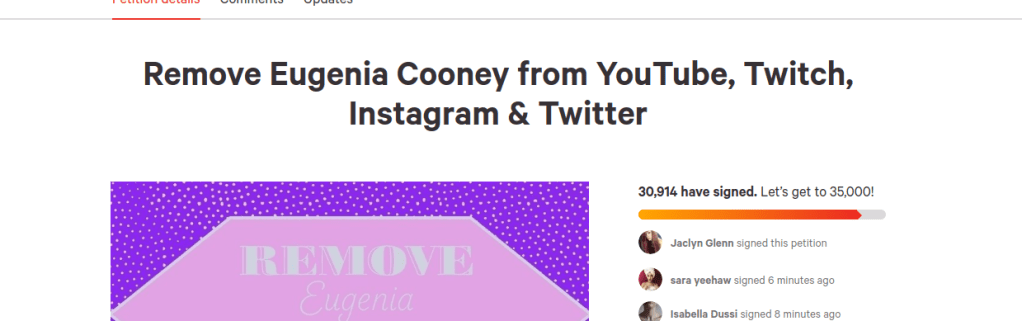
Practically, what do they want? They want this woman to lose her ability to express herself, and her connection to her audience, virtually overnight, with zero guarantees she would access any help as a result. They want her ostracised, shamed, made to feel like she should hide away and not participate in society, as her appearance is unacceptable to them.
Supported by resident YouTube saint Jaclyn Glenn and started by a person who managed to overcome anorexia, the petition states the following:
(…) It is for this reason that we ask YouTube, Twitch, Twitter and Instagram to step in and to take an active role in temporarily removing Eugenia from said platforms while she receives the help that she so desperately needs. Many people are afraid that Eugenia will pass away before she is able to receive treatment. By removing Eugenia from these platforms, she will no longer be bombarded with comments regarding her low weight, which only seem to encourage her eating disorder.
(…) It is the opinion of many that the only way for Eugenia to get help is to be removed from her public platforms, specifically YouTube, Twitch, Twitter and Instagram. Until Eugenia is willing to confront her eating disorder head on it is irresponsible and selfish to continue uploading and streaming to an audience of over 2 million viewers, most of whom are young and impressionable (emphasis added).
(…) Many individuals have tried to reach out to Eugenia regarding her eating disorder and the influence she has over her audience, however their concerns have been ignored. Eugenia is unwilling to take accountability for her influence and actions. Until Eugenia engages in treatment and is willing to talk about her experience with an eating disorder, it is fair to say that she will continue to waste away in front of millions of people. These people are concerned for her health and safety, many of them reaching out to local authorities in her area.
(…) Eugenia was subsequently hospitalised for what many speculate to be Anorexia Nervosa, a deadly eating disorder with the highest mortality rate of any mental illness.
Please note the commonality in these paragraphs : “many people think”, “it is the opinion of many”, “many speculate”. On this basis alone, of their opinions, they are willing to push for someone’s income and outreach to be taken away. One might suspect them of having mental issues themselves – being on a power trip.
In other words, this isn’t based on some expert strategy to help someone deal with an ED – it’s the crowd doing what it always does: the one-size-fits-all solution of ostracism. They are not psychiatrists, psychologists or what have you. They are internet users and that’s about it.
They have no qualms regarding what taking everything away from a person can do to them, which could cause even healthy individuals to have a mental breakdown and even become suicidal – let alone someone who is already struggling. They are goose-marching into someone’s privacy, health condition, income and ability to communicate with the rest of the world, as they freely admit:
(…) By removing Eugenia from these platforms, she will no longer be bombarded with comments regarding her low weight, which only seem to encourage her eating disorder.
Imagine thinking they should have so much power over another adult’s life, who is in no way related to them, that they should decide what that person should be allowed to read or hear.
“Oh please, won’t someone think of the children?!”
Nowadays, whenever someone’s de-platforming is brewing, there’s always a way to portray them as a bad influence on younger generations, to justify silencing them. Because let’s face it – most adults engage in some conduct or another that is not necessarily worth imitating. Because, you know… they’re adults and they’re able to. This could be said about anybody with a platform; there would be at least one aspect to pick on. Social media makes it far too easy for people to be scrutinised and picked apart.
(…) This situation is more than a few concerned fans who are worried about Eugenia. While we are worried about her, we are also concerned about the impact that Eugenia is having on her audience and the detrimental effects of her content. At the end of the day, Eugenia is an influencer, and to have influence is to have, ‘the capacity to have an effect on the character, development, or behaviour of someone or something, or the effect itself.’
It’s eerily reminiscent of past decades, when everything from being gay to being suspected of Satanism led to an outcry from bored housewives and their social clubs. We, had, apparently, moved past that. The generational curse of witch hunting is apparently unchanged by the passing of time or radical cultural changes; there seems to be a need for these crowds to single out a target and emotionally purge by uniting towards that person’s vilification.
Nowadays, it seems, taking radical actions against a person falls under the umbrella of “helping them” by force, even if that presumed help makes no sense whatsoever and is, in every practical way, nothing but harm. It’s nothing but a way for elements in the crowd to feel self-important.
 The Artistry Of Glorified Bullshit